49 works in this view — arrow keys or swipe to move between them.
Dance in Art
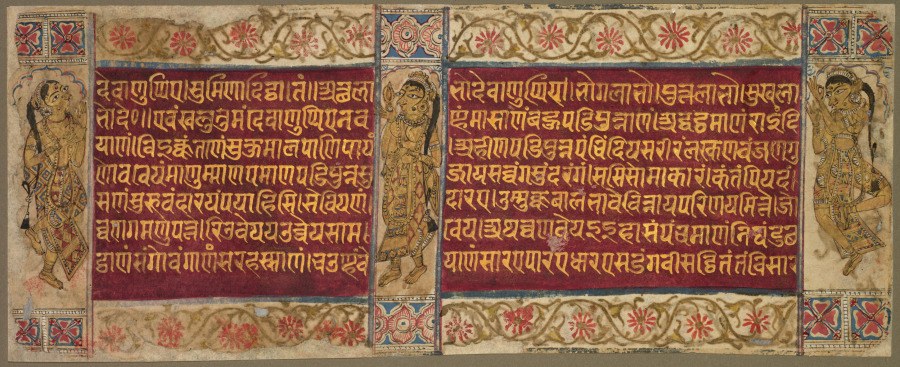
Celestial Dancers folio 5 recto from Brahman Rishabhadat
Unknown artist
- Source:
- Cleveland Museum of Art
- Rights:
- Public domain — free to use, share and adapt.
- Recorded as:
- CC0 (Public Domain)
This work is a rare documentary evidence of how celestial dancers were visualized and composed in medieval Indian religious art, and it shows the intimate connection between manuscript production, performance traditions, and devotional practice. For historians of classical Indian dance, the image preserves idealized gesture vocabularies from a period when the written textual traditions of dance (such as the Natyashastra) were circulating among the same learned communities that commissioned manuscripts. The formal composition reveals how dance figures were conceptualized not as performers but as cosmic or divine presences that sanctified sacred text.
What you are looking at
This is a manuscript folio from a Sanskrit religious text, displayed as an open two-page spread. The pages are framed by ornamental borders in gold leaf and polychrome pigment, with repeating floral motifs in red and pink. The central area of each page contains dense Sanskrit text in gold script on a deep red or maroon ground. The text is flanked by two standing figures on each page—four celestial or divine dancers in total, rendered in gold with careful articulation of their limbs. The figures wear elaborate crowns or headdresses and appear to be depicted in graceful, elongated poses. The overall composition is highly formal and symmetrical, with the dancers serving as visual frame elements to the sacred text rather than as the primary subject. The manuscript shows age and wear, with visible creasing and oxidation of the gold leaf.
The dancing
Each figure stands in a refined, vertical posture with weight distributed evenly. The dancers' arms are raised and curved in elaborate positions—upper arms held away from the body, forearms and hands positioned with evident care to suggest divine grace and celestial movement. The bodies are slender and attenuated, typical of classical Indian manuscript illustration. The positioning of the figures—one on each outer margin of the folio—suggests they are not interacting with one another but rather serving as symmetric guardian or emblematic presences framing the text. The gestures appear to be stylized representations of classical dance mudras (hand positions) rather than a narrative sequence of movement.
The dance depicted
The work most likely depicts celestial dancers (surasundaris or apsaras) common to Hindu and Jain manuscript tradition, particularly in texts devoted to sacred mythology and cosmology. These are not narrative dance scenes but rather iconic representations of divine feminine grace embedded within a religious manuscript. The 'Brahman Rishabhadat' context suggests this folio is from a Jain text about Rishabhanatha (the first Tirthankara in Jain tradition). The dancers are rendered in the classical idiom of Indian manuscript painting, which drew conventions from both temple sculpture and the living dance traditions of South and Southeast Asia. The specific dances are not identifiable from gesture alone; instead, the image presents an ideal abstraction of celestial movement intended to sanctify and enhance the manuscript's sacred text.
How it was made
This is a manuscript folio created on paper using gold leaf, pigment (likely mineral-based), and ink. The technique is consistent with Jain manuscript production practices of medieval India, where text and image were applied in layers—first the gold ground, then the pigmented underpainting, then the gold leaf for highlights and details on the figures. The precise registration of text and image, and the lavish use of gold, indicate this was a high-status commission intended for a temple or wealthy patron's library. The format—an open folio with marginal figures—is typical of Indian manuscript design, where sacred text occupies the central visual authority and figures serve ornamental and devotional functions.
About this work
This folio from the Brahman Rishabhadat is a work of religious manuscript art in which celestial dancers appear as decorative and symbolic elements framing sacred Sanskrit text. The dancers are not the primary subject but rather part of the ornamental and devotional apparatus surrounding the text—their refined postures and elaborate gestures invoke divine grace and sanctity. The work belongs to the tradition of Jain and Hindu manuscript illumination, a practice that integrated visual representations of classical dance idioms into the material form of sacred knowledge. It testifies to the deep association between dance, divinity, and the ornamentation of holy texts in Indian religious culture.
How to look at it
Attend to the posture and hand positions of the four figures: each is rendered with careful attention to the curves of the arms and the delicate articulation of the fingers. The artist has chosen to freeze the dancers in a state of graceful, static elevation rather than a moment of dynamic movement—they appear to be suspended in an ideal, timeless pose rather than caught mid-gesture. Notice how the symmetrical placement and the formal borders create a sense of sacred enclosure around the text; the dancers do not draw the eye toward themselves but rather direct attention inward toward the words they frame. The gold leaf on the figures' bodies creates a luminous quality that distinguishes the celestial realm from the earthly, material world.
The period
This manuscript was produced during the medieval period of Indian manuscript art, likely between the 12th and 16th centuries, when Jain communities in western India were commissioning elaborate illuminated manuscripts as acts of religious merit. The folio reflects the classical conventions of Indian dance representation inherited from temple sculpture and codified in texts like the Natyashastra and the Abhinaya Darpana. During this period, the celestial dancer (apsara or surasundari) was a standard iconographic element in Hindu and Jain art, representing divine beauty, grace, and the sanctification of sacred space. The placement of dancers as marginal ornaments in manuscripts reflects a broader cultural understanding of dance as an elevated, spiritually potent activity associated with the divine realm.
Where it lives
The work is held in the Cleveland Museum of Art and appears to have been catalogued as part of their collection of dance-related art. The museum record provides minimal documentation, and the manuscript's earlier provenance, precise date, and textual identification remain uncertain.
Dance in this work
Questions about this work
Are these dancers performing, or are they decorative?
They are both: in Indian manuscript tradition, celestial dancers serve ornamental functions while also carrying spiritual meaning. The figures frame and sanctify the sacred text rather than depicting a scene of actual performance. Their formal, symmetrical positioning and their marginal placement indicate they are iconic presences rather than narrative actors.
What dance tradition does this represent?
The image does not depict a specific named dance but rather an idealized celestial form drawn from classical Indian dance aesthetics. The hand and arm positions suggest familiarity with mudra (gesture) vocabularies codified in texts like the Natyashastra, but the figures are abstracted presences rather than practitioners of a particular dance technique.
Why are dancers placed in a religious manuscript?
In Hindu and Jain theology, dance is associated with divine beauty and cosmic order. Celestial dancers (apsaras) were believed to inhabit the heavenly realms and to sanctify sacred space. Including them in manuscripts was a way of elevating the text and invoking divine presence and blessings for those who read or viewed the work.
More dance artwork