49 works in this view — arrow keys or swipe to move between them.
Dance in Art
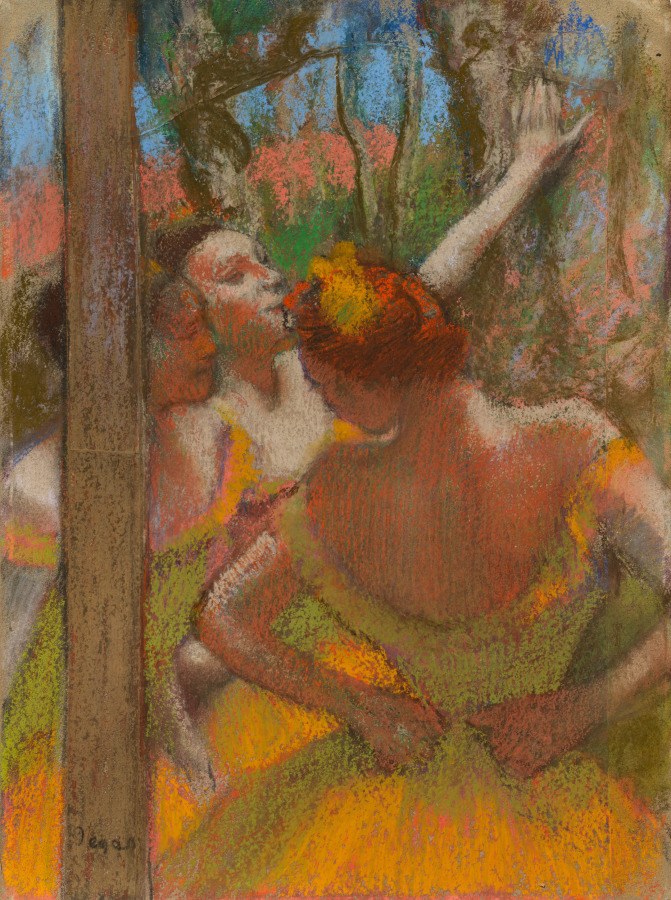
Dancers
Edgar Degas (French, 1834–1917)
- Source:
- Cleveland Museum of Art
- Rights:
- Public domain — free to use, share and adapt.
- Recorded as:
- CC0 (Public Domain)
This work testifies to the visual culture surrounding early modern and interpretive dance, showing how painters engaged with the revolutionary ideas about the body and movement that emerged in the early 20th century. It captures not a codified technique but a *philosophy* of dance: one that valued spontaneity, emotional truth, and the body's dialogue with nature over virtuosity or formal display. For anyone studying how modernism in dance and visual art developed together, this image is a primary document.
What you are looking at
A woman in a long skirt and short-sleeved bodice, rendered in warm orange-red tones with golden accents, reaches upward through a forest of gnarled brown tree trunks and branches. The composition is vertical and intimate, with her body positioned in graceful asymmetry—weight shifted, one arm extended overhead in a gesture of aspiration or ecstasy. The setting is dreamlike rather than naturalistic: thin blue sky visible between twisted limbs suggests a sylvan enclosure, while the color palette—warm ochres, muted greens, dusty browns—creates an atmosphere of dappled light through foliage. The woman's pose and the surrounding vegetation suggest movement through or within nature, though the painting technique (soft, granular, almost textured) gives the whole scene a sense of emotional rather than literal landscape.
The dancing
A single female figure occupies the center and slightly left of the canvas. Her weight appears to rest on one leg, with her torso twisted and upper body reaching upward; one arm extends fully overhead and slightly forward in an open, unguarded gesture, while her other arm hangs at her side or is softly modeled into her torso. Her head tilts back, following the upward impulse of her raised arm. The posture suggests neither the supported grace of classical ballet nor the grounded, geometric clarity of modern dance—instead, it reads as personal, spontaneous, and expressive, closer to interpretive or lyrical improvisation. The absence of a partner, costume structure, or formal frame suggests solo or free-form rather than codified social or theatrical dance.
The dance depicted
This appears to be interpretive or expressive dance of the early modern period, possibly influenced by free-form or Duncanian aesthetic—though the painting style and costume (the long skirt, the softness of the form) could place it anywhere from the 1890s through the 1930s. The image captures a moment of introspection or transcendence rather than technical display: the upward reach and backward tilt of the head evoke Romantic themes of yearning, communion with nature, or spiritual aspiration. The woman is alone with the natural world, and her movement seems generated from within emotion rather than external choreographic command. Without signature or clearer documentation, specific identification of the dance form is impossible, but the visual language suggests early modern or expressionist dance rather than ballet, ballroom, or folk traditions.
How it was made
The work appears to be executed in oil or tempera on canvas or paper, characterized by a soft, almost pastel-like surface with visible brushwork and a granular, atmospheric quality. The artist has used color—particularly the warm oranges and reds of the figure against cooler browns and greens—to create mood and emotional depth rather than anatomical clarity. This technique, neither photorealistic nor purely abstract, is consistent with early modernist painting practices of the 1890s–1930s, when artists frequently worked from observation and memory rather than strict life study. The soft focus and emotional intensity suggest the work may have been made from memory or imagination rather than from a living model in motion, which was common practice for dance imagery in this period.
About this work
This small painting captures a solitary female dancer reaching upward through a forest, rendered in soft, warm tones that emphasize emotional and spiritual content over technical precision. The work belongs to the tradition of early modern interpretive dance imagery, when painters began to document the expressive, often free-form movement of dancers outside the ballet tradition. The posture, costume, and setting all suggest a work created during the period of Duncanian or art-song-inflected dance—a moment when dance was understood as personal expression and connection to nature rather than as formal technique. The painting demonstrates how visual artists of the period understood and valorized this new freedom in movement.
How to look at it
Notice the pose first: the artist has chosen a moment of maximum extension and apparent aspiration—not a moment of stability or display, but of yearning. The raised arm is not held in any formal position; it reaches, and the head follows. Watch how the tree trunks frame the figure without constraining it; the natural world is not a stage set but an environment the dancer moves through. The warm, granular color suggests both the physical presence of the body and something more fugitive—memory, emotion, the quality of light filtered through leaves. The softness of the rendering suggests the artist was less interested in anatomical accuracy than in capturing a subjective, perhaps even dreamlike, moment of communion between the human figure and nature.
The period
This painting likely dates from the late 19th or early 20th century, a period of radical transformation in dance and the visual arts. The rise of free movement and interpretive dance—championed by Isadora Duncan, Ruth St. Denis, and others—challenged the dominance of academic ballet and created new subjects for painters and photographers. Simultaneously, modernist painters were exploring color, emotion, and subjective experience over literal representation. This painting sits at the intersection of those developments: it documents a body in motion while using painting technique itself to convey psychological and spiritual states. The soft, almost Symbolist handling of color and form suggests the artist was influenced by broader modernist movements while remaining focused on the human figure and its expressive potential.
Where it lives
The work is held in the Cleveland Museum of Art collection and is documented as part of their dance-related art holdings. It arrived at the museum via their curatorial process for collecting modernist and early modern works, though specific acquisition date and prior ownership are not recorded here.
Dance in this work
Questions about this work
Is this ballet?
Almost certainly not. The pose, costume, and setting suggest interpretive or expressive dance, which emerged as a deliberate rejection of ballet's formal codes. The woman is alone, unadorned, and reaching toward nature—all of which are contrary to ballet's structured, partnered, and formally costumed tradition.
What dance is this actually showing?
The painting does not depict a named or codified dance form; it captures a moment of free-form interpretive movement. If it was made between 1900 and 1930, it likely reflects the influence of early modern pioneers like Isadora Duncan or her followers, but the artist has prioritized emotional and spiritual expression over documentary accuracy of any particular choreography.
Why is the figure reaching upward?
The upward reach is a gesture laden with meaning in early modern dance: aspiration, transcendence, spiritual yearning, or communion with forces beyond the self. In the context of interpretive dance, such gestures were meant to express inner emotional states and ideas, rather than to display technique or follow a prescribed movement vocabulary.
What period does this belong to?
Based on the painting technique, costume, and dance aesthetic, this work most likely dates from the 1890s through the 1930s, the period when interpretive and free-form dance was ascendant and modernist painters were exploring subjective color and emotion. Without a signature or dated record, a narrower date is not possible.
More dance artwork