49 works in this view — arrow keys or swipe to move between them.
Dance in Art
Dancers in a Pavilion
Jean-Baptiste Pater (French, 1695–1736)
- Source:
- Cleveland Museum of Art
- Rights:
- Public domain — free to use, share and adapt.
- Recorded as:
- CC0 (Public Domain)
This painting documents how the minuet and other formal social dances structured aristocratic courtship and social hierarchy in the eighteenth century. For dance historians, it provides visual evidence of the spatial arrangement, dress, posture, and social dynamics that governed elite dance practice before Romanticism and the rise of theatrical ballet transformed European dance culture.
What you are looking at
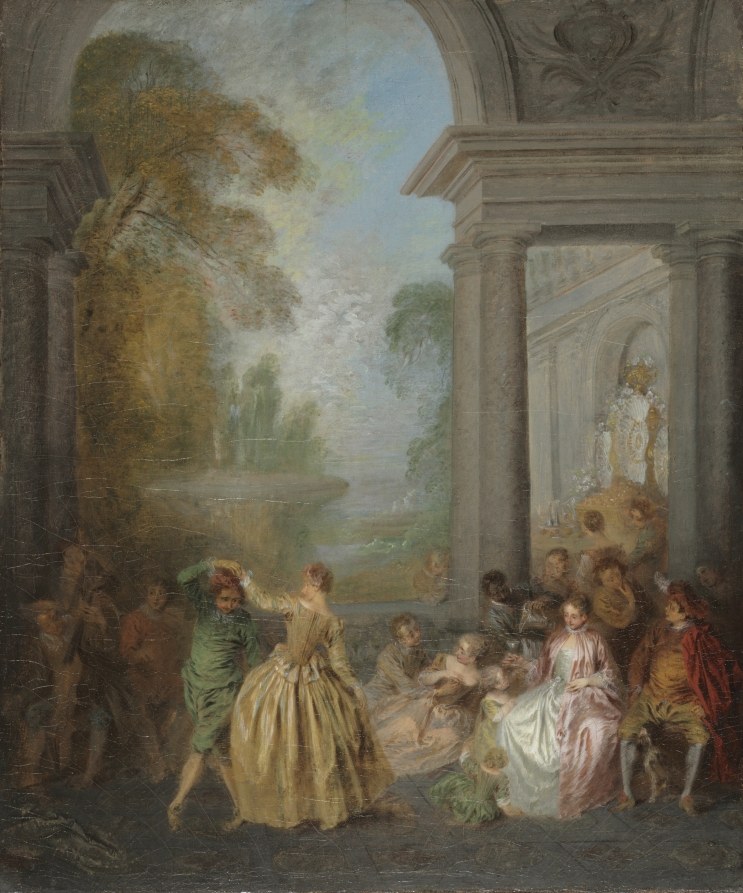
An elegant outdoor gathering beneath a classical pavilion, where figures in eighteenth-century dress move in a choreographed social arrangement. The composition opens through a colonnade onto a luminous landscape with water and trees rendered in soft greens and golds. In the foreground, a woman in a pale yellow gown stands at the center of attention, her posture upright and graceful; around her, other elegantly dressed figures—men in jewel tones and women in white and pastel silks—are arranged in a loose social formation. The light is warm and diffused, falling across the figures and architectural elements, creating an atmosphere of leisurely refinement. In the middle distance, barely visible through the columns, additional figures gesture and cluster, suggesting a larger assembly. The setting suggests a fête galante or garden entertainment of the aristocratic sort.
The dancing
The central woman displays an upright, poised carriage with one arm extended in a welcoming or demonstrative gesture, her body weight centered and her gown arranged for visibility. Around her, figures adopt varied positions: some stand with arms extended in conversation or greeting, others are drawn inward toward her in attention. The men's postures suggest deference or courtship address. The overall frame is one of social choreography rather than vigorous movement—bodies are positioned for display and interaction rather than in rapid transit. The nearest figures to the viewer are most sharply defined; those deeper in the composition blur into an atmospheric crowd.
The dance depicted
This appears to depict a formal social dance of the eighteenth century, most likely a minuet or quadrille in an aristocratic garden setting. The minuet was the dominant courtship dance of the period, characterized by restrained, graceful movement and deliberate positioning of partners. The composition suggests the opening or a formal moment of such a dance—the central woman's pose and the arranged attention of the surrounding figures align with minuet convention, where dancers progressed through formal positions with geometric precision. The outdoor pavilion setting, while theatrical, was consistent with elite entertainments of the period. The dress and setting are unmistakably rococo French or French-influenced, pointing to the mid-to-late eighteenth century.
How it was made
The work is painted in oil, executed in a rococo style with loose brushwork and atmospheric perspective. The artist has used soft layering of pigment to create the luminous quality of the sky and the hazy middle distance. The technique allows for rich color harmonies—the pale yellows and pinks of the gowns are set off against deeper jewel tones and the cool stone of the architecture. The painting technique suggests this was created for display in a wealthy household and would have been viewed from a moderate distance; the brushwork dissolves into atmosphere rather than maintaining sharp detail throughout. This approach was typical of rococo decorative painting intended for intimate aristocratic spaces.
About this work
This rococo painting captures a moment of formal social dancing in an aristocratic garden, rendered in the elegant, decorative idiom of eighteenth-century French or Francophile court art. The scene depicts what appears to be a minuet or similar courtship dance set within a classical pavilion, with carefully arranged figures in period dress positioned to show both the social order and the grace of the participants. The work belongs to a tradition of fête galante painting that celebrated leisure, courtship, and refinement among the elite. Such paintings served both as records of actual entertainments and as idealized representations of aristocratic life and aesthetic values.
Within the history of dance in visual culture, this painting represents a crucial moment: the rococo period when social dance had become central to both courtship ritual and the display of social status. The work captures not a moment of virtuosity or dramatic action, but rather the restrained, geometry-based movement that defined elite social dance in the era immediately before the French Revolution.
How to look at it
Attend to the strict compositional geometry: the way the pavilion's colonnade creates a formal frame and the way the figures are distributed in space along implicit lines. Notice the central woman's still, upright posture—this is not spontaneous movement but a moment in a predetermined sequence. The gestures of the surrounding figures, while varied, are all proportionate and controlled; no one lurches or reaches. The soft, diffused light and the hazy recession of the landscape create a dreamlike atmosphere that emphasizes the scene's artificiality—this is a vision of aristocratic leisure, not a snapshot of actual motion. The painting asks you to read social relationships and hierarchies through spatial proximity and bodily orientation.
The period
The eighteenth century, particularly the rococo period (c. 1730–1760), saw social dance reach new heights of refinement and formality in European aristocratic culture. The minuet, which had emerged in France in the previous century, became the defining courtship dance of the age, spreading throughout the courts of Europe. Dance manuals proliferated, and dance masters were essential figures at court. Simultaneously, rococo painting developed as the visual language of aristocratic leisure and pleasure; artists including Watteau, Boucher, and Fragonard specialized in scenes of courtship, entertainment, and refined social interaction set in idealized outdoor spaces. The fête galante genre merged these interests, depicting both the actual entertainments of the elite and the aesthetic values they embodied.
Where it lives
The work is held in the Cleveland Museum of Art's collection and is catalogued as part of their holdings related to dance in art. Its catalogue record is sparse, lacking established attribution, precise date, or medium notation, suggesting it may have been catalogued generically or acquired as part of a collection.
Dance in this work
Questions about this work
What dance is being depicted?
Most likely a minuet or quadrille, the formal social dances that dominated aristocratic courts in the eighteenth century. The upright posture, the arranged spacing of figures, and the social context all point to one of these highly structured, geometry-based dances rather than anything more energetic.
Is this a real event or an idealization?
It is likely both. The rococo painters of this era documented actual entertainments and aristocratic life, but they idealized and aestheticized them. The luminous light, the graceful poses, and the perfect arrangement of figures suggest an imagined or heightened version of reality rather than a reportorial record.
Why would an eighteenth-century aristocrat commission such a painting?
Such works served multiple purposes: they recorded and memorialized important social gatherings, they displayed the patron's wealth and refined taste, and they celebrated the aesthetic ideals of the rococo period. Owning a painting of an elegant fête demonstrated one's participation in elite culture.
What changed in dance after this period?
Romantic ballet emerged in the early nineteenth century, prioritizing virtuosity, emotion, and theatrical spectacle over social hierarchy and geometric restraint. Social dances also became less rigidly formal. By the end of the nineteenth century, the minuet had become a historical curiosity rather than a living social practice.
More dance artwork