49 works in this view — arrow keys or swipe to move between them.
Dance in Art
Dancer
Cowan Pottery Studio (America, Rocky River, Ohio, 1920–1931)
- Source:
- Cleveland Museum of Art
- Rights:
- Public domain — free to use, share and adapt.
- Recorded as:
- CC0 (Public Domain)
This sculpture captures a crucial moment in the history of both dance and visual art: the period when dance broke from classical ballet and the human body became a vehicle for modernist expression. For dancers and choreographers, it offers a visual record of how the revolutionary dancers of the early twentieth century—those associated with Denishawn, Graham, Wigman, and the Ballets Russes—were understood and represented by sculptors. For art historians, it demonstrates how sculpture responded to and absorbed the aesthetics of modernist dance, particularly the emphasis on abstraction, emotional intensity, and the body as a subject worthy of formal innovation.
What you are looking at
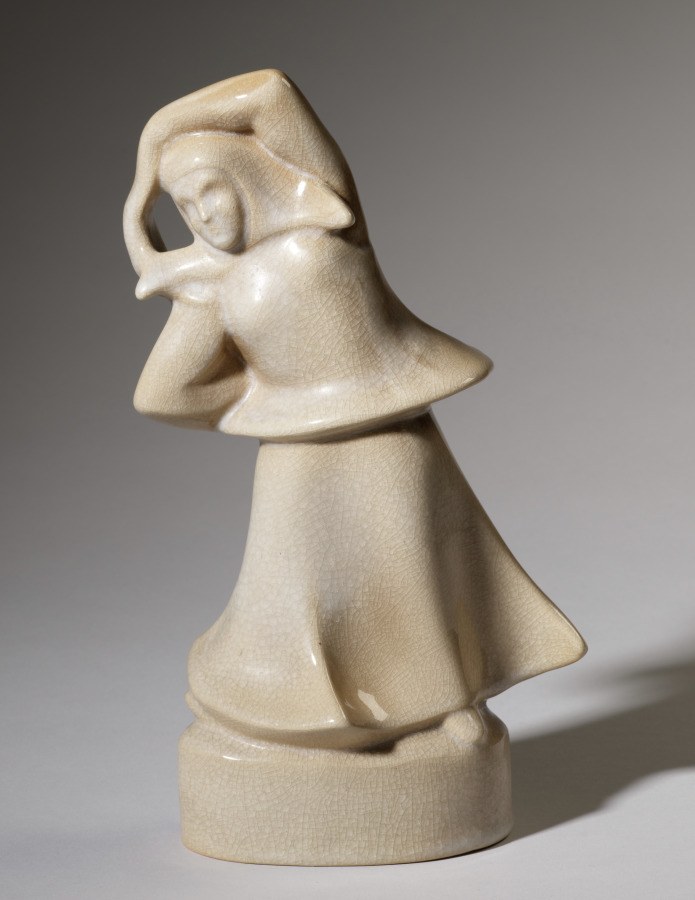
A cream-colored stone or plaster sculpture of a single female figure, carved in a highly abstracted, modernist style. The figure is depicted from roughly the waist up, with the body reduced to essential geometric forms. The head is tilted back at an extreme angle, almost ninety degrees, with the face simplified to basic features—a prominent nose and defined cheekbones. The shoulders and torso are broad and simplified, with deep undercutting that creates strong shadows. The figure wears what appears to be a draped garment or shawl across the shoulders and upper body, suggested by the flowing, curved lines that wrap around the form. The carving shows confident, direct tool marks; the artist has worked from solid material to reveal the form within, using negative space and light-catching planes to define movement and emotion. The work is mounted on a cylindrical base, and the whole piece stands perhaps 12–16 inches tall. The lighting emphasizes the volumetric quality of the stone, casting deep shadows in the folds and between the body and its drapery.
The dancing
A single standing figure with an extreme backward tilt of the head—a dramatic arching of the spine and neck that suggests intense emotion, ecstasy, or a moment of release. The body is compact and frontal, not arranged in a classical contrapposto, but rather held in a state of expressive tension. The shoulders are broad and squared; the arms are not clearly defined in the round, but the drapery suggests movement across the torso. The weight of the head and the backward curve of the neck dominate the composition, drawing the viewer's eye upward and backward. There is no indication of footwork or leg position; the figure dissolves into abstraction at the base.
The dance depicted
This appears to depict a moment of intense physical and emotional expression associated with modern dance or theatrical performance rather than any codified dance technique. The extreme backward arch of the head and neck suggests expressionist or modernist dance of the early twentieth century—perhaps the vocabulary of Graham technique, Denishawn, or the Ballets Russes-influenced work of that era. The figure conveys abandonment, passion, or transcendence rather than technical precision. The sculptor has captured a moment of maximum extension and vulnerability, with the body in a state of surrender. Without inscription or clearer context, the specific dance cannot be identified, but the modernist carving style and the intensity of the gesture suggest a work created during or reflecting on the revolutionary dance practices of the 1920s–1940s.
How it was made
This is a carved sculpture in stone or a stone-like material (limestone, alabaster, or plaster are all possibilities given the cream color and fine surface). The work has been carved subtractive—material removed to reveal the form—rather than modeled or assembled. The artist has left visible tool marks and chisel facets, particularly on the drapery and torso, suggesting direct carving rather than a finished, polished surface. This technique was closely associated with modernist sculpture of the early twentieth century and implies a practice rooted in European avant-garde traditions. The scale and portability suggest this was a gallery or exhibition piece, likely created for display in a museum or collector's home rather than as a public monument.
About this work
This is an abstracted stone carving of a female dancer captured in a moment of extreme emotional and physical intensity. The sculptor has distilled the figure to essential geometric forms while preserving the expressive power of the pose—a backward arch that communicates ecstasy, abandon, or transcendence. The work sits at the intersection of modernist sculpture and the revolutionary dance practices of the early twentieth century, a period when dancers like Martha Graham, Mary Wigman, and the Ballets Russes challenged classical ballet and introduced the body as an instrument of raw emotion. The carving demonstrates technical mastery of stone and a deep engagement with how the human body might be rendered to convey motion and feeling rather than anatomical accuracy.
As a sculpture in a dance collection, this work documents how visual artists responded to the modernist dance movement. It is not a record of a specific technique or style, but rather a meditation on the expressive potential of the dancing body—what the artist understood dance to be at a moment of radical transformation. The work asks the viewer to read dance not as step or pattern, but as a state of being.
How to look at it
Attend first to the angle of the head and the extreme arch of the spine—this is the moment the sculptor has chosen to freeze, a moment of maximum vulnerability and release. Notice how the face is simplified almost to anonymity, yet the tilt of the head and the tension in the neck convey powerful emotion. Look at how the drapery across the shoulders and torso is rendered through deep carving rather than detail; the artist has used negative space and shadow to suggest movement and texture. Finally, observe the contrast between the simplified, almost geometric torso and the more naturalistic definition of the head and neck: the sculptor prioritized expression in the face and upper body, where the emotion of the dance is concentrated.
The period
This work likely dates to the 1920s–1940s, a period of extraordinary ferment in both modern dance and modernist visual art. Martha Graham and Mary Wigman were reimagining the body as an instrument of emotional and spiritual expression, rejecting the strictures of classical ballet. Simultaneously, sculptors across Europe—Brancusi, Epstein, Moore, Archipenko—were developing abstracted, volumetric approaches to the human figure. The direct carving technique and geometric simplification evident in this work align with the sculpture of that period. The subject matter—a female dancer in a state of ecstatic abandonment—connects to the Romantic and Symbolist traditions of representing the dancing body as a vehicle of transcendence, but rendered in the vocabulary of modernist abstraction rather than naturalism or academic form.
Where it lives
The work is documented in the Cleveland Museum of Art collection as part of the museum's holdings of dance-related art. The sparse catalogue record—with artist, date, and medium unrecorded—suggests the work may have entered the collection as a gift or bequest without full documentation, a not uncommon situation for sculpture of this period.
Dance in this work
Questions about this work
What dance is this?
The work cannot be identified with certainty as depicting a specific dance technique or choreography. The extreme backward arch of the head and the expressive intensity suggest modernist dance of the early twentieth century—the vocabulary of Martha Graham, Mary Wigman, or Denishawn—rather than classical ballet. The sculptor has captured a gesture of emotional and physical release rather than a recognizable step or position. Without an inscription or artist's statement, the precise dance remains unknown.
Who made this and when?
The artist and date are not recorded in the catalogue. The style—direct carving, geometric abstraction, the treatment of the dancing figure—is consistent with modernist sculpture of the 1920s–1940s. Stylistic comparison with sculptors of that period might narrow the attribution, but this would require expert examination and archival research beyond the current record.
Is this plaster, stone, or something else?
The material is not recorded, but the appearance—cream color, fine carving, visible tool marks—suggests a limestone, alabaster, or similar stone material. It could also be a plaster cast, though the finish and condition suggest carved stone. The work has the weight and permanence of a stone sculpture rather than the fragility of cast plaster.
Why is the head tilted so far back?
The extreme backward arch is a gesture of emotional release—ecstasy, abandon, transcendence, or surrender. In modernist dance, such extreme positions were used to communicate feeling and spiritual intensity rather than technical virtuosity. The sculptor has seized on this moment as the essential expression of the figure, making the arch of the head and neck the organizing principle of the entire composition.
More dance artwork