49 works in this view — arrow keys or swipe to move between them.
Dance in Art
Dancer
Unknown artist
- Source:
- Cleveland Museum of Art
- Rights:
- Public domain — free to use, share and adapt.
- Recorded as:
- CC0 (Public Domain)
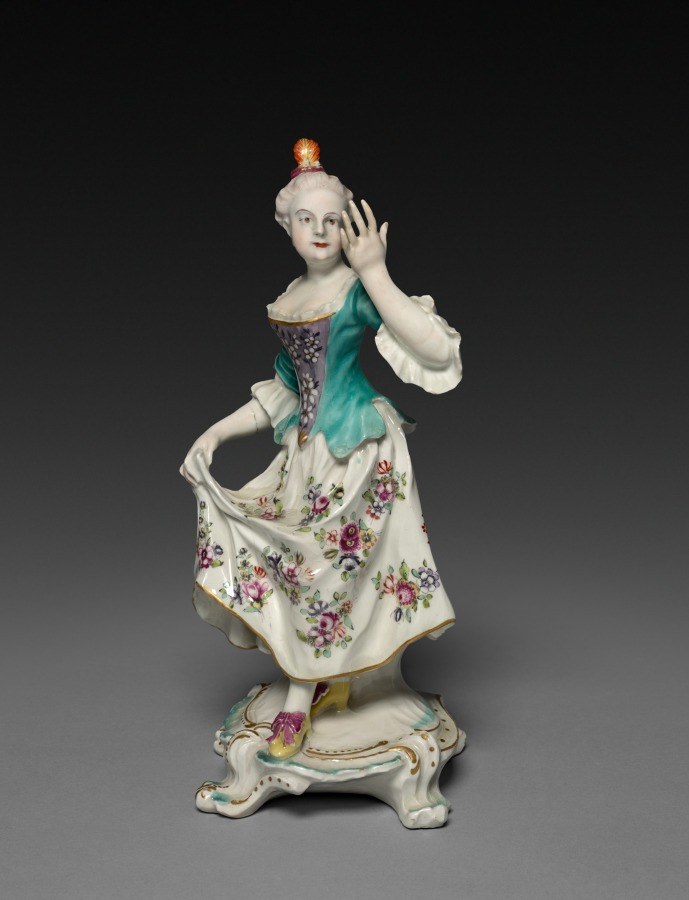
Porcelain figurines like this one are among the most direct visual records of how eighteenth-century ballroom deportment was actually performed and valued. They show not a narrative moment but an ideal—a codification of grace into three-dimensional form that functioned as both art object and conduct guide for aristocratic women learning to move through social space.
What you are looking at
A porcelain figurine depicts a young woman in eighteenth-century dress, captured mid-gesture with one hand raised to her head and her body poised in an elegant contrapposto. She wears a teal-green silk bodice with a decorative purple-and-gold corset front, its edges finished with cream lace at the neckline and shoulders. Her skirt is cream-white silk or satin, swept dramatically to one side and adorned with hand-painted sprigs of purple, pink, and red flowers scattered across its surface. Her pale powdered hair is styled high, topped with a small gilded ornament or jewel. The figure stands on a rococo scroll-and-shell base in white porcelain with turquoise and gilt accents, against a plain grey background. The modeling captures a moment of refined leisure—perhaps a pause in conversation or a moment of social interaction—rather than active dance movement. Every surface shows the precision hand-painting characteristic of high-quality eighteenth-century porcelain manufacture.
The dancing
The single figure stands with weight primarily on her right leg, the left foot extended slightly forward in a relaxed stance. Her raised right hand reaches toward her head in a gesture of refinement or contemplation, the arm elegantly curved. Her left arm hangs naturally, holding a fold of her skirt. The posture suggests social grace and aristocratic deportment rather than the energy of active dancing—the body is composed, the bearing upright, the gesture considered and theatrical in the mannered style of court performance.
The dance depicted
This figurine most likely represents a moment from court dance or ballroom society of the mid-eighteenth century, when such graceful poses were integral to genteel entertainment. The raised hand and elegant gesture are typical of the minuet or the formal processional dances of the baroque and rococo periods. However, the figure is not in active dance movement—she is paused, posed, demonstrating deportment and grace. The work functions as a document of how aristocratic women were expected to carry themselves in social contexts where dance, music, and refined movement were central to the performance of status and education.
How it was made
This is hard-paste porcelain, likely produced in a German or Central European workshop, with hand-applied underglaze blue decoration and overglaze enamels and gilding. The base shows the characteristic rococo scrollwork of the period. The modeling is finely detailed—the face has delicate painted features, the fabric is suggested through sculptural form and surface decoration rather than carved relief, and the skirt's scattered floral pattern is entirely hand-painted. This technique allowed for high-volume production of luxury goods for aristocratic collectors while retaining individual hand-finishing; each piece would have been unique in its decorative details.
About this work
This porcelain figurine is an artifact of the European rococo fascination with grace, femininity, and the social rituals of courtship and leisure. It depicts an idealized young woman in the dress and deportment of the eighteenth-century aristocracy, posed in a moment of refined gesture rather than active dancing. The work is part of a widespread tradition of porcelain figurines that documented and celebrated the visual culture of the ballroom and drawing room, serving both as domestic decoration and as a form of cultural instruction—showing how a well-bred woman should stand, move, and present herself. As material evidence of how dance and deportment were understood and valued in elite society, it reveals the aesthetic ideals that shaped ballroom culture and the commerce in luxury goods that supported that culture.
How to look at it
Notice the careful construction of the pose: the raised hand is not casual but deliberate, placed at a precise angle that suggests training and self-awareness. The way the skirt is held and swept shows knowledge of how fabric moves in dance and formal movement. The facial expression—calm, slightly remote—and the upright bearing communicate aristocratic self-possession. The figurine captures not movement but the arrested moment between movements, the pause that allows the body's grace to be seen. This was the aesthetic ideal of rococo dance: elegant, controlled, and fundamentally concerned with visual beauty over athletic display.
The period
This figurine dates to the height of the rococo period (c. 1740–1770), when porcelain was the most prestigious luxury medium in Europe and when the minuet and other formal court dances defined aristocratic social life. Porcelain figurines, many produced in Meissen, Höchst, and other German workshops, became fashionable accessories for the European elite. They often depicted dancers, musicians, lovers, and figures from the commedia dell'arte, reflecting both the visual culture of the theater and the lived culture of the drawing room. The manufacture and collection of such pieces was itself a performance of wealth and taste.
Where it lives
This figurine is part of the Cleveland Museum of Art's collection of European decorative arts and sculpture. The museum's records provide no recorded artist attribution, date, medium specification, or provenance details; the dating and attributions here derive from stylistic analysis of the object itself.
Dance in this work
Questions about this work
Is this figurine a dancer?
She is posed as if participating in courtly social life where dance was central, but she is not captured in the act of dancing. Instead, she exemplifies the refined deportment and grace that aristocratic women were expected to display. The raised hand and elegant stance show the kind of controlled, gestural movement that was integral to both formal dance and everyday aristocratic behavior.
What does the costume tell us?
The teal silk bodice, cream silk skirt, and high-piled powdered hair are characteristic of mid-eighteenth-century European aristocratic dress. The fitted bodice and full skirt allowed for the flowing movements of the minuet and other court dances. The hand-painted floral sprigs on the skirt are typical of rococo taste and would have been luxury details visible only in wealthy households.
Why was porcelain used for dance figurines?
Porcelain was the most prestigious and expensive ceramic medium available to European elites in the eighteenth century. Figurines in porcelain functioned simultaneously as artworks, luxury goods, and portable documents of courtly culture. They were collected by aristocrats and displayed in cabinets as evidence of refined taste and were often given as diplomatic gifts or betrothal presents.
What dance does she represent?
The pose does not illustrate a specific dance movement but rather the ideal deportment valued across the formal dances of the period—particularly the minuet. The raised hand and elegant counterpose were appropriate to minuets, country dances, and the processional dances of the court, all of which emphasized graceful carriage and refined gesture.
More dance artwork