49 works in this view — arrow keys or swipe to move between them.
Dance in Art
Dance of Death The Count
Hans Holbein the Younger (German, active England and Switzerland, 1497/98–1543)
- Source:
- Cleveland Museum of Art
- Rights:
- Public domain — free to use, share and adapt.
- Recorded as:
- CC0 (Public Domain)
The danse macabre is one of the few contexts in which medieval and Renaissance art consciously used choreographed, coupled movement as a primary vehicle for philosophical meaning. For dance historians, these images reveal how dancing bodies were understood—as ordered, formal, rule-governed—and how that orderliness could be inverted to express transgression or doom. The genre also shows us that dance was a sufficiently legible, universally understood human behavior that it could carry allegorical weight across class and literacy barriers.
What you are looking at
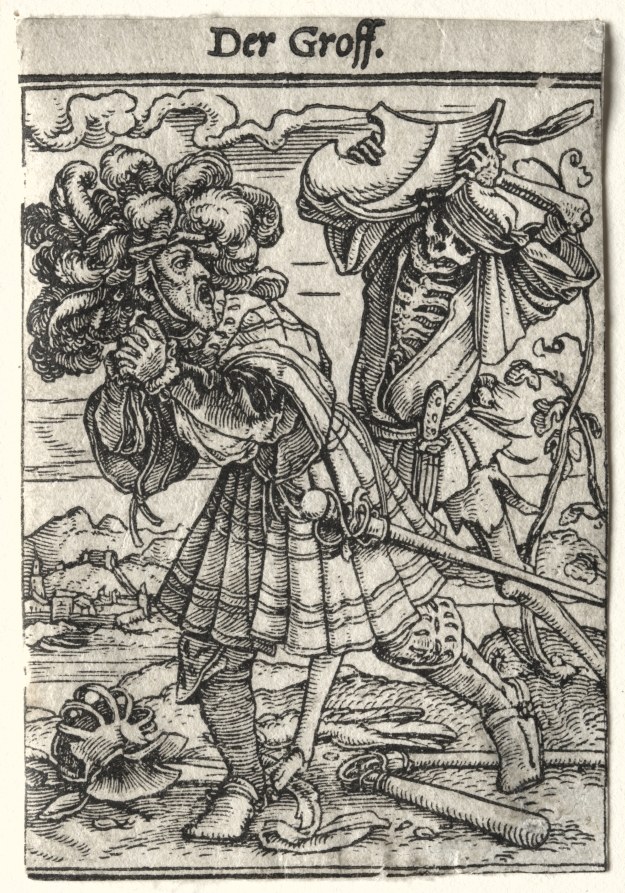
A skeletal figure of Death, rendered as a grinning skull with a large feathered headdress atop a body of exposed bones, leads a richly dressed nobleman in an intricate dance. The Count, identifiable by his elaborate period costume with puffed sleeves, ornate doublet, and fine fabrics, moves in close proximity to Death with arms raised and body angled in a formal dancing posture. The composition is characteristic of memento mori imagery: the stark contrast between Death's skeletal frame and the nobleman's aristocratic dress emphasizes the leveling power of mortality. The background suggests an outdoor or liminal setting with simple architectural elements, while the foreground is scattered with grave goods—a skull, bones, and implements of mortality. The engraving technique creates sharp lines and dense hatching that render both the delicacy of the Count's costume and the horror of his inevitable fate.
The dancing
The Count's body is positioned in a formal dancing frame with his arms raised and bent, suggesting the arm carriage of courtly dance. His weight appears to shift forward in a gestural movement toward or away from Death, rather than in a flowing ballroom progression. Death's skeletal body is rigid, almost puppet-like, yet positioned to mirror the Count's posture—a visual pun on the mechanical inevitability of the dance. The spatial relationship between the two figures—close, intimate, almost in a partner hold—is the crux of the danse macabre conceit: Death leads, the living must follow.
The dance depicted
This is a danse macabre, a late medieval and Renaissance genre of allegorical imagery in which Death personified leads figures of various social ranks in an unavoidable final dance. The scene likely depicts a specific moment from a longer sequence or pageant showing the hierarchy of society—various estates and professions—summoned equally to dance. The Count represents the aristocratic class, whose fine dress and elevated status are rendered meaningless before Death. The dance itself is formalized and courtly, not wild or chaotic; the horror lies in the orderliness of the procession and the universality of the summons. This is social commentary rendered through the visual language of Renaissance court dance.
How it was made
This is a woodcut or engraving from the Renaissance period—the record does not specify, but the technique is evident from the image. The fine linear hatching, the crisp outlines, and the capacity to render both elaborate costume detail and anatomical precision are characteristic of Northern European printmaking of the 15th–16th centuries. The print medium allowed multiple copies to circulate widely, making danse macabre imagery accessible beyond the wealthy elite. It was a repeatable, distributable form of moral instruction and social satire, much more widely seen than a single painting would have been.
About this work
This is 'Der Groff' (likely 'The Count'), a sheet from a danse macabre sequence—a popular Renaissance genre that used the visual language of dance to articulate a stark memento mori message: death comes for all, regardless of rank or wealth. The Count, dressed in the height of courtly fashion, is locked in a formal dance with a skeletal Death figure. The work is both technically accomplished and deeply moralized: the aristocrat's elaborate costume and refined gesture make his subjection to Death all the more pointed. Danse macabre images saturated European culture from roughly 1400 onward, appearing in prints, manuscripts, murals, and performance, and they reflect a specific moment of anxiety about mortality, social disorder, and the limits of human dignity. This print is a document of how Renaissance society imagined the leveling power of death—and how it imagined dance as the formal language through which that leveling would occur.
How to look at it
Attend first to the formal quality of the Count's dancing posture: he is not fleeing or writhing, but dancing according to the rules—arms raised, body angled, dressed to the height of fashion. This is the work's central visual irony: Death does not come as chaos or violence, but as an orderly partner demanding a dance the living cannot refuse. Notice too the contrast between the elaborate, individualized rendering of the Count's costume (each fold and pleating rendered with precision) and the geometric severity of Death's skeletal frame. The print's composition keeps the two figures locked together, inseparable—there is no escape from the dance, only submission to its steps.
The artist
The artist is not recorded. The work is part of a widespread tradition of danse macabre printmaking that flourished in Northern Europe, particularly in Germany and the Low Countries, from the 15th through 17th centuries. Such prints were often produced as series, with individual sheets depicting different social types (pope, emperor, merchant, peasant, fool, etc.) summoned to dance with Death. The tradition drew on both folk beliefs about death and sophisticated theological and humanist commentary on human vanity.
The period
The danse macabre genre emerged in the late 14th century in the wake of repeated plague epidemics and persisted through the Renaissance as a form of moral instruction and entertainment. By the 16th century, when this print was likely made, danse macabre imagery was ubiquitous in Northern European visual culture. Simultaneously, Renaissance court dance was becoming increasingly formalized and codified—the very orderliness and elegance that the Count's posture displays. The danse macabre thus sits at a fascinating intersection: it appropriates the language of refined courtly dancing in order to deconstruct and mock the social hierarchies that dancing bodies normally reinforced. The memento mori message was urgent and resonant in an era of religious upheaval and recurring plague.
Where it lives
The work is held in the Cleveland Museum of Art's dance-related art collection. It is catalogued as part of the museum's holdings but without detailed accession or exhibition history in the current record.
Dance in this work
Questions about this work
What is a danse macabre?
A danse macabre is an allegorical representation of Death leading figures of various social ranks in a final, inescapable dance. The genre emerged in late medieval Europe and flourished during the Renaissance, particularly in Northern Europe. It served as both memento mori (reminder of mortality) and social satire, emphasizing that death levels all hierarchies of rank, wealth, and power. The most famous surviving example is the Danse Macabre fresco at the Holy Innocents Cemetery in Paris, but the imagery circulated widely in prints, manuscripts, murals, and occasionally in live performance.
Why is Death dancing with the Count?
In danse macabre ideology, Death summons representatives of each social estate in turn—pope, emperor, merchant, peasant, and so on—to dance. The point is that no one, however exalted, can refuse or escape. The Count's elaborate dress and refined posture make his subjection to Death all the more poignant: all his wealth, status, and elegance cannot exempt him from the universal dance. The formality and order of the dance, rather than chaos, is what makes the image disturbing—death comes as an inescapable rule, not an aberration.
Who made this print?
The artist is not recorded in the Cleveland Museum of Art's catalogue. The work is part of a widespread tradition of danse macabre printmaking in Northern Europe, particularly Germany and the Low Countries, from the 15th through 17th centuries. Individual prints were often issued as sets, with each sheet depicting a different social type. Without a signature, inscription, or known provenance, it is difficult to attribute the work to a specific maker, though the style and technique are consistent with mid-to-late Renaissance German or Flemish printmaking.
What does 'Der Groff' mean?
'Groff' is a German or Low German term that likely means 'Count' or 'Earl' (related to 'Graf'). The title identifies the social rank of the nobleman depicted—one of a series of danse macabre figures, each representing a different estate or profession.
More dance artwork