49 works in this view — arrow keys or swipe to move between them.
Dance in Art
Dance staff for Esu Ògò Èlẹgba
Unknown artist
- Source:
- Cleveland Museum of Art
- Rights:
- Public domain — free to use, share and adapt.
- Recorded as:
- CC0 (Public Domain)
Dancers and choreographers working with African diasporic traditions, ritual revival, or spirituality-centered practice should know this object because it demonstrates how West African ceremonial objects materialize the relationship between human movement, cosmic force, and ornamental display. It shows that 'dance' in Yoruba religious contexts is not confined to human bodies but extends to objects that move, are moved, and animate the space around them. The staff's design—with its bilateral symmetry and formal gesture—encodes principles of balance and cosmic mediation that underlie Esu's role and that resurface in diaspora traditions like Candomblé and Santería.
What you are looking at
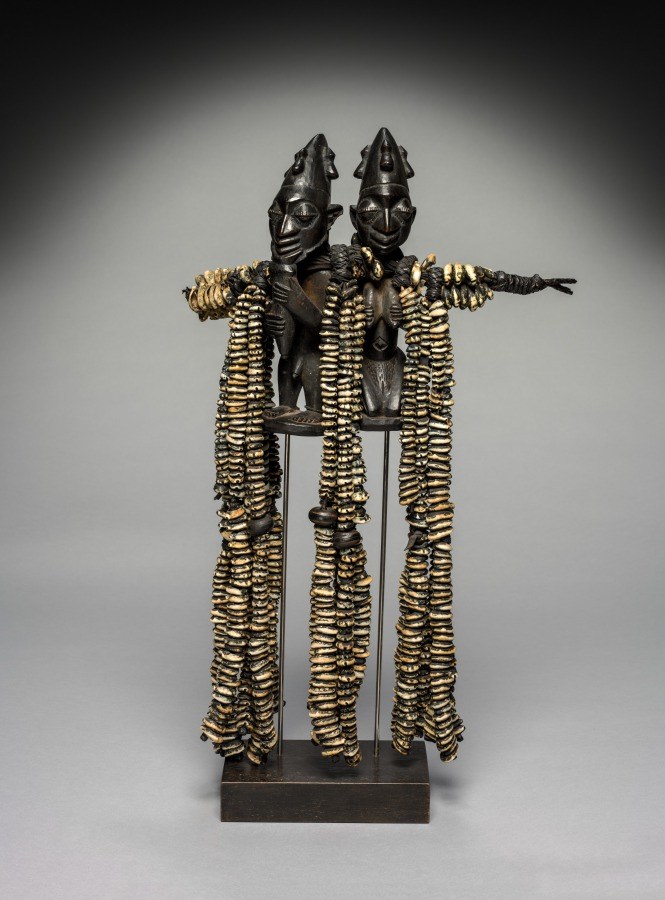
Two identical dark bronze figures stand back-to-back on a black rectangular base, their bodies facing outward with arms extended horizontally as if gesturing or conducting. Each figure wears an elaborate costume of stacked circular brass rings or discs that cascade from the shoulders down the full length of the body like segmented robes or armor, creating a striking visual rhythm of metallic gold against the dark patina of the carved heads and torsos. The figures have stylized facial features with prominent noses and mouths, their heads topped with tall, pointed headdress elements that give them an otherworldly or ceremonial appearance. The composition creates perfect bilateral symmetry, with the two figures forming a single unified object despite their opposing orientations. The work appears to be a sculptural staff or ceremonial object rather than a representation of dancers in motion, yet the extended arms and the formal, ritualized posture suggest a dance-like formality or ceremonial stance.
The dancing
The two figures maintain an identical upright posture with the arms extended outward from the body at shoulder height, a position suggesting either a formal greeting, blessing, or ceremonial presentation. The bodies show no indication of weight shift, bend, or rotation—they are static and symmetrical. The extended arms are straight and level, neither bent nor lowered. The costume of stacked rings obscures the legs entirely, making footwork indiscernible. The mirrored arrangement creates a formal, hieratic quality rather than a naturalistic representation of human movement.
The dance depicted
This is not a representation of dancers but rather a ritual object or staff used in Yoruba sacred practice, specifically a dance staff for Esu (also known as Elegba or Elegbara), a trickster deity in Yoruba religion and Vodun. The object itself was likely carried, waved, or planted in the ground during ceremonial dances honoring Esu, rather than worn by a dancer. The extended arm gesture and ceremonial posture reflect the formal, ritualized nature of Esu worship and the cosmic role of this orisha as a guardian of boundaries and crossroads. The object embodies rather than depicts the dance—it is a tool within the performance rather than a record of dancers' bodies.
How it was made
This is a carved wooden staff with applied metalwork, combining subtractive carving (the heads, torsos, and headdresses) with additive metalwork (the stacked brass or gilt rings that form the segmented costumes). The ring ornaments are individually fitted and stacked, requiring precision in dimensioning and assembly. The patina on the wood and the color distinction between the dark bronze carved sections and the brighter brass rings suggests considerable age and ritual use. This technique—combining carved wood with metal ornament—is typical of Yoruba and related West African sculptural traditions and indicates an object made for serious ceremonial use rather than for export or display.
About this work
This dance staff (opa) for Esu Ògò Èlẹgba is a sculptural object central to Yoruba ritual performance, not a representation of dancers but an active agent in ceremonial practice. The dual figures with their formal extended-arm posture and elaborate ring costumes embody the presence and power of Esu, the boundary-crossing, shape-shifting orisha who mediates between the human and divine realms. In performance, priests and devotees would use this object in dances honoring Esu, making the carved figures themselves partial dancers in a larger ritual choreography.
The staff exemplifies how African ceremonial practice integrates sculpture, dress, movement, and spiritual presence into a unified performance event. Where Western art tradition separates the representation of dance (a painted or carved scene) from the tools of dance (costumes, masks, instruments kept separately), this object collapses those categories. It is simultaneously a sculpture, a costume element, a dance implement, and a manifestation of sacred power.
How to look at it
Stand back and take in the bilateral symmetry and the formal, almost heraldic quality of the pose—this is not naturalistic movement but ceremonial formality. Then move closer and follow the cascade of brass rings down the length of each figure, noticing how the stacked ornament transforms the wooden torso into something both more-than-human and costume-like. Look at the extended arms and the pointing gesture or presentation: this is a posture of address, blessing, or boundary-marking, the kind of gesture that would activate the figure during performance. Notice that despite the dual figures, they form a single unified object—a staff, not a pair.
The period
The object's age is unknown, but its style is consistent with Yoruba sculptural traditions spanning centuries. The brass-ring costume is a marker of wealth and prestige in Yoruba visual culture, and the quality of carving suggests a work made within a guild or established workshop tradition. If the object dates to the 19th or early 20th century, it was made during a period of intensive European colonial interest in African 'ethnographic' material, though this staff would have been made for Yoruba ceremonial use, not for sale or collection. The formal, hieratic style—with the tall headdresses and symmetrical composition—reflects enduring principles of Yoruba sacred art rather than a particular historical moment.
Where it lives
The work is held in the Cleveland Museum of Art and is listed as part of the museum's dance-related art collection. No accession number, date of acquisition, or prior provenance is recorded in the available catalogue entry.
Dance in this work
Questions about this work
Is this a dance costume or a dance representation?
It is neither—it is a dance implement, a ritual object used in Yoruba ceremonies honoring Esu. Priests and priestesses would carry, wave, or plant this staff during performances. The object itself is an active participant in the dance rather than a depiction of dancers' bodies. In African ceremonial practice, the boundary between object and dancer, costume and sculpture, is far more fluid than in Western art traditions.
What are the brass rings?
They are ornamental rings—likely brass or bronze—stacked and fitted to create a segmented 'costume' or body covering that hangs from the shoulders. In Yoruba culture, brass and metalwork are markers of wealth, power, and sacred status. The rings may also evoke certain Yoruba dress forms or the segmented bodies of certain spiritual entities.
Why are there two figures back-to-back?
The dual figures likely represent Esu's nature as a boundary-crosser and mediator between opposing realms (human/divine, living/ancestral, male/female). The back-to-back posture, with arms extended outward, creates a balanced, symmetrical icon that can face multiple directions simultaneously—appropriate for a deity associated with crossroads and intersections.
How old is this object?
The catalogue record does not provide a date. Based on style and technique, it is consistent with Yoruba sculptural traditions, but it could date anywhere from the 18th century to the 20th. The patina and evidence of ritual use suggest age and active ceremonial history, but a precise dating would require technical analysis and archival research.
More dance artwork