49 works in this view — arrow keys or swipe to move between them.
Dance in Art
Dancing Apsaras
Unknown artist
- Source:
- Cleveland Museum of Art
- Rights:
- Public domain — free to use, share and adapt.
- Recorded as:
- CC0 (Public Domain)
This object is crucial evidence for understanding how classical South and Southeast Asian dancers trained and imagined their own bodies. The apsara was the supreme cultural ideal against which temple dancers measured themselves; to see how a sculptor understood and rendered the apsara's posture, weight distribution, and spatial presence is to glimpse the kinesthetic ideal that governed training and choreography. The work also documents the continuity between fine art representation and lived dance practice—a dialogue that shaped both for centuries.
What you are looking at
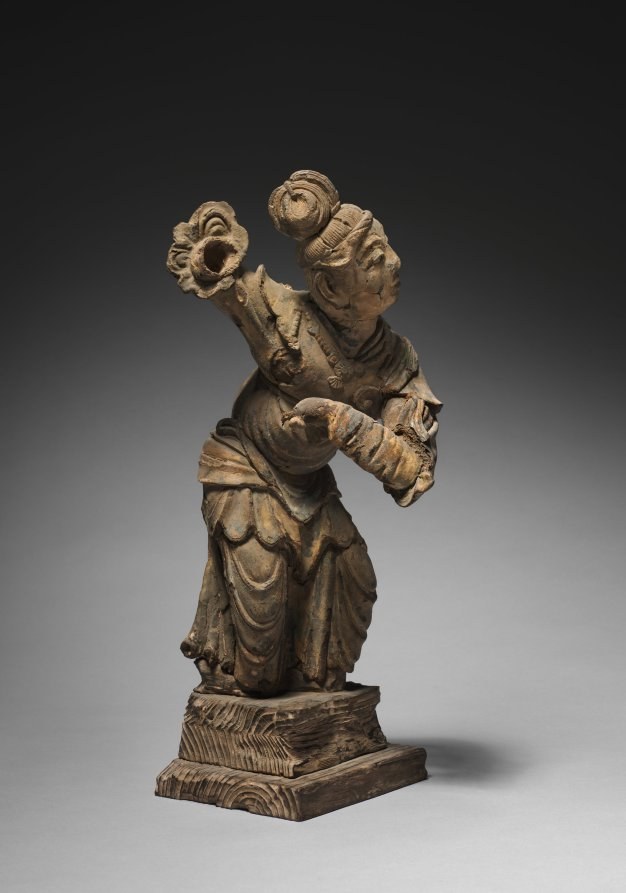
A wooden sculpture depicts a single celestial dancer in an arrested moment of graceful motion. The figure stands on a rectangular base with a decorative underside and rises in a contrapposto pose that suggests upward lift and ethereal buoyancy. The dancer wears flowing drapery that clings and swirls around the lower body while the upper torso remains bare or lightly clothed, characteristic of classical temple dancer representation. Both arms are raised in a lyrical gesture: the right arm curves upward and outward at roughly shoulder height with palm open; the left arm bends at the elbow and curves inward toward the body. The head tilts slightly, gazing toward the raised right hand in a moment of introspection or devotional focus. The carving shows assured understanding of the body in motion—the weight appears centered over the supporting leg, the opposing hip lifted, creating the dynamic asymmetry that gives the figure its sense of suspended movement rather than static repose.
The dancing
The single dancer occupies the full height of the composition, with arms in what appears to be a classical upper-body frame: one arm raised and extended, the other bent and drawn inward, neither constrained by a partner. The supporting leg is straight and stable; the free leg appears slightly bent or lifted, suggesting weight transfer mid-movement. The torso twists gently, with the shoulders rotated slightly against the hips—a hallmark of South or Southeast Asian classical dance technique where torso articulation is primary. The head follows the gaze of the raised hand, aligning with a fundamental principle of classical Indian and Southeast Asian dance where the gaze (drishti) leads the movement.
The dance depicted
This is almost certainly an *apsara* (or *apsaras*, plural), a celestial dancer from Hindu and Buddhist cosmology depicted in the classical dance traditions of South and Southeast Asia. The title confirms this. Apsaras appear throughout temple sculpture and dance practice, most notably in Khmer classical dance (Robam Tep Apsara) and in the classical Indian dance forms. The upward lift, the devotional quality of the gesture, and the flowing drapery all align with how these divine dancers were imagined and performed. The carver demonstrates familiarity with the essential feature of apsara representation: a moment of transcendent grace rather than earthly dynamism—the pose suggests floating or ascending rather than stepping or turning.
How it was made
This is a three-dimensional wooden carving, likely executed with chisels and gouges in a reductive process. The wood appears to be a hard, fine-grained variety suited to holding sharp detail; the surface shows both polished passages and areas where the tool marks remain visible, suggesting the work was left partially unfinished or intentionally textured. The base is carefully articulated with a decorative molding or beaded edge, indicating this was a finished architectural or devotional object rather than a sketch model. The technique allows the sculptor to reveal the dancer's form from all sides—a quality photograph or painting cannot match—and the apparent age of the wood and weathering of the surface suggests this is an antique or historical object.
About this work
This wooden sculpture preserves the classical aesthetic of the apsara in three-dimensional form, capturing a moment of celestial grace through the language of the body in space. It belongs to a vast corpus of apsara imagery spanning Hindu temples, Buddhist monasteries, and classical dance traditions across Asia. The work is not a record of a specific performance but an idealization of divine dance itself—the transcendent, weightless motion that apsaras were believed to embody. For dancers and historians, it serves as primary evidence of how the apsara was conceived and embodied in classical tradition: not as virtuosity or athletic achievement, but as an otherworldly presence marked by restraint, verticality, and an inward-turned spiritual focus.
How to look at it
Study the weight and balance first: notice how the figure does not rest squarely on both legs, but instead creates a diagonal line of energy from the supporting foot through the lifted hip and raised arm. This is the fundamental geometry of apsara pose—an ascending, ungrounded feeling despite the solid base below. Attend to the hands and arms: the raised hand is not grasping or gesturing toward something external, but rather opened and offered upward as if in offering or transcendence. The inward curve of the other arm mirrors this inward focus. Finally, observe the head and gaze: the slight tilt and downward turn of the face toward the raised hand exemplifies the inward concentration (antaranga bhava) that marks celestial rather than earthly dance.
The period
Apsara imagery flourished in Southeast Asian art and architecture during the Angkorian period (9th–15th centuries) and in South Asian temples during the classical era, when celestial dancer figures decorated temple walls, columns, and manuscripts. The apsara became a central motif in classical Khmer dance, which was preserved and revived after periods of suppression. By the colonial and early modern periods, apsara figures were sought for ethnographic collections and art museums. The sculptural tradition of representing celestial dancers in three dimensions runs parallel to the living tradition of their performance and may have served as teaching tools, devotional objects, or temple ornamentation. The carving style and materials suggest this work may date to a period when apsara imagery was being collected and valued by Western institutions.
Where it lives
The object is held in the Cleveland Museum of Art and was obtained through the museum's collection, described only as 'Artwork from the Cleveland Museum of Art. Part of the museum's dance-related art collection.' No further provenance, date of acquisition, or prior ownership is recorded in the provided catalogue information.
Dance in this work
Questions about this work
What is an apsara?
An apsara is a celestial female dancer in Hindu and Buddhist cosmology, associated with divine beauty, grace, and eternal youth. In art and sculpture across South and Southeast Asia, apsaras are depicted in idealized poses of ethereal motion. In classical dance traditions—particularly Khmer ballet—the apsara became the highest expression of feminine beauty and technique, and dancers trained to embody this celestial ideal.
How does this sculpture relate to dance practice?
This carving likely served multiple functions: as a devotional object in a temple or shrine, as architectural ornament, and potentially as a teaching reference for dancers learning to embody the apsara ideal. The pose encodes fundamental principles of classical South and Southeast Asian dance—verticality, weight shift through the supporting leg, arm patterns that suggest transcendence rather than labor, and an inward spiritual focus.
Why are the arms positioned this way?
The raised and opened arm, paired with the inward-turning arm, creates the essential gesture language of celestial dance. This is not a functional hold or preparation for a step, but an expression of devotion, offering, and otherworldly grace. The slight asymmetry and the inward gaze direct the viewer's attention upward and inward, away from the earthly and toward the transcendent.
Could this be from a specific temple or dancer?
The catalogue record does not provide information about the sculpture's origins, date, or specific cultural context. Based on the style and the apsara motif, it likely originates from Cambodia, Thailand, India, or another region with a strong temple dance tradition, but without documentation, we cannot be more specific.
More dance artwork