49 works in this view — arrow keys or swipe to move between them.
Dance in Art
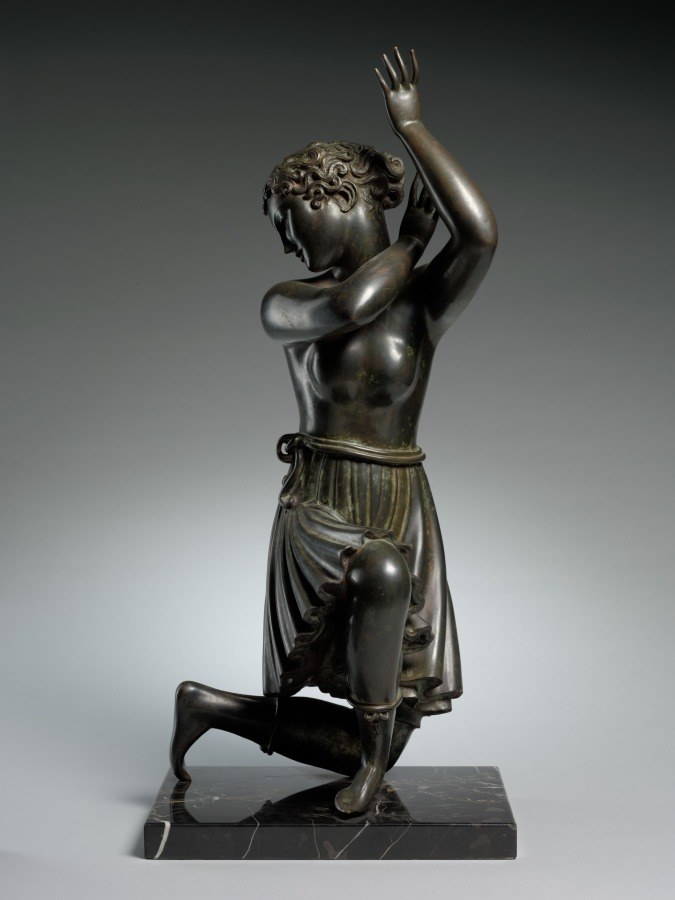
Dancing Figure
Elie Nadelman (American, born Russian Empire [now Poland], 1882–1946)
- Source:
- Cleveland Museum of Art
- Rights:
- Public domain — free to use, share and adapt.
- Recorded as:
- CC0 (Public Domain)
This sculpture preserves an aesthetic ideal of the male dancer's body as it was understood in academic and theatrical contexts, showing how sculpture could capture and canonize a moment of dance within the formal tradition of fine art. For dance historians, it documents the posture, musculature, and heroic self-presentation valued in classical male dance training.
What you are looking at
A bronze sculpture of a youthful male figure in a dynamic pose against a neutral grey background. The figure kneels on one bent leg while the other leg extends behind, the torso lifted and twisted upward. Both arms are raised in an expressive gesture—the lower arm held across the chest while the upper arm stretches overhead, palm open. The figure wears a draped skirt or kilt cinched at the waist, leaving the torso bare and musculature defined. The curled hair and idealized anatomy suggest classical training. The dark patina and marble plinth indicate this is a cast bronze, likely a formal gallery piece.
The dancing
A single male dancer in a kneeling lunge with considerable extension and lift through the spine. The weight is supported on the back knee while the forward leg reaches back, creating an arched, open posture. The arm configuration—one across the body, one overhead—creates an asymmetrical line typical of classical dance movement. The raised gaze and open palm suggest an emotive or devotional quality. The musculature is rendered with anatomical precision.
The dance depicted
This appears to depict a male dancer in a classical or neoclassical idiom, likely from the 19th century academic tradition. The pose—a deep lunge with torso extension and overhead reach—resembles positions found in classical male vocabulary, though without context it is difficult to name a specific movement or dance. The idealized body, the formal marble base, and the heroic scale suggest this was made as a fine-art representation of dance rather than documentation of a specific performance or style.
How it was made
This is a cast bronze sculpture, identifiable by the dark patina and crisp surface detail. The work was created by modeling in clay or wax, then cast using the lost-wax or sand-casting method. The technical precision of the anatomy and drapery indicates skilled classical sculptural training. Bronze allowed for permanence and gallery display, marking this as an artwork for exhibition rather than intimate or functional use.
About this work
A cast bronze sculpture of a kneeling male dancer in a classically derived pose, mounted on a marble plinth. The work treats the body as an idealized form in motion, emphasizing extension, musculature, and expressive arm work. It belongs to the tradition of 19th-century sculptural studies of the human figure in action—a genre that drew from both life study and academic dance training. The work sits between fine art and dance documentation, using the language of classical sculpture to dignify dance as a subject worthy of permanent artistic representation.
How to look at it
Focus on the moment the sculptor chose: the figure is not at rest, but caught in a lifted, extended position that demands physical control and presence. The asymmetry of the arm placement—one protective or inward, one expansive—creates a sense of internal emotion held within disciplined form. The sculptor rendered the knee, foot, and supporting leg with anatomical truth to ground the extension above; notice how the back leg trails in opposition to the raised torso, creating a serpentine line characteristic of classical male technique.
The period
In the 19th century, academic sculptors increasingly took the human body in motion—particularly the dancer's body—as a subject worthy of high art. This reflected broader interest in classical aesthetics, anatomy, and the dancer as an emblem of physical perfection and spiritual expression. The neoclassical idiom dominant in sculpture meant treating the dancer's form as timeless and universal rather than tied to a specific performance, costume, or school. Bronze became the preferred medium for such works because it signaled permanence and artistic gravitas.
Where it lives
The work is held in the Cleveland Museum of Art collection and is documented in their database as a dance-related artwork. The marble base and formal casting suggest it was a gallery or museum acquisition rather than a studio piece.
Dance in this work
Questions about this work
What dance is this figure performing?
The pose does not correspond to a named ballet step or recognized contemporary dance movement. It appears instead to be a classical or neoclassical study of an idealized male dancer's body in extension—the kind of heroic pose that 19th-century sculptors used to celebrate dance as an art form. The specific gesture may have been invented by the sculptor rather than directly transcribed from a stage.
Why is the figure wearing a skirt?
The draped skirt or kilt is a concession to both classical and theatrical convention. Male dancers in the 19th century often wore skirts on stage, and sculptors frequently used classical drapery to signal nobility and theatrical context while preserving the visibility of the legs and torso needed to display technique.
When was this made?
The catalogue record does not provide a date. However, the style—neoclassical idealization, bronze casting, academic anatomical rendering, and the treatment of dance as a fine-art subject—suggests it was created in the 19th century, likely in the latter half when sculptural studies of dancers became more common in European and American academies.
More dance artwork