49 works in this view — arrow keys or swipe to move between them.
Dance in Art
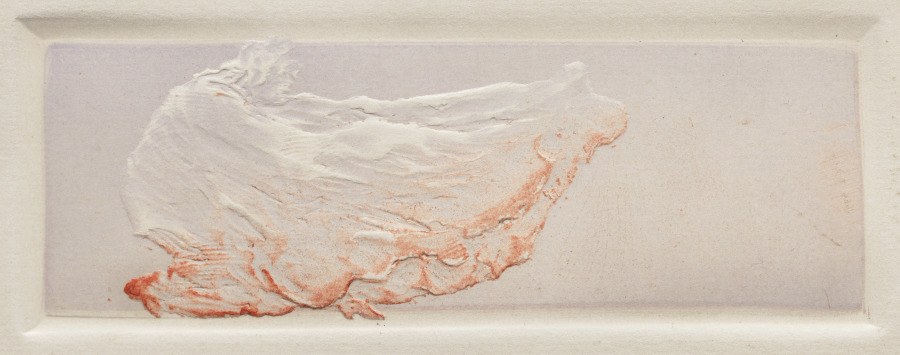
Dancing Woman Slightly Crouched
Pierre Roche (French, 1855–1922)
- Source:
- Cleveland Museum of Art
- Rights:
- Public domain — free to use, share and adapt.
- Recorded as:
- CC0 (Public Domain)
This drawing captures a body position that demands flexibility, strength, and control in equal measure. For dancers and movement practitioners, it serves as evidence of how an artist trained to observe movement can isolate and commemorate a single gesture. For art historians, it exemplifies the period's interest in the dancing body as a subject worthy of sustained study.
What you are looking at
A single female figure occupies the composition, rendered in a delicate technique that emphasizes the fluidity of movement. The dancer is caught in a moment of deep flexion, her body folded forward from the hips in a pronounced crouch or deep bow. Her weight appears to rest on bent legs, with her torso angled steeply downward. The drawing employs a warm terracotta or rust-colored line over a pale lavender-gray ground, creating an impression of soft, continuous movement. The white or lighter passages suggest drapery—possibly a skirt or cloak—that sweeps across the upper portion of the composition, rendered with energetic, gestural marks that convey the fabric's motion and weight. The figure is isolated against the plain background, with no setting, musicians, or other dancers to contextualize the moment.
The dancing
The dancer's body forms a acute angle, with her head dropped toward her knees and her arms either clasped or hanging down in the deep fold of the body. Her legs are visibly bent and flexed, supporting the full weight of a forward-bending posture that suggests either an intentional movement vocabulary or a moment of physical extremity. The linear quality of the drawing allows the artist to suggest muscular tension and the strain inherent in this posture. There is no visible closed hold or partnership—the dancer is solitary, and the emphasis falls entirely on the elasticity and control of her own spine and legs.
The dance depicted
The deep crouch or profound forward fold does not correspond clearly to any canonical Western theatrical dance form visible in the posture alone. The extreme flexibility required and the apparent ease of the positioning suggest either a trained body in a contemporary or experimental movement practice, or a figure drawn from observation of non-Western dance traditions or acrobatic disciplines. The absence of pointe shoes, tutu, or codified ballet uniform, combined with the emphasis on spinal flexion and grounding, could indicate modern dance, release-based technique, or a flow-arts or acro-dance context. Without inscription, date, or artist attribution, confident identification remains elusive. The drawing's refinement and the specificity of the pose suggest the artist had direct knowledge of the movement.
How it was made
The work appears to be a drawing—most likely charcoal, chalk, or crayon over a prepared ground. The warm reddish-orange linear marks are laid over a cooler lavender or gray underpainting, creating a color harmony characteristic of early 20th-century figurative studies. The white or lighter areas, particularly in the drapery, were left unpainted or were achieved through the preparation of the ground or lifting technique. The scale and finish suggest this is a study or completed work on paper, made for collection or exhibition rather than commercial reproduction. The technique favors clarity of line and gesture over photographic detail, allowing the viewer to read the movement directly from the mark-making.
About this work
This is a study of a female dancer in a posture of extreme forward flexion—a deep crouch or profound bow. The artist, unknown, rendered the figure with particular attention to the fluidity and controlled strength required for the position. The work is held in the Cleveland Museum of Art's dance-related art collection, which indicates its recognition as a dance document rather than a generic figure study. The drawing dates to an unknown period and was created in an unknown medium, though the style and presentation suggest early-to-mid 20th-century practice. It belongs in a gallery about dance because it records a specific moment of somatic knowledge—the body's capacity for deep flexion—and preserves it as an object of aesthetic interest.
How to look at it
Attend to the diagonal thrust of the spine and the acute angle of the crouch—this is not a standing figure viewed from the side, but a body folded almost in half. The artist's choice to emphasize the linearity of the movement (the curve of the back, the line of the legs) rather than volumetric modeling tells us they were interested in the geometry of the pose and the body's capacity for folding. The treatment of the drapery as a separate visual element, rendered in white or light marks, creates a sense of motion independent of the figure's own weight—cloth and body move in concert.
The period
Early 20th-century artists developed a sustained interest in the dancing body, particularly following the influence of Isadora Duncan and the Ballets Russes, which challenged academic conventions and opened European and American art to non-balletic movement vocabularies. The same decades saw the rise of modern dance, acrobatic practice, and experimental movement in both Western and non-Western contexts. Figure drawing remained a foundational skill, but artists increasingly used it to record movement in unfamiliar or extreme positions rather than to demonstrate academic anatomy.
Where it lives
The work is part of the Cleveland Museum of Art's collection and is labeled as dance-related art. No accession number, date, medium, or artist name is recorded in the catalogue.
Dance in this work
Questions about this work
What dance form is this?
The specific dance form cannot be determined from the image alone. The extreme forward fold and clear anatomical control suggest either modern dance, release-based contemporary technique, or a non-Western dance or acrobatic practice. The artist's precise understanding of the movement indicates direct observation of trained practice.
Who made this drawing?
The artist is unknown. The drawing is held at the Cleveland Museum of Art, which may have additional archival information not reflected in the public catalogue record.
When was it made?
The date is unknown. The style and technique suggest early-to-mid 20th-century practice, but without inscription or provenance documentation, the period cannot be confirmed.
Is this a study or a finished work?
The level of finish and the isolation of the figure suggest this was a deliberate study of a particular movement or posture, likely made from observation or memory. It reads as a complete work rather than a preliminary sketch.
More dance artwork