49 works in this view — arrow keys or swipe to move between them.
Dance in Art
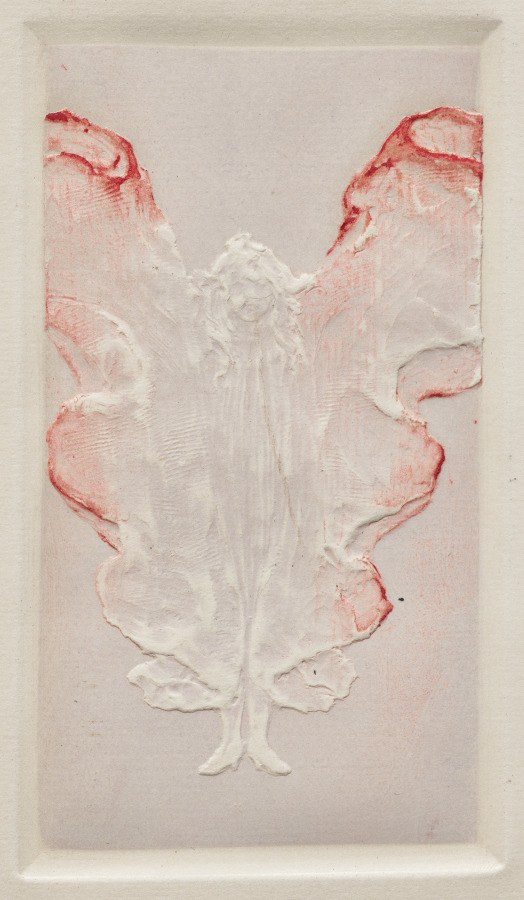
Dancing Woman with Arms Raised
Pierre Roche (French, 1855–1922)
- Source:
- Cleveland Museum of Art
- Rights:
- Public domain — free to use, share and adapt.
- Recorded as:
- CC0 (Public Domain)
This work exemplifies how the figure of the dancer was elevated to the status of an ideal or timeless form in early modernist design and sculpture, stripped of narrative and theatricality to become a pure embodiment of grace and verticality. For historians of dance representation, it shows the persistence of the neoclassical body—the elongated line, the symmetry, the aspiring gesture—as a visual language for representing dance outside the stage.
What you are looking at
A single female figure occupies the center of a shallow relief composition, rendered in white and coral-red tones against a pale ground. The figure stands with arms raised and spread wide, the body elongated and frontal. The dress—suggested by delicate incised lines—appears to be a classical or neoclassical garment, possibly a chiton or simple draped gown that falls vertically from the raised arms. The composition is symmetrical and vertical, emphasizing the upward thrust of the pose. The medium itself is tactile: the white areas are built up slightly in relief, creating shadow where the red-tinted surfaces recede, while fine linear detail indicates drapery, limbs, and the suggestion of a central vertical axis (possibly a staff or pole) running through the figure's body. The shallow depth and formal frontality suggest an archaic or deliberately classicizing aesthetic.
The dancing
The single dancer is shown in a frontal, symmetrical stance with both arms raised at approximately shoulder height or higher, spread wide to either side. The body is elongated and centered, the legs appearing to stand in a neutral position rather than in any pronounced stride or attitude. The raised arms and open frame suggest an aspiring or opening gesture rather than closed partnered movement. There is no visible weight shift or indication of locomotion; the figure appears static and statuesque, oriented toward the viewer.
The dance depicted
The pose is most consistent with Romantic or Classical ballet vocabulary—specifically a raised arm position (possibly épaule or allongé alignment) that would be taught at the barre or in adagio. The figure could represent a moment from a classical ballet sequence, though the stylization and archaic treatment make it impossible to identify a specific role or choreography. The emphasis on verticality, symmetry, and the celestial or ethereal quality created by the white relief suggests an idealized or aspirational image of the dancer, rather than a snapshot of social or theatrical dance in progress. The composition reads as a study or apotheosis of the dancing figure rather than a narrative scene.
How it was made
The object is a bas-relief or molded wall panel, executed in white plaster or ceramic material with applied coral-red toning to define shadow and contour. The technique—shallow carving combined with surface incision—allowed for precise articulation of drapery and limbs while maintaining the frontal, iconic quality of the figure. This method of production suggests the work was intended as decorative architectural ornament or a framed wall-mounted panel for domestic or institutional display. The monumental simplification and relief format elevate the dancer to a permanent, sculptural status rather than capturing a fleeting theatrical moment.
About this work
This is a neoclassical or early modernist relief panel depicting a single female dancer in an idealized, symmetrically posed stance with raised arms and classical drapery. The work sits at the intersection of sculpture and dance representation, using the shallow relief medium to create a timeless, archetypal image of the dancer rather than a narrative or theatrical scene. The formal language and archaic stylization suggest it may be a twentieth-century work responding to classical and neoclassical aesthetics, or conceivably a later revival or pastiche of such forms. The absence of documentation makes confident dating and attribution impossible, but the material and compositional choices indicate it was conceived as a permanent decorative object, likely intended for architectural or institutional contexts.
How to look at it
Attend to the tension between the figure's static frontality and the implied upward aspiration of the raised arms—the pose is not naturalistic but rather a crystallized moment of opening or transcendence. Notice how the shallow relief creates definition through shadow and the warm coral-red toning, which picks out contours and drapery folds while the white maintains the sense of an idealized, immaterial form. The vertical emphasis and symmetry are the work's primary language; there is no movement through space, only an iconic presentation of the dancing body.
The period
The stylization and relief technique suggest a work created in the early twentieth century or later, during a period when modernist and Art Deco aesthetics were reviving and reinterpreting classical and neoclassical forms. The figure of the idealised dancer was a recurring motif in decorative arts, sculpture, and architecture of this era—visible in the work of sculptors like Demetre Chiparus and designers working in the Streamline Moderne and Art Deco idioms. The choice to render the dancer as a permanent sculptural object, isolated and formal, reflects a broader cultural fascination with the dancer as an emblem of modernity, grace, and formal purity.
Where it lives
The work is recorded as part of the Cleveland Museum of Art's dance-related collection and was sourced from the CMA database. No further provenance, accession number, or contextual information is provided in the available record.
Dance in this work
Questions about this work
What dance form is this depicting?
The raised-arm pose and elongated stance are consistent with classical or Romantic ballet vocabulary, but the work is so stylized and formal that it represents an idealized type rather than a specific choreography or performance. It may equally reference ancient Greek or neoclassical art historical conventions applied to the figure of the dancer.
Is this a relief sculpture or a painting?
This is a shallow relief, most likely in white plaster or ceramic with applied surface toning. The three-dimensionality is subtle but real; the white figure is built up from the ground and incised with linear detail. It is a sculptural form intended for wall display or architectural integration.
Why are the dancer's arms raised?
The raised arms suggest several meanings at once: the aspiring line of classical ballet training, a gesture of invocation or transcendence, and the visual ideal of verticality and openness that characterized neoclassical aesthetics. The pose is formal and timeless rather than narrative.
More dance artwork