49 works in this view — arrow keys or swipe to move between them.
Dance in Art
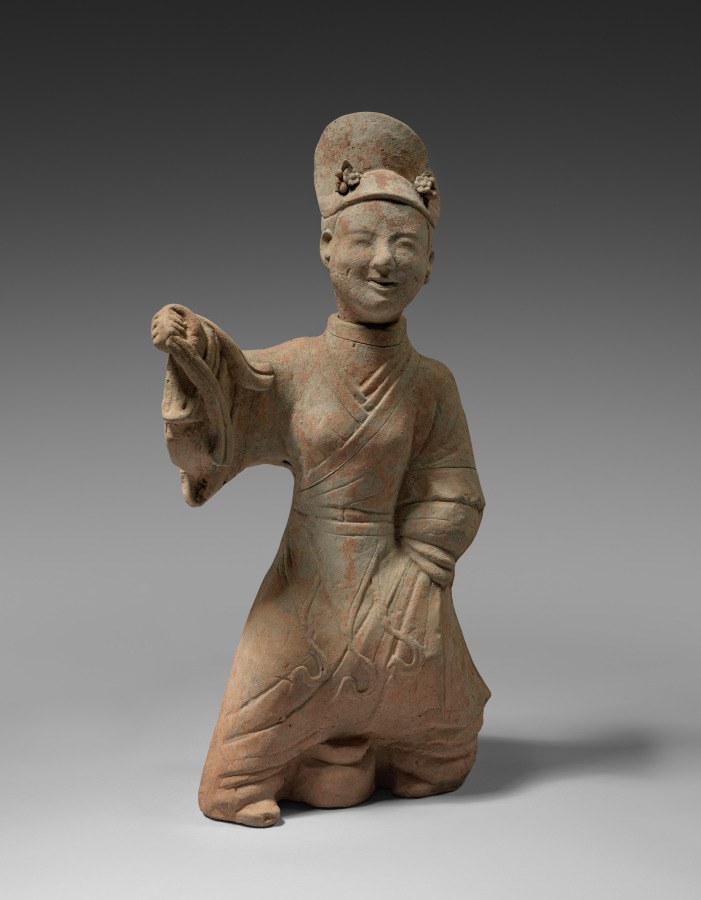
Female Figure of a Court Entertainer Dancing
Unknown artist
- Source:
- Cleveland Museum of Art
- Rights:
- Public domain — free to use, share and adapt.
- Recorded as:
- CC0 (Public Domain)
This figure is invaluable evidence for understanding early East Asian court dance, a form that combined elements of music, gesture, martial display, and entertainment. Rather than depicting a moment frozen from an actual performance, it captures the bearing, costume, and character of a recognized professional dancer—a social category whose skills and status were high enough to warrant commemoration in a durable medium.
What you are looking at
A terracotta figure of a woman stands in a kneeling or seated pose, her body leaning slightly forward with an open, animated expression. She wears a form-fitting garment with a narrow waist and draped sleeves, carved with fine linear details that suggest fabric pleating or pattern. Her hair is bound in an elaborate headdress—a tall, rounded crown decorated with small ornamental knobs or finials. She holds a length of cloth or silk in her right hand, which falls away from her body in a flowing gesture. Her left hand rests against her body. The figure is carved with remarkable anatomical attention, the musculature of her torso and limbs clearly defined. The terracotta has a warm, aged patina with earth-toned discoloration suggesting considerable age. Her face is open and engaging, with a gentle smile that conveys ease and entertainment.
The dancing
The dancer is depicted kneeling, her torso twisted slightly forward in a posture of active engagement rather than repose. Her weight appears centered over her knees, giving her an alert, ready quality. The swept gesture of the cloth held in her raised right hand creates a dynamic line across her body; her left arm is bent, hand positioned at her torso. The carving shows understanding of how fabric moves independently of the body—the cloth curves and falls with its own momentum, not simply following the contour of her frame.
The dance depicted
This is almost certainly a court entertainer from ancient China, likely Tang Dynasty (618–907 CE) or later, depicted in a moment of performance. The elaborate headdress, fitted dress with sleeves, and flowing fabric suggest a court dancer or musician-dancer of high status. The pose captures not a codified dance step but a moment of display and engagement—the kind of courtly entertainment that combined music, gesture, and dramatic presence. The cloth in her hand may be a ribbon or silk scarf used as a prop, a common element in East Asian court dance. The uplifted gaze and gentle expression suggest a performer conscious of her audience.
How it was made
This is a hand-modeled and carved terracotta sculpture, built in sections and joined. The artist worked with remarkable precision to define musculature, facial features, and the fine details of dress and headdress. The surface shows the marks of carving tools and the subtle variations of hand-finishing. Terracotta was a standard material for tomb furnishings in Chinese burial practice, where such figures represented the entertainers and companions who would serve the deceased in the afterlife. The technique required both sculptural skill and knowledge of costume, hairstyle, and bearing.
About this work
This terracotta figure documents a moment in the performance practice of the Chinese imperial court, preserving not just the aesthetic of a court entertainer but the physical understanding of her art: her stance, the handling of fabric, the quality of presence expected. The carving captures a specific instant—the dancer animated and engaged, her costume and bearing speaking to her status and training. She belongs in the history of dance because she is evidence: she tells us what a court dancer looked like, how she held herself, what props and dress defined her role, and how an artist of her own time chose to remember her.
How to look at it
Observe the animation in the dancer's face and the way her body is poised in readiness rather than stillness. The carver has captured the moment just before or during active movement, not a static pose. Note how the cloth falls from her hand—it moves with its own weight and momentum, distinct from her body's axis. Look at the care taken in her headdress and dress; these are not generic but represent specific, recognizable courtly costume. The slight forward lean of her torso and the positioning of her limbs suggest familiarity with how an entertainer actually moves and carries herself.
The period
Court dance in Tang and post-Tang China was a sophisticated art form performed by trained professionals, often women, for the entertainment of the imperial household and the display of cultural refinement. These entertainers held significant social status and often commanded high fees. Terracotta tomb figures served both practical and commemorative purposes, preserving the dress, posture, and character types of the living world for the afterlife. The sculptor was working within a well-established tradition of depicting entertainers, musicians, and servants in clay—a practice that has left us one of our best visual records of daily life, performance practice, and costume in medieval East Asia.
Where it lives
The figure is held by the Cleveland Museum of Art and is attributed to a period labeled 'Unknown Era' in the museum's records, suggesting either uncertainty about dating or a decision not to narrow the chronology beyond what the material itself indicates. It is catalogued as part of the museum's dance-related art collection. The catalogue provides no maker, specific archaeological context, or former ownership.
Dance in this work
Questions about this work
What period is this from?
The catalogue record does not specify a date. Based on the style of dress, headdress, and terracotta technique, this figure likely dates to Tang Dynasty (618–907 CE) or the several centuries following, but this cannot be confirmed from the information provided. Archaeological context and chemical analysis of the clay would be necessary for more precise dating.
Was this woman a real person?
She is almost certainly not a portrait of an individual, but rather a type figure—the representation of a professional court entertainer as a recognizable social category. Such figures were placed in tombs to serve or entertain the deceased in the afterlife, and many copies of similar dancers exist, suggesting a standard artistic convention rather than individual commemoration.
What is the cloth she is holding?
It is likely a silk ribbon, scarf, or streamers—props used in court dance to create visual effects and extend the lines of the body. The flowing gesture shown here was a recognized element of court entertainment, where the manipulation of fabric added drama and complexity to the performer's movement.
How do we know this depicts dance?
The inscription on the museum's label identifies her as a 'court entertainer dancing.' Her pose—animated, forward-leaning, with one arm raised in a gestural sweep—is consistent with performance rather than everyday activity. The formal dress, elaborate headdress, and the presence of a prop all mark her as a professional performer captured in the act of her work.
More dance artwork