49 works in this view — arrow keys or swipe to move between them.
Dance in Art
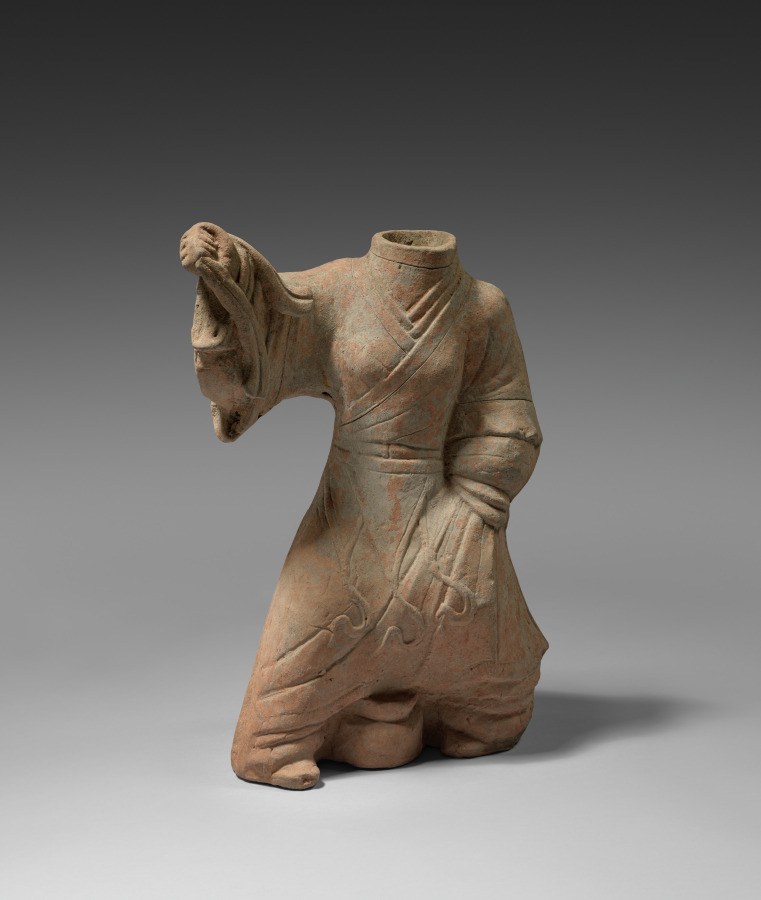
Female Figure of a Court Entertainer Dancing Body
Unknown artist
- Source:
- Cleveland Museum of Art
- Rights:
- Public domain — free to use, share and adapt.
- Recorded as:
- CC0 (Public Domain)
This figure documents a living dance tradition through an object made in the period itself, capturing not just the idea of court dance but the actual details of how a performer held their body, positioned their limbs, and dressed for performance. For historians of dance in Asia, such terracotta figures are among the most reliable sources for reconstructing movement and training practices that left no written description. For contemporary viewers, it shows that the aesthetics of refinement, grace, and controlled gesture have deep historical roots in courtly performance traditions.
What you are looking at
A terracotta figure of a kneeling dancer, rendered in the round without a base. The figure is shown from the waist up, with the torso leaning forward in an active posture. The dancer wears a short-sleeved tunic or court robe with visible pleating or gathering at the chest and waist, rendered with careful linear incision. The left arm is raised and bent, with the hand held near the face in a graceful gesture; the right arm appears to be positioned across or against the body. The head is turned sharply to the viewer's right, with a detailed face and what appears to be styled or bound hair. The figure kneels on both legs, with the weight distributed through the lower body in a posture suggesting active movement or sustained performance. The surface shows the warm, oxidized color typical of ancient fired clay, with subtle modeling of musculature and drapery.
The dancing
A single figure in a kneeling position, the body weight settled into the knees and lower legs rather than on the feet. The torso leans forward from the hips in a deep forward bend or bow. The raised left arm, with hand near the face, suggests a refined gestural vocabulary; the positioning of the right arm is less clear but appears to frame the body. The head turn away from the body's centerline, combined with the arm lift, creates an open, demonstrative quality characteristic of courtly performance. The posture is neither stiff nor naturalistic; it shows a trained, composed bearing despite the dynamic kneeling stance.
The dance depicted
This figure almost certainly depicts a court entertainer or professional dancer from an East Asian courtly context, most likely China given the terracotta medium, style of dress, and the kneeling performance posture. The figure exemplifies a tradition of courtly dance entertainment in which performers, often female, executed formal, controlled movements before aristocratic audiences. The kneeling posture and forward-leaning torso, combined with the refined arm and head positioning, suggest a moment in a choreographed sequence—neither an acrobatic display nor a casual movement, but a posed, graceful gesture within a formal dance tradition. The lack of instruments or musical props indicates this is a movement-based performance rather than instrumental accompaniment.
How it was made
This is a terracotta sculpture, hand-modeled and fired. The artist worked in the round, which means the figure was conceived three-dimensionally from all sides, a demanding approach for a small-scale work. Fine details—the pleating of the robe, the facial features, the styling of the hair—were incised or carved into the surface after the main form was established. The technique allowed the sculptor to capture both the overall posture of the dancer and the refined details of court dress and grooming. Terracotta's porous, warm surface records fingerprints and tool marks, giving the work an immediate tactile quality; the material was valued for both functional vessels and small-scale figurative works in many ancient cultures.
About this work
A terracotta figurine of a court dancer in a kneeling performance posture, hands and arms positioned in a refined gesture, wearing a pleated short-sleeved robe. The work dates to an unknown period but is recognizable as East Asian in style, most plausibly Chinese, and represents the tradition of courtly dance entertainment by professional performers. The figure is significant as physical evidence of how court dancers of the period understood and executed their art—the specific combination of posture, gesture, and costume reveals what movements were valued, who performed them, and in what contexts. These small-scale terracotta dancers survive in many museum collections and provide a rare three-dimensional record of movement vocabularies that are otherwise known only from painting, poetry, or written records.
How to look at it
Examine the relationship between the forward lean and the kneeling position: the dancer is not simply sitting, but actively balanced, suggesting the moment partway through a sustained gesture rather than a resting pose. Notice how the head turn creates a diagonal line through the figure that counters the vertical axis of the kneeling legs; this opposition is typical of courtly movement vocabularies, which valued elegance achieved through subtle asymmetry. Study the arm position carefully—the raised arm with hand near the face is a specific gestural phrase, not a generic flourish, and its meaning would have been immediately legible to a contemporary courtly audience.
The period
Court entertainment in ancient East Asia, particularly China, incorporated professional dancers whose status and training resembled those of musicians and poets. Such performers were often enslaved or purchased into noble households and received formal instruction in movement, gesture, and deportment. Kneeling performance postures appear frequently in surviving visual records and suggest that the spatial relationship between dancer and patron—with the dancer positioned lower than the seated court audience—was integral to the performance ethos. Terracotta figurines of dancers, musicians, and attendants are found in burial contexts and domestic settings, indicating they served both as grave goods and as representations of household prestige.
Where it lives
The work is held in the Cleveland Museum of Art's collection and entered via the museum's established curatorial acquisition practices, though the specific date of acquisition and prior provenance are not recorded in the available catalogue data.
Dance in this work
Questions about this work
How old is this figure?
The catalogue record does not provide a date. The style of dress and the terracotta medium suggest an East Asian origin, most likely China, but without scientific analysis or comparison to securely dated contexts, a precise dating cannot be established from the object alone.
Was this figure used as a toy or a serious art object?
The fine detail, careful finish, and refined subject matter suggest this was made for a patron of some means—either as a household ornament, a burial furnishing, or both. It is unlikely to be a child's toy, though terracotta figures served multiple functions in ancient domestic and funerary contexts.
What tells you this is a court dancer and not just any dancer?
The short-sleeved robe with pleating, the refined facial features, and the composed, controlled posture all point to an elite performance context. The kneeling position and gesture are characteristic of formal courtly entertainment, where dancers performed for seated patrons, rather than community or religious dances that might employ different postures and dress.
Could this figure be performing a religious or ceremonial dance?
Possibly, though the courtly dress and the refined, composed quality of the gesture suggest a secular entertainment context more strongly than a religious one. Without more information about the figure's provenance and the broader context in which it was made and used, the distinction cannot be made with certainty.
More dance artwork