49 works in this view — arrow keys or swipe to move between them.
Dance in Art
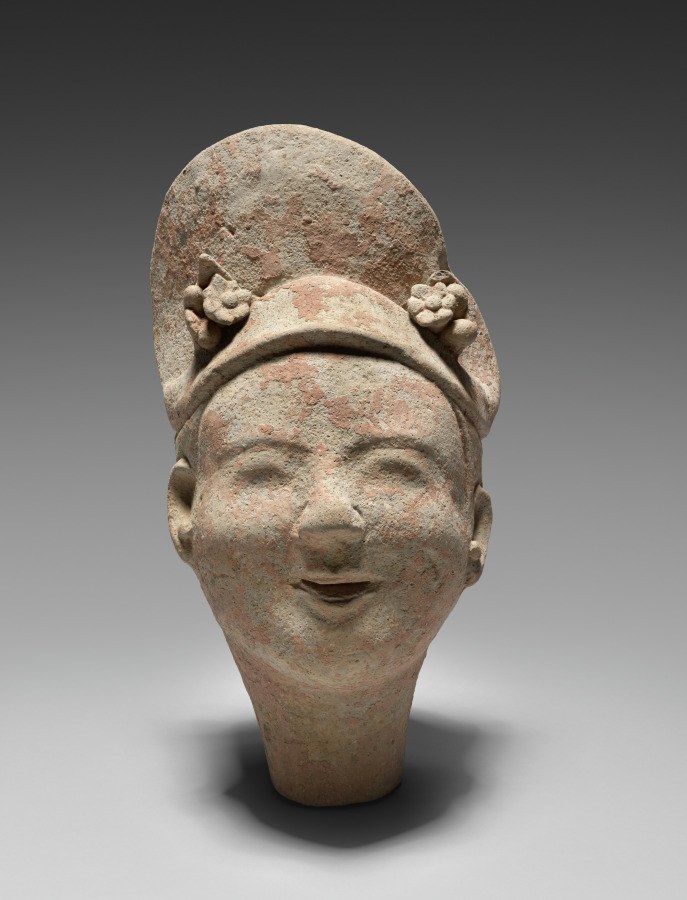
Female Figure of a Court Entertainer Dancing Head
Unknown artist
- Source:
- Cleveland Museum of Art
- Rights:
- Public domain — free to use, share and adapt.
- Recorded as:
- CC0 (Public Domain)
For dancers and historians, this work is primarily valuable as evidence of how courtly dance was practiced within elite hierarchies: the costume and headdress indicate that formal court dance involved elaborate regalia that signaled rank and ceremonial function. The object demonstrates how sculpture was used to commemorate performers and entertainers in court contexts, and suggests that the dance traditions it represents were significant enough to warrant permanent, prestigious commemoration in stone.
What you are looking at
This is a sculptured head in stone, shown in isolation against a neutral gray background. The work depicts a face with simplified, idealized features characteristic of ancient portraiture—smooth planes, almond-shaped eyes, a composed closed-mouth expression. The most distinctive feature is the elaborate headdress: a tall, rounded crown or cap rises above the head, and small decorative elements (possibly flowers or ornaments) flank the sides of the face at ear level. The face itself is broad and symmetrical, with a serene, frontal gaze. The stone shows signs of age and weathering, with surface discoloration and patina that suggest considerable antiquity. The work is photographed in strong light that casts a subtle shadow beneath the chin and neck, emphasizing the three-dimensional form.
The dancing
This is a portrait head only, not a full figure, so dance posture and movement cannot be assessed from the body. The face presents a static, formal expression typical of court or ceremonial portraiture rather than a moment of active movement. The ornamental headdress and side decorations suggest high rank or ceremonial function. Without the body, torso, or limbs, no gestural evidence of dance training or posture survives.
The dance depicted
The catalogue identifies this as a 'Female Figure of a Court Entertainer Dancing Head,' which suggests the original full figure was a dancer or court entertainer. However, the head alone provides no visual evidence of the dance style or movement. The headdress and formal presentation are consistent with courtly or ceremonial contexts in several East or Southeast Asian traditions, but without the body, the specific dance tradition cannot be determined from the sculpture itself. The title may derive from museum archival records rather than from visual analysis of the work.
How it was made
This is carved stone sculpture, likely limestone or similar sedimentary stone. The carving technique is subtractive and relatively smooth, with minimal undercutting except in the delineation of the facial features and the ornamental elements. The stylized, frontal composition and simplified modeling suggest high-status portraiture created within a formal artistic tradition. Stone sculpture of this type required significant labor and was typically commissioned for temples, court complexes, or elite burial contexts. The durability of the medium has allowed it to survive to the present, though weathering and loss are visible.
About this work
This is an ancient stone portrait head, identified in the catalogue as part of a larger sculpture of a female court entertainer. The work exemplifies portraiture conventions from a tradition (likely East or Southeast Asian, based on the headdress style) in which rank and function were signaled through formal dress and ornamental detail. The elaborate crowned headdress and the serene, idealized face suggest a figure of high ceremonial status. As a fragment, the head is now encountered as a sculptural object in its own right, displayed for its formal and historical interest rather than as evidence of a complete dancer in motion.
How to look at it
Attend to the headdress: its shape, materials, and the side ornaments are the most informative elements, as they would have conveyed rank, region, and possibly the specific ceremony or court in which the dancer performed. The idealized and serene expression is typical of formal portraiture in many ancient traditions and does not depict a moment of action. The smooth, frontal presentation treats the head as a symbol of rank and beauty rather than as a study of individual personality or movement. The weathering of the stone is itself informative—it indicates age and original outdoor or temple placement.
The period
The sculptural style, stone medium, and formal portraiture conventions suggest an ancient or medieval court tradition, likely in East or Southeast Asia. In those regions, court entertainment systems were well-established by the medieval period, with elaborate hierarchies of musicians, dancers, and entertainers who served ceremonial and diplomatic functions. Female court entertainers often held high social status and were commemorated in art. The headdress style may provide clues to a specific region and period, though without scholarly identification in the current record, the precise cultural and chronological context remains uncertain.
Where it lives
The work is held by the Cleveland Museum of Art and is part of their collection of dance-related art. It is catalogued as a head from a larger figure, indicating the full sculpture may have been lost, fragmented, or displayed separately. The classification as part of a dance collection suggests the museum recognized the entertainment or performance function of the original.
Dance in this work
Questions about this work
What can we tell about the dance from just the head?
Very little. The head alone does not show posture, footwork, arm position, or movement. We can infer from the headdress and formal dress that the dancer held high rank in a court system, and that the dance involved elaborate costume, but the specific technique and style are not visible. The full figure, if it survives, would provide much more information.
Why was this sculpture made?
In many court traditions, high-ranking entertainers were commemorated in stone to mark their status and preserve their memory. This practice suggests the original dancer held significant social position and that court entertainment was considered important enough to warrant permanent artistic commemoration.
How old is this, and where is it from?
The catalogue record lists the era as 'Unknown Era' and provides no date or origin. The sculptural style and headdress suggest an ancient or medieval court tradition in East or Southeast Asia, but precise dating and provenance would require specialist evaluation. The museum may have more detailed information in their archives.
More dance artwork