49 works in this view — arrow keys or swipe to move between them.
Dance in Art
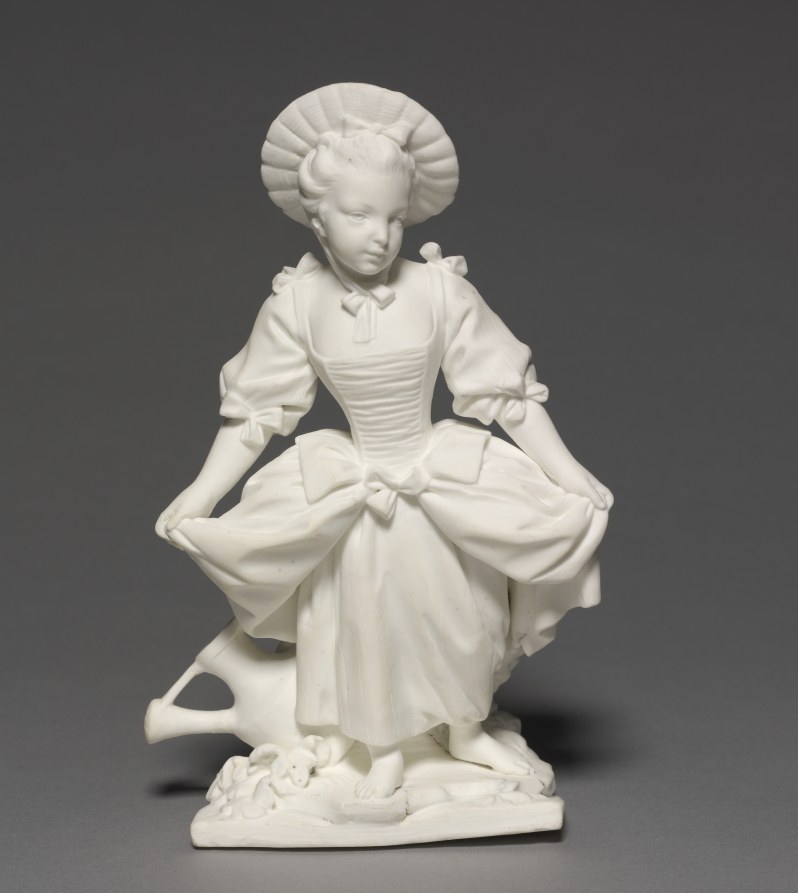
Figure of the Dancer La Danseuse
Vincennes Porcelain Factory (France, 1740–56)
- Source:
- Cleveland Museum of Art
- Rights:
- Public domain — free to use, share and adapt.
- Recorded as:
- CC0 (Public Domain)
This sculpture provides material evidence of how eighteenth-century court dance was understood and valued: not as spectacle but as a practice inseparable from costume, deportment, and refined aesthetic judgment. For historians of dance and costume, the work documents the precise silhouette and construction of period dress with a precision that paintings or prints could not always achieve. For historians of sculpture, it demonstrates the adaptation of neoclassical form to the subject of dance.
What you are looking at
A white marble or plaster figure of a young woman stands in a graceful contrapposto pose against a neutral ground. She wears an elaborate costume of the eighteenth century: a fitted bodice with horizontal pleating and a full skirt caught up at the sides by draped fabric tied with a large bow at center front. The sleeves are voluminous, gathered at the shoulders and extending to mid-arm. Her hair is dressed high and wide in the fashionable style of the period, framed by what appears to be a tall, sculpted headdress or coiffure arrangement. She gazes downward with a serene expression, her weight resting primarily on one leg in a pose that suggests both stillness and potential movement. The sculpture captures a moment of elegant repose, the drapery suggesting the kind of light, controlled motion associated with court dances of the era.
The dancing
The dancer's weight is distributed asymmetrically, with the body leaning slightly toward the engaged leg while the other remains relatively straight—a classic contrapposto stance. The arms hang naturalistically at the sides, the fingers visible and delicately rendered. The upright posture and lifted carriage of the torso convey the formal bearing required of court dancers. The pose is fundamentally static rather than dynamic; there is no indication of a leap, turn, or vigorous footwork. Instead, the sculptor has chosen to emphasize the refined deportment and the architectural quality of the costume itself.
The dance depicted
This figure most likely represents a dancer of the Baroque or early Rococo period, when court dances such as the minuet, bourrée, or gavotte dominated aristocratic entertainments. The costume—the high-waisted silhouette, voluminous sleeves, and structured bodice—and the refined, restrained posture are consistent with the aesthetic of French court dance in the early-to-mid eighteenth century. The downward gaze and gentle stance suggest a moment of courtly decorum rather than theatrical spectacle. Without an inscription or documented title, the specific dance cannot be confirmed, but the visual evidence points strongly to the formal, choreographed world of historic Baroque court dance.
How it was made
This is a carved sculpture, most likely marble or white plaster, executed with considerable technical refinement. The delicate undercutting of the drapery, the precise rendering of facial features, and the smooth finish indicate either professional marble carving or skilled plaster casting, possibly from a mold. The monochromatic white surface emphasizes the linear and volumetric qualities of the design; the play of light and shadow across the pleated bodice and flowing skirt becomes the primary means of creating visual interest. This technique was well suited to creating gallery pieces intended for display and contemplation rather than functional objects.
About this work
This is a sculpture of a young woman in eighteenth-century court dress, frozen in an attitude of graceful repose. The work belongs to a tradition of neoclassical sculpture in which dance, particularly the refined courtly dances of the Baroque and Rococo periods, became a subject worthy of serious artistic attention. Such sculptures served multiple purposes: they documented the aesthetic ideals of their era, preserved the memory of celebrated dancers, and elevated dance from a performative to a fine-art context. The figure's downward gaze and the meticulous rendering of costume details suggest this was created as a commemorative or decorative object for a cultured audience familiar with the conventions of court dance.
In the broader history of dance imagery, this work occupies the space between documentary record and idealized representation. Rather than capturing a specific moment of virtuosity or narrative action, the sculptor has chosen to present the dancer as an embodiment of grace, decorum, and elegance—the core values of Baroque court culture. The work testifies to the high status dance had achieved among the aristocracy and to the visual culture that surrounded it.
How to look at it
Notice first the costume: the bodice is the sculptural anchor of the work, with its regular pleating creating a column of shadow and light. Follow the way the drapery of the skirt moves away from the body, suggesting weight and breath rather than stiffness. Observe the downward gaze and the subtle turn of the head—the sculptor has caught a moment not of display or virtuosity, but of composure and inner focus. This is not the exuberant movement of a theatrical dance, but the controlled, almost meditative carriage of a court dancer at rest or in the opening moments of a formal figure.
The period
The eighteenth century saw a flowering of interest in dance as a subject for the visual and decorative arts. Court dances—particularly the minuet, which dominated aristocratic life—were performed, choreographed, and notated with unprecedented precision. At the same time, neoclassical aesthetics were reshaping sculpture and the fine arts across Europe. The marriage of these two currents produced a small but significant body of work depicting dancers in the formal dress and postures of court culture. Marble and plaster sculptures of dancers became popular as gallery objects and decorative furnishings for the homes of the nobility and wealthy merchant classes. This work sits within that tradition, capturing the moment when dance was being elevated from a living practice to a subject worthy of fine-art treatment.
Where it lives
The work is held in the Cleveland Museum of Art and is listed in their dance-related art collection. The catalogue record provides no information on the sculptor, date, or technique; the present description is based on visual analysis of the marble or plaster sculpture itself.
Dance in this work
Questions about this work
Who was La Danseuse?
The catalogue record does not identify the specific dancer or sculptor. 'La Danseuse' (The Dancer) was a common title for such works in the eighteenth century, and it may refer to a celebrated court dancer of the period, a type or ideal rather than a specific individual, or a work created in homage to dance itself. Without inscription or documentation, her identity cannot be established from the image alone.
What dance is being shown?
The costume, posture, and refined bearing suggest a dancer trained in the formal court dances of the Baroque or early Rococo period—likely a minuet, bourrée, or gavotte. However, the sculpture does not depict a specific step or movement; instead, it captures an idealized moment of elegant repose. The actual choreography would have involved more vigorous footwork and arm gestures than this pose suggests.
Why is the dancer looking down?
The downward gaze was a convention in both court dance and in neoclassical art. It conveys modesty, composure, and introspection—qualities prized in aristocratic culture. In the context of the minuet, such a gaze would be appropriate to the dignified, measured character of the dance itself.
Is this marble or plaster?
The catalogue record does not specify. Based on the quality of the carving and the finish, it appears to be either carved marble or a skilled plaster cast, possibly from a mold. The material would have been chosen based on whether the work was intended as a unique fine-art sculpture or as one of a series of decorative objects.
More dance artwork