49 works in this view — arrow keys or swipe to move between them.
Dance in Art
Flowers of a Hundred Worlds Momoyogusa Dancing Odori
Kamisaka Sekka (Japanese, 1866–1942)
- Source:
- Cleveland Museum of Art
- Rights:
- Public domain — free to use, share and adapt.
- Recorded as:
- CC0 (Public Domain)
The work documents a specific moment in the circulation and codification of Japanese odori, showing what contemporary viewers would have recognized as dance performance through costume and pose alone. It provides material evidence of how theatrical and social dance entered visual culture and popular entertainment in the period when ukiyo-e was a dominant medium, offering insight into both the aesthetics and the social contexts of dance representation.
What you are looking at
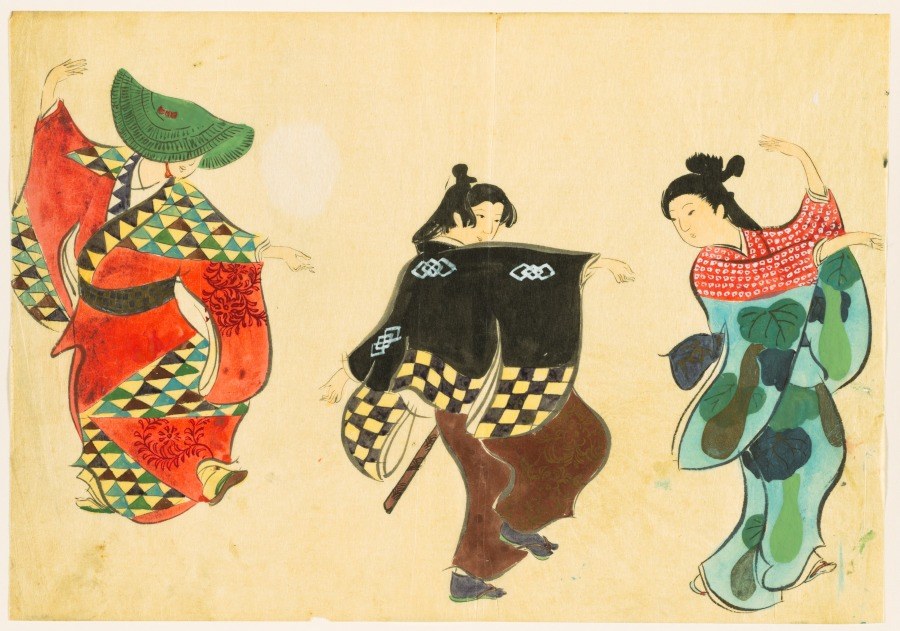
Three figures in elaborate dress are arranged across the composition, each rendered in a distinctive linear style against a cream background. At left, a dancer in brilliant red robes decorated with geometric patterns wears a large green hat and holds a fan; the figure's posture suggests motion, with limbs extended dynamically. In the center, a second dancer dressed in black with yellow-and-white checked lower garments and a patterned upper robe moves with similar energy, arms raised. At right, a third figure in turquoise-blue robes with green leaf or petal motifs wears her hair in an elaborate topknot and also holds what appears to be a fan or similar object. All three figures are depicted in profile or three-quarter view, with elongated limbs and stylized features characteristic of East Asian woodblock-print conventions. The composition has no setting beyond the flat background; focus falls entirely on the dancers and their costume.
The dancing
Each of the three figures is rendered with high vertical extension and slightly exaggerated proportions. The bodies are in motion but frozen mid-gesture: the dancer on the left leans forward with arms outstretched, the center figure has arms raised and bent at the elbows in an open frame, and the right-hand dancer reaches upward and to the side. The feet are small and delicate; weight appears distributed lightly, with no grounded stance. All three wear elaborate robes and headpieces that occupy as much visual space as the bodies themselves, and the drapery of the cloth is rendered with strong linear patterning and color blocking rather than naturalistic folds.
The dance depicted
This image appears to depict Japanese odori (folk or social dance), consistent with the title 'Flowers of a Hundred Worlds Momoyogusa Dancing Odori.' Odori encompasses a broad category of Japanese social and performance dances, often associated with festival, celebration, and theatrical contexts. The three-figure composition, the raised and extended arm gestures, and the celebratory costume suggest a festive or theatrical occasion rather than court dance. The figures move independently but in visual concert; there is no partnering hold or formation visible. The costumes and styling suggest this may document or represent a specific recognized repertory, though without additional context the precise style of odori cannot be determined from the image alone.
How it was made
This is a colored woodblock print, a format evident from the bold outlines, flat color fields, and the registration of multiple color layers typical of Japanese ukiyo-e production. The print shows characteristics of meticulous hand-finishing: the geometric patterns on the robes are rendered with precision, and the decorative details of the fans and headdresses are carefully articulated. The medium allowed for wide distribution; this format was produced in multiples and circulated as a popular art form rather than a unique work. The technique prioritizes silhouette, pattern, and decorative effect over spatial illusionism, focusing the viewer's attention on costume and gesture.
About this work
This colored woodblock print depicts three dancers in elaborate Japanese festival or theatrical dress, posed in dynamic gestures that suggest the repertory of odori (traditional Japanese social dance). The work appears to be from a series or publication titled 'Momoyogusa' (Flowers of a Hundred Worlds), a format that collected images of contemporary life, costume, and performance. The print demonstrates both documentary interest—in recording the specifics of costume and adornment—and aesthetic pleasure in pattern, color, and the linear vocabulary of woodblock design. As a popular-format image of performance, it offers evidence of how Japanese dance was visualized and circulated to a broad audience, and what visual codes signaled 'dance' to contemporary viewers.
How to look at it
Attend to the costume and its decoration as the primary vehicle of meaning: the prints, colors, and construction of the robes communicate wealth, festivity, and cultural specificity as much as the bodies do. Notice how the artist has arranged the three figures—not in a line or formation, but staggered across the space—to create a sense of individual movement within a shared frame. The raised arms and forward-leaning postures suggest a moment of exuberant motion, yet each figure is rendered with careful attention to linear outline and pattern, prioritizing the visual impact of shape and decoration over anatomical exactness or spatial logic.
The artist
The artist is not recorded. The work is from a publication or series (Momoyogusa), a format that typically involved collaborative production between designer, carver, and printer. The style and execution are consistent with mid- to late-period Japanese woodblock print practice, though dating and attribution would require further research.
The period
Japanese odori evolved as a broad social and festival dance practice, encompassing regional and theatrical variations. By the period of this print's creation, such dances were documented in visual media as markers of contemporary Japanese life and entertainment. Ukiyo-e woodblock prints served as a primary medium for recording and disseminating images of performance, costume, and social practice to a literate and visually engaged urban audience. The format of 'Momoyogusa' and similar compilations reflected growing interest in cataloguing and displaying contemporary Japanese culture.
Where it lives
The work is part of the Cleveland Museum of Art's collection of dance-related art. It is catalogued as a Japanese woodblock print with the title 'Flowers of a Hundred Worlds Momoyogusa Dancing Odori,' though the artist, precise date, and medium specifications are not currently recorded in the collection database.
Dance in this work
Questions about this work
What is odori?
Odori is a broad category of Japanese social and festival dance, distinct from more formal court or theatrical dance forms. It encompasses regional variations and has been performed in celebration, theater, and social contexts. The term can apply to specific repertory pieces as well as to generalized social dancing.
What does the Momoyogusa series show?
Momoyogusa (Flowers of a Hundred Worlds) appears to be a compilation or series of woodblock prints documenting aspects of contemporary Japanese life, costume, and performance. Such compilations were popular in the period and served as visual reference collections and entertainment for urban audiences.
Are these three dancers performing together?
The composition suggests they may be part of a coordinated performance or celebratory context, though they are not in a formed group or holding formation. They appear to be moving independently but within a shared moment, which is consistent with social or festival dancing.
Why is so much attention paid to costume?
In Japanese visual culture of this period, costume, pattern, and adornment were primary signifiers of social context, festivity, and cultural identity. The woodblock print medium's strength in rendering bold color and linear pattern made it ideal for documenting and celebrating the visual splendor of Japanese dress.
More dance artwork