49 works in this view — arrow keys or swipe to move between them.
Dance in Art
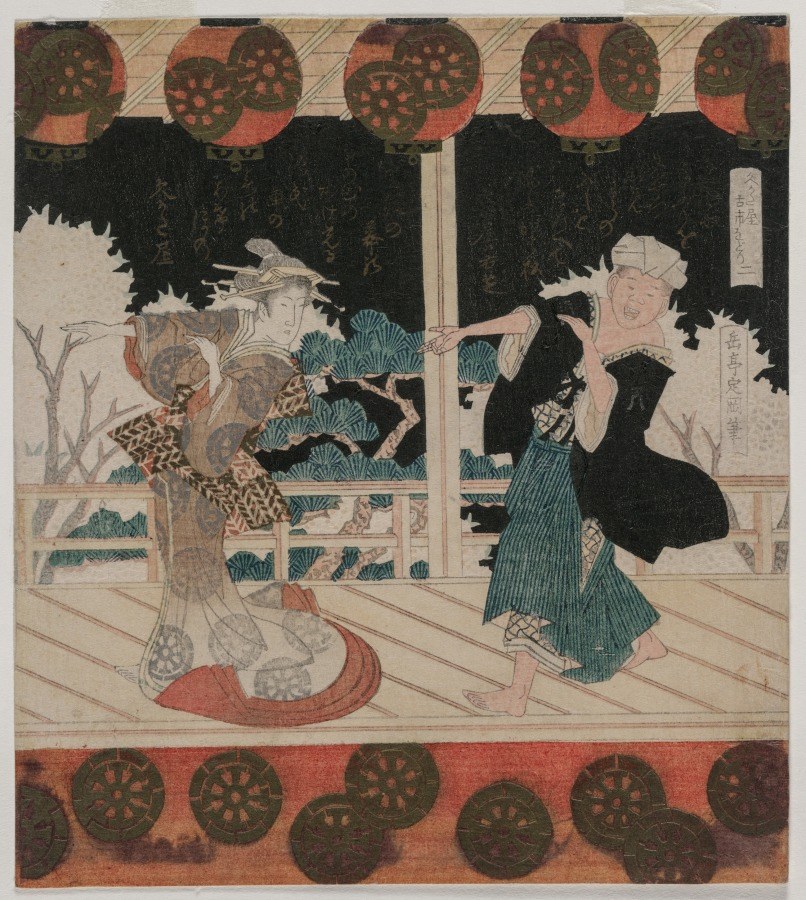
Furuichi Dance at the Hisagataya
Gakutei Harunobu (Japanese, 1786(?)-1868)
- Source:
- Cleveland Museum of Art
- Rights:
- Public domain — free to use, share and adapt.
- Recorded as:
- CC0 (Public Domain)
This is documentary evidence of how a specific Japanese theatrical tradition looked in performance—not a reconstruction or a description, but a contemporary visual record made to circulate to an urban audience. It shows that 'dance' in this context meant something fundamentally different from Western theatrical dance: a fully costumed, narrative-driven, character-based performance where movement served dramatic expression. For anyone studying the history of global performance, the relationship between costume and movement, or the diversity of what counts as dance, this print is invaluable.
What you are looking at
Two figures in elaborate costume occupy a wooden platform or stage set against a deep black background. The figure on the left wears a richly patterned robe with geometric designs in rust and gold tones, and a tall white headdress; the figure on the right wears a simpler blue-striped robe and a white hat. Both appear to be in motion, their bodies angled toward each other in what seems a playful or theatrical exchange. The setting includes stylized landscape elements—bare branches and what may be architectural details—rendered in muted greens and earth tones. A decorative border of overlapping red circles frames the composition at top and bottom, suggestive of theatrical or festival ornamentation. The wood-grain floor is rendered in fine parallel lines, emphasizing the stage or performance space.
The dancing
Both figures are captured mid-gesture with arms extended and bodies in dynamic postures that suggest animation and humor rather than formal dance technique. The left figure leans forward with arms outstretched; the right figure mirrors this with an open, responsive stance. Neither figure displays the turned-out positions, lifted frame, or balletic alignment that would indicate Western theatrical dance training. Their weight appears grounded and their movement suggests folk or vernacular performance, with emphasis on character and expression over technical precision. The relative scale and positioning suggest these are the primary performers in a comedic or narrative exchange.
The dance depicted
This appears to be a Japanese theatrical performance, most likely a scene from Noh, Kyōgen, or a related traditional form, based on the costume style, the elaborate headdress, the architectural stage setting, and the catalogue reference to 'Furuichi Dance' at the Hisagataya (a known performance venue). The title 'Furuichi' refers to a specific dance or dance-drama known in Japanese performance tradition. The figures' loose, expressive movement and the emphasis on character and interaction over virtuosity suggest Kyōgen (comic interlude theater) or a similar vernacular dramatic form rather than the more formalized Noh. The presence of two figures in close theatrical relationship, their costume contrasts, and the comic potential of their gestures all support a narrative or comedic dramatic performance rather than abstract or purely decorative dance.
How it was made
This is a woodblock print (ukiyo-e), recognizable from the bold outlines, flat color planes, the layered composition with distinct background and foreground, and the decorative border treatment typical of the medium. The technique allowed for mass reproduction and made theatrical scenes accessible to a broad urban audience in Japan. The careful registration of multiple wood blocks—evidenced by the precise alignment of the patterned costume details and the sharp edges of the colored areas—indicates skilled carving and printing. This precision and the deliberate composition suggest this was a documented performance of some renown, created to commemorate or publicize a specific theatrical event.
About this work
This woodblock print documents a scene from a traditional Japanese theatrical performance, likely from the Edo or early Meiji period, capturing two performers in an animated exchange on a formal stage. The work preserves a moment of comic or dramatic interaction in a form of theater that valued character, costume, and narrative gesture over the abstract movement language of Western concert dance. The print format itself speaks to the popularity and cultural currency of such performances in urban Japan, and the careful attention to costume detail and theatrical composition suggests this was a notable or memorable production. For historians of Japanese theater and for dancers interested in how non-Western performance traditions prioritize expression and narrative, this image is a direct historical record of stage practice and aesthetic intention.
How to look at it
Attend to the exact moment the artist chose: not a static pose but a moment of interaction and movement, with both figures in the middle of a gesture or turn. The artist has frozen an instant of comic or dramatic exchange, with the figures' bodies angled toward each other and their arms in active positions. Notice how the costume—the elaborate patterned robe, the distinctive headdress, the color contrasts—is itself part of the performance language; the visual spectacle was as important as any footwork. The decorative border and the formal framing of the stage space indicate this was a documented performance of significance, not an improvised scene.
The period
Japanese woodblock printing (ukiyo-e) flourished from the 17th century onward, and theatrical scenes—particularly Noh, Kyōgen, and Kabuki—were among the most popular subjects. Hisagataya was a known performance venue, and the documentation of specific performances through prints suggests these were celebrated events. The print tradition itself was intertwined with theater culture: actors and performances were celebrities, and prints functioned as both souvenirs and advertisements. The style and costume detail here align with Edo-period theatrical practices, when such performances were central to urban entertainment and when the print trade had developed the technical sophistication to capture elaborate costume and setting.
Where it lives
The work is held in the Cleveland Museum of Art and is documented in their collection database. It is a Japanese woodblock print, likely from the Edo or Meiji period, and represents the museum's holdings in Japanese theatrical documentation and ukiyo-e.
Dance in this work
Questions about this work
What is the Furuichi Dance?
The Furuichi is a specific traditional Japanese dance or dance-drama, known from historical performance records. The title in this print indicates this is a documented performance of that work, likely at the Hisagataya venue. Without more documentation, the exact form and history of the Furuichi cannot be established from the print alone, but the theatrical staging and costume suggest it was a known piece in the urban performance repertoire.
Is this Kabuki, Noh, or Kyōgen?
The style of dress, the stage setting, the emphasis on character and comic interaction, and the apparent narrative content all suggest this is more likely Kyōgen (comic theater) or a related vernacular form rather than the more formalized and austere Noh tradition. The bright colors and animated gestures also support a comic or popular theatrical rather than ritual performance context.
How do I know this is a woodblock print and not a drawing or painting?
The flat color planes with no gradient or shading, the bold black outlines, the precise registration of multiple colors, and the decorative border framing are all characteristic of woodblock printing technique. The method allowed the image to be reproduced multiple times, which is why such prints survive and why they were created—to reach a broad urban audience interested in theater.
More dance artwork