49 works in this view — arrow keys or swipe to move between them.
Dance in Art
Grotesque Dancers Performing
Unknown artist
- Source:
- Cleveland Museum of Art
- Rights:
- Public domain — free to use, share and adapt.
- Recorded as:
- CC0 (Public Domain)
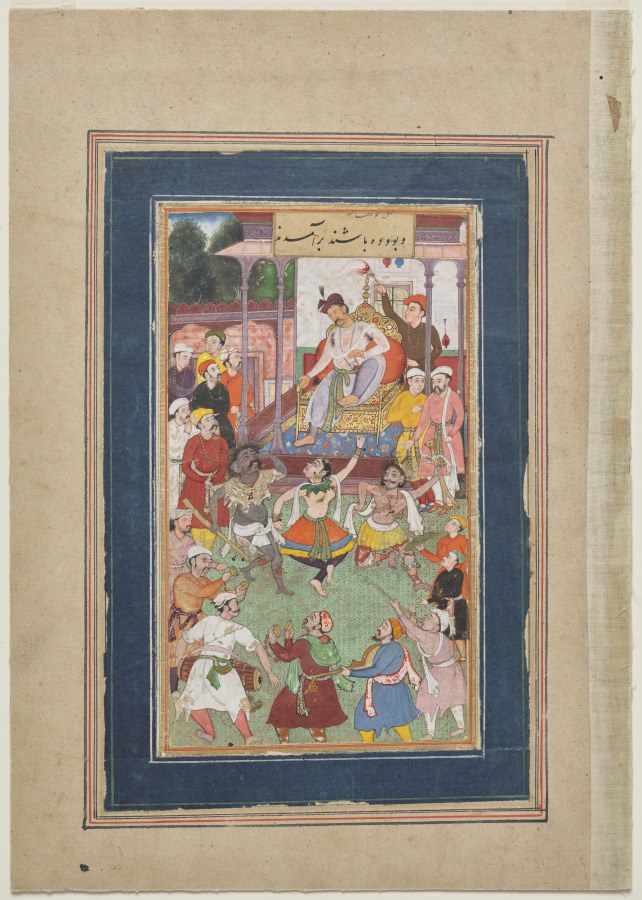
This miniature documents a form of court entertainment that rarely survives in historical record: the comic, acrobatic, or "grotesque" performers whose work existed alongside and sometimes in contrast to classical court dance traditions. The image shows that Mughal courts valued a spectrum of movement and performance, not only refined classical dance but also exaggerated, funny, and physically virtuosic entertainment. For dancers and historians, it complicates the common assumption that historical court dance was always formal and elevated.
What you are looking at
This is a densely populated court or palace scene rendered in Persian or Mughal miniature style. A large gathering of figures in jewel-toned dress occupies a multi-level architectural space with arched colonnades, latticed screens, and gardens visible in the background. The composition divides into zones: an elevated dais or platform at upper right where seated figures of apparent authority preside; a central courtyard where numerous figures stand, gesture, and move; and foreground figures in the lower register who engage with the action. The figures wear elaborate robes, turbans, and headpieces in reds, blues, golds, and greens, many adorned with jewels. The artist has used gold leaf for highlights and employed rich mineral pigments typical of Indo-Persian court art. The scene is alive with incident: some figures appear to dance or posture theatrically in the central space, while others watch, converse, or gesture emphatically from the periphery. The title "Grotesque Dancers" suggests the artist intended the viewer to read this as a performance or entertainment scene, though the exact nature of the movement remains ambiguous without clearer inscription.
The dancing
Multiple figures occupy the center ground in dynamic poses suggesting performance or entertainment. Several bodies are turned in profile or three-quarter view with raised arms, extended limbs, and postures suggesting movement or exertion—particularly visible are figures with one or both arms raised in flourishing gestures. A woman in the absolute center appears to be in a pronounced turn or leap, her body twisted and limbs deployed. The figures wear voluminous robes that would conceal detailed footwork, and their spacing and arrangement do not suggest the coupled formations of European court dance; instead, they appear to be dancing individually or in loose informal groupings within a watching crowd. The watching figures on the dais and perimeter are rendered with more static, seated, or standing poses, establishing a clear performer-audience dynamic.
The dance depicted
The title labels these as "grotesque dancers," a term that in 16th–18th-century European art criticism often denoted exaggerated, comic, or acrobatic movement—but this work is plainly not European. The costume, architectural setting, and painting style identify this as Indo-Persian court art, likely from a Mughal manuscript or album. In such contexts, dancing and acrobatic performance were regular court entertainments, often including professional performers of lower social status. The postures and raised-arm gestures are consistent with classical Indian dance vocabularies (particularly the upraised mudras and arm positions of Kathak or Bharatanatyam), but the term "grotesque" and the loose informal arrangement suggest these may be comic or acrobatic performers rather than classical court dancers—possibly depicting the kind of entertainment labeled as "baize" (buffoonery) or acrobatic performance in Mughal court records. The scene likely documents a specific court entertainment event rather than identifying a named formal dance style.
How it was made
This is a miniature painting on paper executed in opaque watercolor (gouache) with extensive use of gold leaf for ornament and highlighting—the standard medium for Indo-Persian manuscript illumination and Mughal court art albums. The technique allowed for minute figural detail, rich color saturation, and the layering of gold that catches light. Miniatures of this scale and finish were produced for court patrons or wealthy collectors and would have circulated within elite circles as bound manuscript folios or loose album pages (muraqqa). The small format and intimate detail work suggests this was meant for close viewing and study rather than public display, placing it within a tradition of court documentation and entertainment.
About this work
This is a Mughal or Indo-Persian court miniature depicting a scene of theatrical performance or entertainment, with multiple figures posed in exaggerated or acrobatic movement within a palace setting filled with courtiers and witnesses. The work is titled "Grotesque Dancers," suggesting the artist or cataloguer classified these as comic or non-classical performers. The painting's style, costume, and architectural detail place it firmly within the Indo-Persian miniature tradition, likely from the 16th–18th century. The work offers rare documentary evidence of court entertainment practices in Mughal India—showing not the formal dances of trained classical performers but the looser, more theatrical comedy and acrobatics that also entertained the court. It belongs in a dance history collection because it captures a specific moment in the material and social history of South Asian performance.
How to look at it
Attend to the contrast between the central figures and the architectural frame. The painter has positioned the dancers in the open courtyard space, clearly illuminated and visible, while the court spectators—seated on the dais or standing in colonnades—occupy positions of social authority. Notice the variety of poses: no two dancers repeat the same gesture, suggesting the artist was documenting the unpredictability or spontaneity of performance. The raised arms, twisted torsos, and forward-tilting postures convey energy and exertion rather than the controlled symmetry of classical court dance. Look also at the clothing: the voluminous robes and turbans constrain and define the silhouette, meaning the painter relied on torso angle, arm position, and head tilt to convey movement.
The period
Mughal courts of the 16th–18th centuries maintained elaborate systems of courtly entertainment, including professional dancers, musicians, acrobats, and comedians. Court chronicles and literary sources describe multiple categories of performer: classical dancers trained in sophisticated traditions, but also entertainers whose work was deliberately comic, crude, or physically extreme. Such performers often came from hereditary performance castes or communities and occupied a liminal social position—valued for their skills but ranked below courtiers of noble birth. European travellers to Mughal courts (such as the Jesuits or later European merchants) frequently remarked on the variety and exuberance of court entertainment. The title "Grotesque Dancers" may reflect both an Indo-Persian vocabulary of entertainment categories and a European (or Europeanized Indian) observer's judgment about the performers' style.
Where it lives
The work is held in the Cleveland Museum of Art and entered the record with minimal documentation. The source designation (cma) confirms the Cleveland attribution.
Dance in this work
Questions about this work
Is this Indian, Persian, or Ottoman?
The painting style, architecture, and figure types point to Indo-Persian court art, most likely Mughal (Indian). The latticed screens, colonnaded pavilions, and the particular manner of rendering faces and dress are consistent with Mughal miniature traditions. Without access to the original object or a more detailed provenance, the precise regional origin cannot be certain, but the idiom is Indo-Persian rather than Turkish or strictly Persian.
What is a 'grotesque dancer' in this context?
The term likely denotes exaggerated, comic, or acrobatic performance—entertainment meant to amuse through physical excess or humor, as opposed to the refined, disciplined movement of classical court dancers. In Mughal records, such performers existed in a recognized category of court entertainment alongside musicians and formally trained dancers.
How does this compare to classical Indian dance?
This scene shows informal, comic performance rather than Bharatanatyam, Kathak, or other classical traditions. The loose grouping, the emphasis on exaggerated gesture, and the title all suggest performers working outside classical codified systems—more akin to circus or comedy performance. Classical dances were also performed in courts, but this work documents a different, looser, and more spontaneous entertainment mode.
Who performed these dances?
Professional entertainers, likely from hereditary performance communities or castes. Such performers were valued for their skills but occupied lower social rank than courtiers. The scene may depict performers summoned for a specific court occasion or festival celebration.
More dance artwork