49 works in this view — arrow keys or swipe to move between them.
Dance in Art
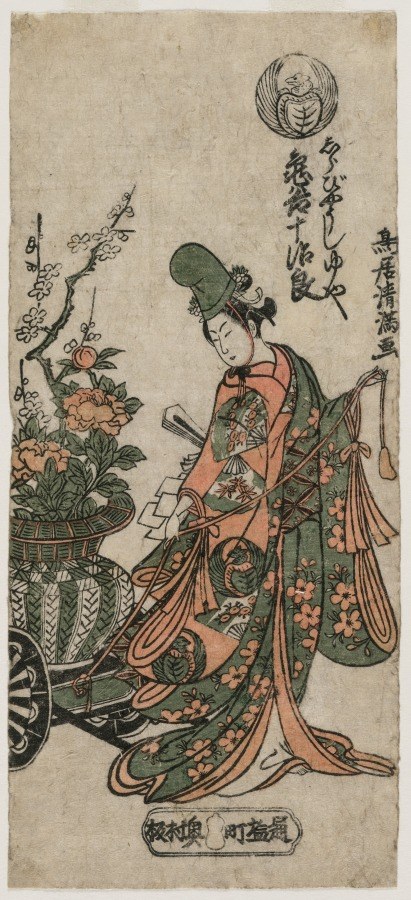
Kametani Jujiro as the Shirabyoshi Dancer Yuya
Torii Kiyomitsu (Japanese, 1735–1785)
- Source:
- Cleveland Museum of Art
- Rights:
- Public domain — free to use, share and adapt.
- Recorded as:
- CC0 (Public Domain)
Shirabyōshi performance is largely lost to us, surviving mainly through literary references, passing mentions in no drama, and images like this one. This print preserves not a notation of steps but the aesthetic and physical reality of how the dance was understood and appreciated in its own time—as an art of presence, decoration, and the cultivation of a particular kind of presence in space. For dance historians, it is evidence of a performance tradition outside the mainstream European ballet and modern dance canons, one that valued subtlety and control over spectacle.
What you are looking at
A standing figure in elaborate Japanese dress occupies the center of the composition, posed in a moment of graceful repose or transition. The figure wears a richly patterned kosode (kimono) in coral-red silk with green panels, decorated throughout with embroidered or painted floral motifs—peonies, chrysanthemums, and blossoming branches rendered in gold and colored pigment. Over this, a translucent outer garment (possibly an uchikake or similar draped layer) flows downward in sweeping curves, its green fabric adorned with scattered floral patterns and gold thread. A tall green hat (likely a black-lacquered headdress of a formal type) crowns the head. The figure's posture is one of controlled elegance: the torso is slightly forward and to the side, one leg appears to bear weight while the other extends or shifts, and the arms are positioned to balance the fall of the heavy silk. To the left of the composition, a ceramic vessel (a Japanese flower vase or incense container) overflows with blooming plum or cherry branches, rendered in pale pink with green leaves—a classical symbol of spring and refinement. The background is plain and warm (likely applied gold or mica), throwing the figure and still life into sharp focus. Japanese characters (possibly a signature or dedicatory inscription) appear at top and bottom of the page.
The dancing
A single figure stands in a contrapposto-like pose, with the weight shifted onto one leg while the other remains free to move. The arms hang naturally but with clear control—the upper arms are held slightly away from the torso, and the hands appear to be positioned in a way that suggests either a moment of pause or the beginning or end of a movement. The spine is gently curved, the head upright but tilted slightly as if attending to something. The heavy layered costume—multiple garments of stiff, decorated silk—constrains movement significantly; the figure's ability to move from the hips and knees would be limited, and any gesture would be achieved through the arms, the tilt of the torso, and the precise shifting of weight from foot to foot. There is no visible footwork in the Western dance sense; instead, the dance likely unfolds through upper-body carriage, hand positions, and the rhythmic swaying or turning of the entire weighted frame.
The dance depicted
This is almost certainly a Shirabyōshi (白拍子) dancer, a female performance artist of medieval and early modern Japan. The catalogue title confirms the subject as 'the Shirabyoshi Dancer Yuya,' suggesting this is a theatrical print documenting a specific performer or character role. Shirabyōshi were known for wearing tall black hats, male-coded hunting costumes (or in later versions, elaborate kimono with masculine elements), and for performing a controlled, stately dance with deeply spiritual and erotic undertones. The pose here—standing upright, poised, one foot forward—captures the moment of transition or contemplation that was characteristic of the form: Shirabyōshi performance alternated between passages of stillness and passages of subtle, fluid movement, often accompanied by song or shamisen music. The flower arrangement beside the figure may reference both the seasonal setting of a particular performance and the aesthetic refinement associated with the art. Without seeing the full costume (notably the lower body), it is difficult to confirm whether this figure is wearing the traditional male hunting attire (sashinuki trousers) associated with classical Shirabyōshi, but the overall composition and the inscription strongly support that identification.
How it was made
This is a woodblock print (most likely a color woodblock, or nishiki-e), a medium that dominated Japanese theatrical and popular imagery from the 17th century onward. The technique involved carving separate blocks for each color—here we can see the warm gold background, the coral-red and green pigments of the kimono, the flesh tones, and the black outlines and text—and printing them in sequence on dampened paper. The fine detail visible in the floral embroidery patterns, the delicate lines of the face and hands, and the precise registration of the color blocks demonstrate a high level of technical skill and expense. Such prints were designed for circulation among theater-goers, patrons of the arts, and collectors; they served as both souvenirs of performances and as objects of aesthetic appreciation in their own right. The presence of a signature cartouche (possibly the artist's seal and name) suggests this was a commercially produced, attributed work, likely part of a series of actor or dancer portraits.
About this work
This is a Japanese woodblock print depicting a Shirabyōshi dancer, almost certainly from the Edo or early Meiji period. Shirabyōshi were a unique category of female performers in Japan—dancers, singers, and entertainers who occupied a liminal social space and were celebrated for a distinctive, spiritually charged aesthetic that blended refinement, eroticism, and androgynous style. The print captures the figure in a moment of poised stillness, the full weight of the elaborate kosode evident in the way it constrains the body. The artist understood the dance not as virtuosic footwork or acrobatic display, but as a matter of carriage, presence, and the subtle communication of emotion through the positioning of the spine, the set of the shoulders, and the inclination of the head. The floral setting references both the seasonal context of performance and the broader Japanese aesthetic principle that linked dance, poetry, and the observation of nature.
This work belongs in a gallery of dance in art precisely because it documents a form of dance that is not primarily about movement—or rather, one in which stillness, poise, and the presentation of the dressed body are themselves the dance. For a viewer accustomed to Western theatrical traditions, the restraint and control visible here may initially read as 'undanced'—as mere costume portraiture. But for anyone familiar with Japanese performance traditions, this pose contains the whole language of Shirabyōshi: the weight-shift that enables the slow turning, the arm positions that frame the face and torso, the relationship between the performer's body and the space around it.
How to look at it
Attend first to the posture and the weight-bearing leg. Where is the pressure? Where is the freedom? Notice how the heavy costume—far heavier than any Western ballet tutu—shapes what the body can do and where the expressiveness must come from. The arms are the key: they are not positioned in any Western balletic frame, but they are placed with absolute intentionality. Look at the angle of the head, the slight turn of the torso, the way the outer fabric is arranged and draped. In Shirabyōshi, the dance is often a matter of microshifts—the turning of the hips by a few degrees, the raising of the arms in a particular sequence, the moment when the weight moves from one foot to the other. This print freezes one such moment, and the artist has chosen it carefully: not the height of a gesture, but a moment of poise or transition where the viewer can feel the control beneath the stillness.
The artist
The artist is not recorded in the catalogue. However, the quality of the carving, the sophisticated color palette, and the presence of a signature cartouche indicate a named, probably commercial artist working in the Edo-period (or later) woodblock print tradition. The style and subject matter suggest this was created by an artist specializing in theatrical and performer portraiture, a thriving category of printmaking in Japan from the 17th century onward. Without additional information, we cannot narrow the attribution further.
The period
Shirabyōshi dancers are documented from the 12th century onward in Japanese literary and historical sources, but the tradition reached its height during the Edo period (1603–1868), when they were celebrated performers in urban entertainment quarters and at the courts of the daimyo. By the time this print was made—and based on the style, likely the 18th or 19th century—the form was already nostalgic, preserved in memory and in artistic representation even as live Shirabyōshi performance was becoming rarer. The woodblock print industry itself was at its peak during this period, with actors, dancers, and courtesans depicted in increasingly refined and colorful compositions. This print sits at the intersection of two traditions: the venerable Shirabyōshi form, which reached back to the medieval court, and the commercial print culture of the urban Edo period, which made images of performers accessible to a broad audience.
Where it lives
The work is held in the Cleveland Museum of Art and is part of the museum's collection of dance-related art. It is catalogued as a source work (cma) from the dance gallery holdings. No accession number, date of acquisition, or further provenance information is recorded in the available catalogue data.
Dance in this work
Questions about this work
What is a Shirabyōshi dancer?
Shirabyōshi (白拍子, literally 'white rhythm') were female entertainers and performers in Japan, documented from the 12th century through the Edo period. They were known for wearing tall black hats, for singing and dancing, and for occupying an ambiguous social status—celebrated as artists but also often associated with courtesanship. They performed at court, in temples, and in urban entertainment districts. The form is largely lost today, surviving mainly in literary texts, no drama references, and images like this print.
Why doesn't the dancer look like she's dancing?
Shirabyōshi performance emphasizes control, presence, and subtle movement over the kind of virtuosic footwork or high extension visible in Western ballet. The dance unfolds through shifts of weight, the positioning of the arms and hands, the angle of the torso, and the inclination of the head. This print captures a moment of poise or transition—likely the end of a phrase or the beginning of a turn. To a Western eye accustomed to dynamic, athletic movement, this stillness can read as 'not dancing,' but it is in fact the core of the aesthetic.
What is the flower arrangement for?
The flowering branches on the left serve multiple purposes. They may reference the season of the performance or the poetic mood associated with a particular role or piece. They also situate the image within the Japanese aesthetic principle of relating human beauty to natural beauty—the dancer is presented alongside blooming flowers as complementary objects of refinement and contemplation. The arrangement may also have been part of the stage setting itself.
How do we know this is a theatrical print and not just a portrait?
The title inscribed on the print ('Kametani Jujiro as the Shirabyoshi Dancer Yuya') identifies this as a theatrical portrait—a depiction of a specific performer in a specific role or at a moment in a performance. The costume, the pose, and the stage-like composition confirm that we are looking at a moment of performance, not a social portrait. Such prints were commercial products, created for sale to theater-goers and collectors.
More dance artwork