49 works in this view — arrow keys or swipe to move between them.
Dance in Art
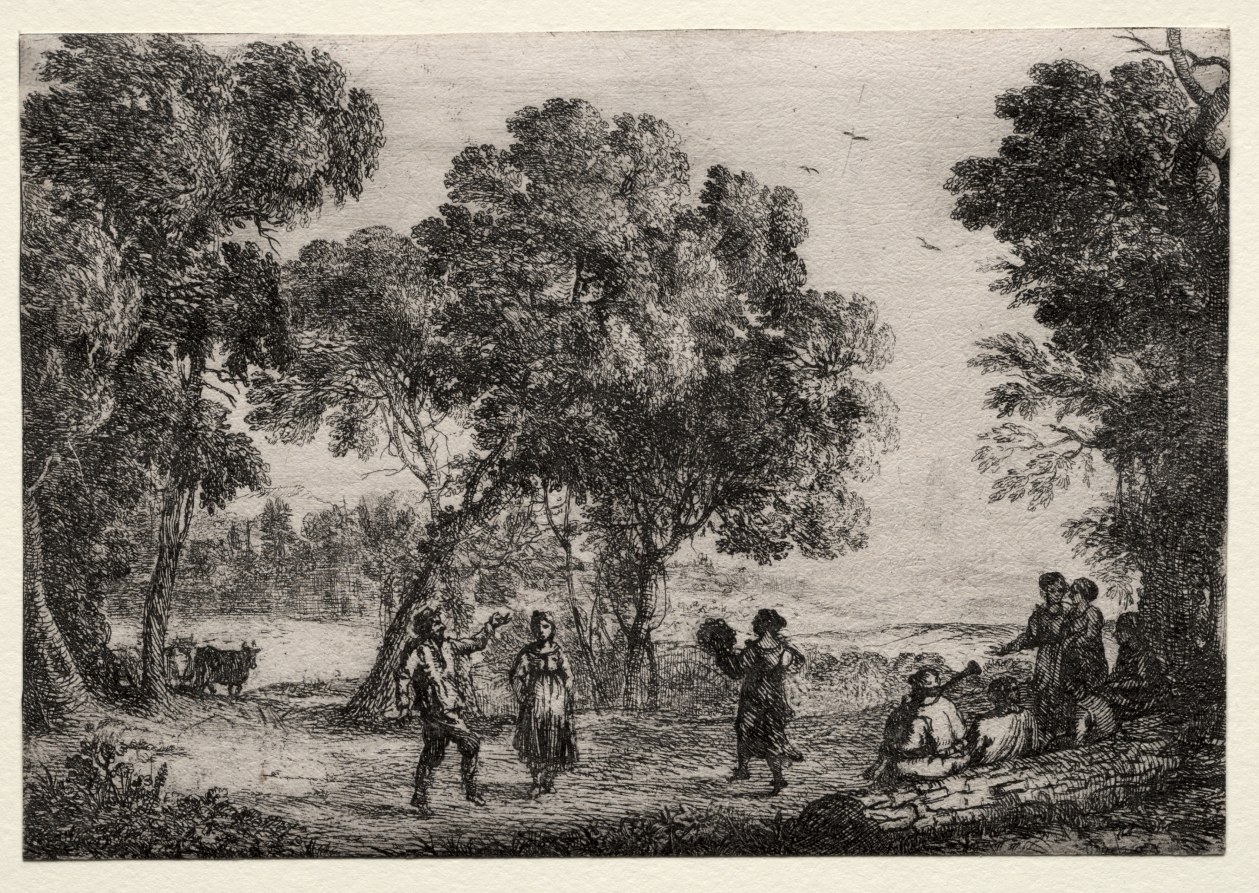
Landscape with a Country Dance Small Plate
Claude Lorrain (French, 1604–1682)
- Source:
- Cleveland Museum of Art
- Rights:
- Public domain — free to use, share and adapt.
- Recorded as:
- CC0 (Public Domain)
This print documents the cultural authority of dance in everyday life—not as a courtly spectacle but as the ordinary accompaniment to rural gathering and celebration. For historians of dance and social life, it is evidence of how the practices and values of courtly dancing trickled down and were adapted, simplified, and made local. The image also exemplifies the role of prints in spreading visual knowledge of dance and festive practice across Europe.
What you are looking at
A wooded landscape opens onto a clearing where a country gathering unfolds. The composition is deep and atmospheric, with massive trees framing both sides—their trunks rendered in bold parallel lines and their foliage creating a dark canopy overhead. In the middle distance, figures in 17th- or 18th-century dress move through a sun-lit meadow. The group clusters loosely: some stand in conversation, others actively dance. A few figures on the right sit or recline, watching. The light is dappled and soft; birds wheel in the pale sky. The print has the quality of an idealized pastoral—a moment of rural leisure and courtship, though the precise narrative is left open. The engraver has worked in fine parallel hatching to create depth and shadow, giving the scene an intimate, copper-plate delicacy despite its modest size.
The dancing
The dancers move in loose, informal pairings and small groups rather than in rigid formation. The bodies suggest sprightly, upright carriage typical of social dancing of the period; one or two figures appear to be in a simple closed or near-closed embrace, while others hold open positions with arms raised or extended. The dress—long skirts, breeches, hats—belongs to the 17th or 18th century. No pointe shoes or theatrical costume; these are country people in their own clothes. The scale and grouping suggest a modest country gathering rather than a formal court ball.
The dance depicted
This is a country or village dance, the kind that would have been danced at rural festivities, harvest celebrations, or fetes across northern Europe. The formal title 'Landscape with a Country Dance' confirms the subject. The small plate format and engraving technique suggest the work was circulated as a print, likely as part of a series of genre scenes or pastoral subjects. The specific style—whether a minuet, bourée, contredanse, or local variant—cannot be determined from the print alone, though the relaxed spacing and outdoor setting distinguish it sharply from court dance. The emphasis is on the social and recreational character of the dance rather than its formal steps.
How it was made
This is an engraving on copper, identifiable from the fine parallel hatching, precise line work, and the small rectangular format typical of cabinet prints. Engraving was the dominant medium for circulating imagery in the 17th and 18th centuries, particularly for genre scenes, landscapes, and illustrations. The technique allowed the artist to achieve delicate tonal gradations and fine detail—note the texture of foliage, the play of light, the differentiation of fabrics in dress. Such prints were relatively inexpensive to produce and distribute, making them accessible to educated and leisured viewers. The 'small plate' designation in the title indicates this is a modest work, likely part of a portfolio or bound collection of similar scenes.
About this work
This is a small engraved print depicting a rural or village dance set in an idealized wooded landscape. The work belongs to the long tradition of pastoral and genre imagery in European printmaking—a tradition that often used the dance as a sign of festive community life, courtship, and the pleasures of the countryside. The print is undated and unattributed in the catalogue record, but its style, subject, and technique place it solidly in the 17th or 18th century, when such scenes were popular among collectors of prints and drawings.
The work matters to dance history not because it documents a specific historical dance practice, but because it captures a crucial moment in the social life of dance: the shift of recreational dancing away from the court and into the village, the fields, and the tavern. It testifies to the circulation of dance imagery across all social strata and its use as a vehicle for ideas about nature, leisure, and collective joy.
How to look at it
Attend to the composition: the artist has chosen to show the dance not as a moment of maximum virtuosity or formality, but as one moment in an extended social scene. Notice how the figures are distributed—some actively moving, others watching, some paired, some alone. Look at the dress and the setting: these are ordinary people in ordinary clothes, not courtiers in silks and jewels. The engraving technique itself—the fine parallel lines, the subtle gradations of light and shade—creates an atmosphere of intimacy and immediacy that differs sharply from the more ceremonial or allegorical treatment of dance in other prints of the period. The landscape, too, is significant: the dance is embedded in nature, not separated from it or elevated above it.
The period
The engraving belongs to a long European tradition of pastoral and genre printmaking that flourished from the 16th through 18th centuries. During this period, the village dance and the country feast became favored subjects for artists working in all media—from Bruegel and his followers in the 16th century to the Rococo printmakers of the 18th. These scenes served multiple functions: they recorded (or idealized) rural social life, they offered educated urban viewers a fantasy of pastoral innocence and pleasure, and they distributed knowledge of dance and festive practice to audiences far beyond the courts where the most prestigious dances were performed. By the 18th century, the country dance had also become fashionable among the aristocracy and gentry, blurring the line between 'high' and 'low' dance. This print sits at that cultural intersection.
Where it lives
The print is held in the Cleveland Museum of Art. It is catalogued as a work from an unknown era by an unknown artist, suggesting it arrived at the museum either as part of a larger collection or as a single acquisition without full documentation of its origins or previous ownership.
Dance in this work
Questions about this work
What kind of dance is this?
The print does not depict a named dance in a formally choreographed sense. Rather, it shows a country or village dance—the kind of social, recreational dancing that would have occurred at rural festivals, harvest celebrations, or village fetes. The specific regional variants and steps are not identifiable from the image alone. The loose, upright postures and informal groupings suggest dances in the English country dance or contredanse tradition, but without more documentation, the exact style cannot be determined.
When was this made?
The catalogue record does not provide a date, but the style, technique, and dress place the engraving in the 17th or 18th century. The costume—the cut of breeches and skirts, the style of hats—and the engraving technique (which was the primary medium for distributing imagery in that period) both support this attribution. A specialist in European prints or costume history could likely narrow the date considerably.
Why is a dance scene in a landscape?
The title itself—'Landscape with a Country Dance'—indicates that the landscape is the primary subject and the dance is an element within it. This was a common convention in pastoral and genre prints of the period. The outdoor setting, the trees, the natural light, and the scattered grouping of figures all contribute to an idealized vision of rural leisure and happiness. For educated viewers of the 17th and 18th centuries, the countryside and the dance were both associated with innocence, pleasure, and freedom from court formality.
Is this an accurate record of how people actually danced?
The print gives a general impression of country dancing—the upright carriage, the loose pairings, the outdoor setting—that is likely plausible. However, genre prints of this period were not documentary. They were idealized fantasies, often made for urban collectors who wanted to imagine rural life. The artist has chosen to emphasize the festive, pleasurable, and harmonious aspects of the scene. For precise information about steps, formations, and music, you would need to consult written dance treatises, choreographies, or other historical sources.
More dance artwork