49 works in this view — arrow keys or swipe to move between them.
Dance in Art
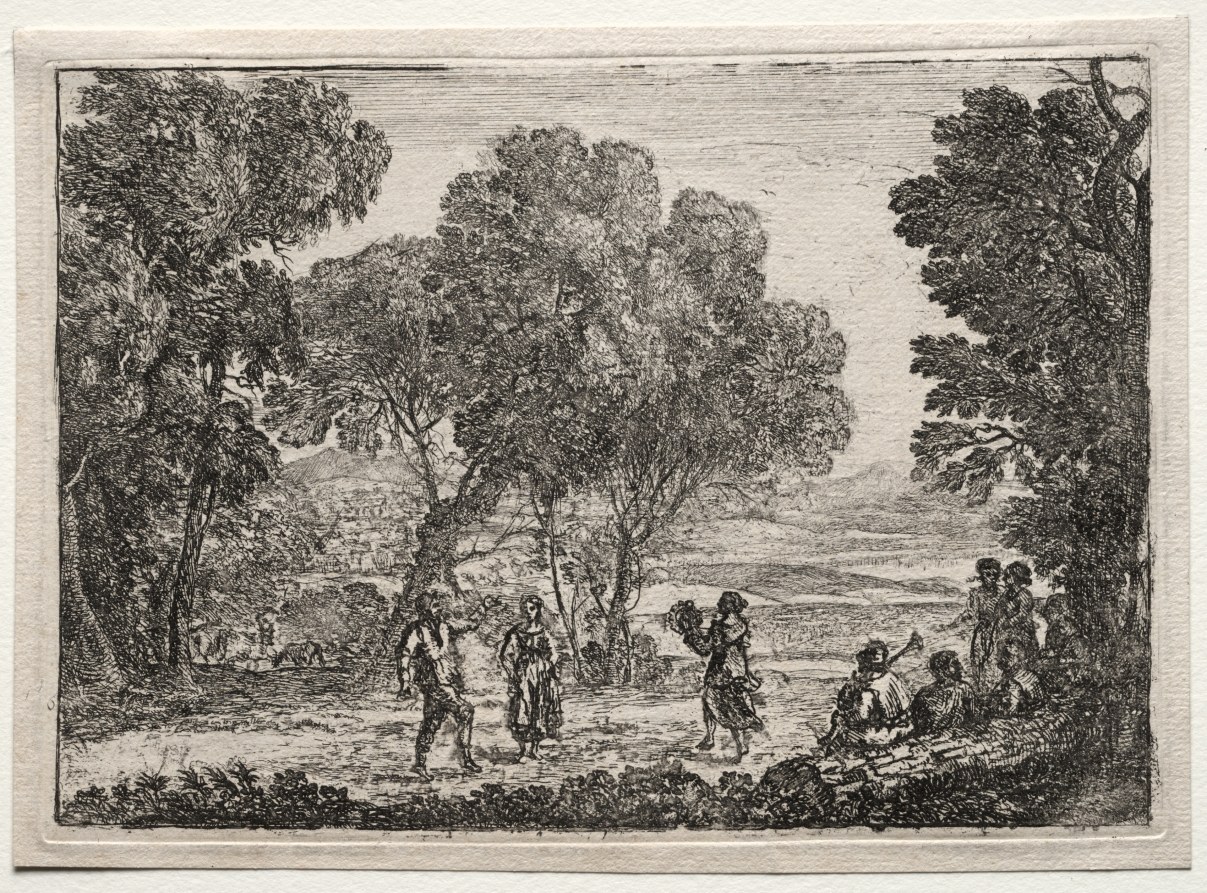
Landscape with a Country Dance Small Plate
Claude Lorrain (French, 1604–1682)
- Source:
- Cleveland Museum of Art
- Rights:
- Public domain — free to use, share and adapt.
- Recorded as:
- CC0 (Public Domain)
This image is one of a relatively sparse body of visual evidence for how ordinary people danced before the modern era. The print shows that country dance was not a formal, choreographed practice but an adaptive, social one—shaped by landscape, music, and occasion rather than written rules. For dance historians, it bridges the gap between written descriptions of country dances (which emphasize formation and figures) and the embodied reality of how these dances were actually performed in their context.
What you are looking at
A woodland clearing opens onto cultivated countryside in this small engraving. The composition is framed by tall, densely foliaged trees on both left and right—their trunks and canopies rendered in intricate cross-hatching that creates a natural proscenium. In the middle distance, a group of figures occupies the cleared ground: some stand in conversation or observation, while others actively dance. The figures are small but their postures are deliberately varied—some bent or turned, others upright. The clothing suggests 17th-century dress, with what appear to be wide breeches and jackets on the men and full skirts on the women. Beyond the dancers, the landscape recedes toward water or low ground with trees along a horizon line. The whole scene is suffused with the delicate parallel lines characteristic of engraving, creating subtle gradations of light across sky, ground, and foliage.
The dancing
The dancers occupy a loose, informal grouping rather than a set formation. Several figures appear to be in motion—legs are bent, bodies are angled in ways that suggest active stepping or turning. The dancers lack the rigid posture and formal hold of court dance; instead they embody a more rustic energy. At least two couples are distinguishable, though the exact number of dancers is difficult to fix precisely given the engraving's scale. The onlookers (perhaps musicians or supervisors) stand apart, creating a social frame around the dancing itself. Arms are relatively free rather than formally constrained, and the general impression is of extemporaneous, country movement rather than choreographed steps.
The dance depicted
This is plainly a country dance, most likely a European peasant or village celebration of the 17th century. The title 'Landscape with a Country Dance' is descriptive and accurate. Country dances of this period were social dances performed by groups or couples, often outdoors at fairs, festivals, or pastoral gatherings, and set to instrumental music played by traveling musicians. The informal grouping, the mixed dress of observers and dancers, and the woodland setting all accord with contemporary prints and descriptions of rural dance. The engraving documents the social function of dance as much as its form—it shows dance as a communal event embedded in landscape and leisure, not a formal courtly display.
How it was made
This is an engraving on paper, identifiable by the fine parallel lines (hatching and cross-hatching) used to build tone and form. Engraving allowed precise, reproducible images and was the primary medium for circulating prints in the 17th century. The small scale ('Small Plate' is in the title) suggests this was part of a series or collection—possibly a study of peasant life, a landscape series, or a set of genre scenes intended for collectors and print dealers. The technical refinement visible in the foliage and atmospheric effects indicates professional skill and a cultivated audience. Engravings of this kind were relatively affordable compared to paintings, making them accessible to middle-class collectors, scholars, and artists seeking reference material.
About this work
This engraving documents a country dance in its social and landscape setting, capturing a moment of rural festivity in what appears to be 17th-century Europe. The work belongs to a broad tradition of genre prints that recorded daily and seasonal life—harvests, fairs, dances, games—as subjects worthy of artistic attention. Dance here is not spectacle performed for court or stage, but a lived social practice: people gathering in a clearing to move together to music, observed by others, framed by nature. The engraving preserves both the movement itself and the meaning it carried—leisure, community, the calendar of rural work and celebration. For historians of dance and social practice, it is evidence of how country people danced and why.
How to look at it
Notice the contrast between the formal framing (the architectural proscenium of trees) and the informal, dispersed action within it. The engraver has chosen not a frozen climactic moment but a scene of ongoing activity—some dancers mid-step, others pausing, onlookers attending. Look at the postures of the active dancers: their bent knees, angled bodies, and free arm positions are the signature of a less codified, more physically free style of dance than courtly forms. The landscape setting is not incidental; it tells you that this dance belongs to an outdoor, seasonal, communal context. The small scale of the figures emphasizes the dance as part of a larger social and natural world.
The period
The 17th century saw the codification of court dance (ballet, minuet, sarabande) under royal patronage and dancing master traditions. Simultaneously, peasant and country dances remained largely undocumented and unregulated—they belonged to oral tradition and local custom. Genre prints of this period reflect growing interest in depicting rural and everyday life as subjects, paralleling the rise of still-life and landscape painting. Artists and engravers recorded peasant dances, markets, harvests, and festivities, often with an ethnographic or moralizing intent. This engraving sits at that intersection: it treats a country dance with the same compositional care and technical skill as a history painting or formal landscape, elevating a humble social practice into a subject worthy of art.
Where it lives
The work is held by the Cleveland Museum of Art. It is catalogued as part of the museum's dance-related art collection. The record does not identify the artist, date, or medium with certainty, though the image plainly shows an engraving from the 17th or early 18th century.
Dance in this work
Questions about this work
Is this a real dance or an invented scene?
Country dances of this type were real social practices documented in multiple sources—written descriptions by dancing masters, contemporary accounts, and other prints and paintings. However, this particular engraving is an artistic composition, not a documentary photograph. The engraver has arranged and composed the scene for aesthetic effect, selecting a woodland setting, a balanced arrangement of figures, and a moment of activity that would make a readable and appealing image. It represents the practice truthfully in its general character (informal, social, outdoors) even if the specific dancers and place are invented or generalized.
What music would have been played for a country dance like this?
Country dances of the 17th century were typically performed to instrumental music—pipe, fiddle, and drum were common. The figures in this print who are not dancing likely include musicians, though they are too small to identify with certainty. Country dance tunes were often simple, repetitive melodies adapted from folk songs, ballads, or popular pieces. The rhythm would have been regular and emphatic enough for dancers to follow without choreographic training.
Why is this work in a gallery of dance in art?
This engraving is valuable evidence for how people danced outside the court and the professional stage. It documents the social context, the physical style, the clothing, and the landscape setting of country dance. For researchers and dancers interested in vernacular movement and the history of social dance, it is a primary source—a visual record of how ordinary people moved together in the past.
How do you know this is a 'country dance' and not some other kind of dance?
The title explicitly names it as a country dance. The image confirms this: the outdoor, rural setting, the informal grouping of mixed company, the lack of formal court dress or court ballroom setting, and the mixture of dancers and onlookers all accord with contemporary descriptions and other images of country dances. Country dances were the social dance of rural and village communities, distinct from both court dances (which required training) and theatrical dances (which required a stage).
More dance artwork