49 works in this view — arrow keys or swipe to move between them.
Dance in Art
Nautch Dancer
Waylande Gregory (American, 1905–1971)
- Source:
- Cleveland Museum of Art
- Rights:
- Public domain — free to use, share and adapt.
- Recorded as:
- CC0 (Public Domain)
This sculpture documents how Western artists encountered and aestheticized South Asian classical dance during the colonial period, and it shows the formal vocabulary they used to render unfamiliar movement. For dancers and historians, it offers insight into which aspects of South Asian technique—the extreme flexibility, the internal focus, the soft arms—registered as visually distinctive to outsiders, and how those qualities were translated into Western sculptural media and conventions.
What you are looking at
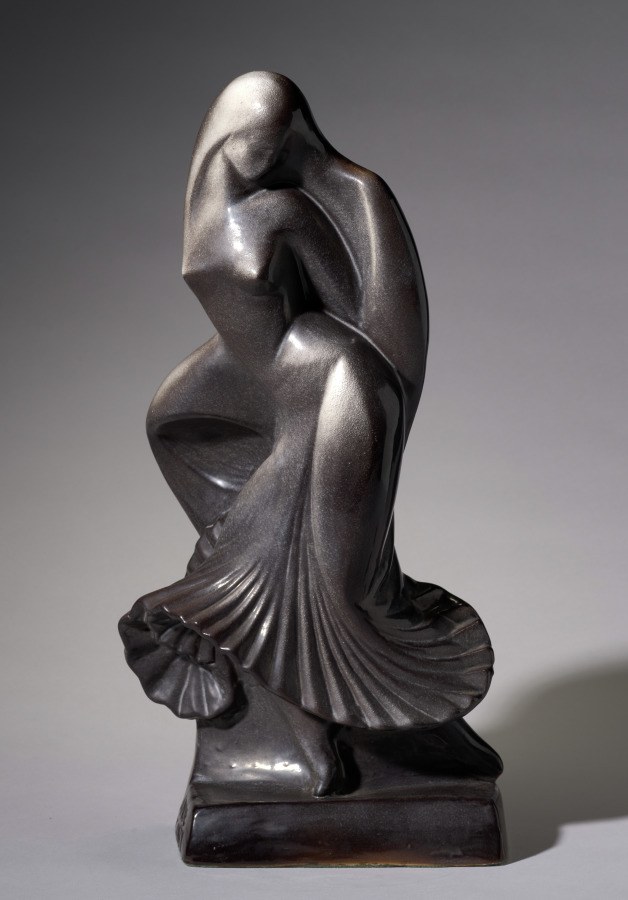
A bronze or dark-patinated sculpture depicts a single female figure in a dramatic, compressed pose. The dancer is folded forward at the waist, her upper body bent sharply toward her thighs, with her head nestled near her knees in a posture of extreme flexibility or introspection. Her arms are drawn inward, one crossing her body. The lower body tapers to a decorative base rendered as stylized drapery or a flared shell-like form, which anchors the composition. The figure is highly polished in places, with light catching the curves of the back, shoulders, and the upper surface of the drapery. The warm gray patina and reflective qualities suggest bronze or similar cast metal. The work stands alone against a neutral background, emphasizing the sinuous, almost boneless quality of the pose.
The dancing
A single dancer is shown in extreme forward flexion, with the torso folded nearly parallel to the thighs and the head brought close to the knees. The pose suggests extraordinary flexibility—the kind associated with trained classical or South Asian classical dancers who routinely achieve such deep forward bends. The arms are soft and gathered inward rather than extended or framing the body. The composition emphasizes the back and the curve of the spine, presenting the dancer from an angle that foregrounds the flexibility of the technique. There is no sense of weight transfer or momentum; instead, the figure reads as a held, almost suspended moment of maximum extension.
The dance depicted
The catalogue identifies this as a 'Nautch Dancer'—a term used from the 18th century onward in colonial sources to describe professional female dancers of South Asia, particularly those trained in classical forms such as Bharatanatyam, Odissi, or Kathak. The extreme forward bend and the soft, internalized arm position are consistent with Odissi dance, which is known for deep back bends and forward folds as foundational postures, as well as the grace and flexibility valued in Bharatanatyam. The decorative base resembles the flared lower body of traditional South Asian dance costumes. However, this work predates or sits outside any living tradition the sculpture documents—it is a Western sculptural interpretation of an imagined or observed dancer, likely produced during the colonial era when such figures were subjects of aesthetic fascination in European and American artistic circles.
How it was made
This appears to be a cast bronze sculpture, established from the dark patina, reflective surface, and the visible facets and seams typical of foundry work. The base is clearly articulated as a separate element, suggesting this was cast as two or more pieces and assembled. The finish—burnished in some areas, matte in others—indicates selective polishing after casting, a technique common in decorative sculpture of the 19th and early 20th centuries. Bronze allowed for fine detail in the drapery and smooth curves in the body, and it was the preferred material for display sculpture in museums and galleries of the period.
About this work
This sculpture is a Western artistic response to South Asian classical dance, filtered through the colonial-era term 'Nautch Dancer' and rendered in the medium of cast bronze. It depicts a single female figure compressed in a posture of extreme flexibility—most likely a forward bend—that was both a technical achievement of trained dancers and an object of aesthetic interest to European and American audiences encountering South Asian dance through travel, performance, and colonial ethnographic display. The work sits at the intersection of ethnographic documentation and formal sculptural study of the human body in motion, and it reflects the particular fascination of 19th- and early 20th-century artists with the exotic and the flexible. As a record of how Western sculptors understood and translated South Asian dance, it is valuable evidence of cross-cultural artistic exchange, though it must be read as interpretation rather than documentation.
How to look at it
Observe the compression and flexibility of the pose: this is not a momentary gesture but a held state of extreme extension that speaks to years of training. Notice how the artist has chosen to present the dancer from behind and above, so that the viewer's attention is drawn to the curve of the spine and the articulation of the drapery at the base rather than to the face or the front of the body. The lack of any narrative or external reference—no musical instruments, no second figure, no architectural setting—invites the viewer to focus purely on the formal properties of the pose: the geometry of the fold, the interplay of light on the bronze, the way the drapery stabilizes and frames the body.
The period
This work was likely produced in the late 19th or early 20th century, a period when European and American artists were increasingly exposed to non-Western performance traditions through colonial networks, world's fairs, and traveling performers. The term 'Nautch' itself reflects the colonial vocabulary used to classify and exoticize South Asian dance. Western sculptors of this era were deeply engaged with the study of the moving body—influenced by photography, anatomical dissection, and a fascination with technical virtuosity—and non-Western dancers offered new models of flexibility and expressiveness. This sculpture is contemporary with the rise of Orientalism in visual art and with the early documentation of Indian classical dance traditions by both colonial observers and Indian scholars.
Where it lives
Catalogued in the Cleveland Museum of Art's collection as part of the museum's dance-related art holdings. No attribution, date, or prior provenance has been recorded. The sculpture may have entered the collection during the period of broad Western acquisition of non-Western art and ethnographic objects in the early-to-mid 20th century.
Dance in this work
Questions about this work
What is a Nautch dancer?
'Nautch' is a colonial-era English term derived from the Hindi word 'nach' (dance), used to describe professional female performers in South Asia. The term often carries orientalist assumptions and was applied broadly to several classical traditions, including Bharatanatyam, Odissi, and Kathak. The term is considered outdated and potentially offensive in contemporary usage, and the dancers themselves would have identified with their specific tradition and regional practice.
Is the extreme flexibility shown here realistic?
Yes. Dancers trained in classical South Asian forms, particularly Odissi and Bharatanatyam, do achieve these deep forward bends and backward arches as part of their standard vocabulary. The flexibility is developed over years of daily practice and is a valued aspect of the dancer's technical mastery. However, this sculpture may exaggerate or idealize the pose for aesthetic effect.
When was this made?
The catalogue record does not provide a date. Based on the style of the bronze work, the sculptural conventions employed, and the colonial-era terminology of 'Nautch,' it was likely produced sometime in the late 19th or early 20th century, but this is not confirmed.
Who made it?
The artist is not recorded in the Cleveland Museum of Art's catalogue. It is not possible to determine from the sculpture alone whether it was made by a Western sculptor, a sculptor trained in the Indian subcontinent, or someone working in a colonial artistic context.
More dance artwork