49 works in this view — arrow keys or swipe to move between them.
Dance in Art
Tablita Dance Headdress
Unknown artist
- Source:
- Cleveland Museum of Art
- Rights:
- Public domain — free to use, share and adapt.
- Recorded as:
- CC0 (Public Domain)
The Tablita represents a sophisticated tradition of dance design in which visual form and spiritual meaning are unified—the headdress itself is a teaching tool, communicating ideas about fertility, landscape, and the cosmos through its geometry. For dancers and historians, it demonstrates that indigenous American dance cannot be studied without understanding costume as active choreography, not as decoration. Its presence in a museum collection raises questions about the ethics of displaying sacred performance objects and about the continuity of living traditions.
What you are looking at
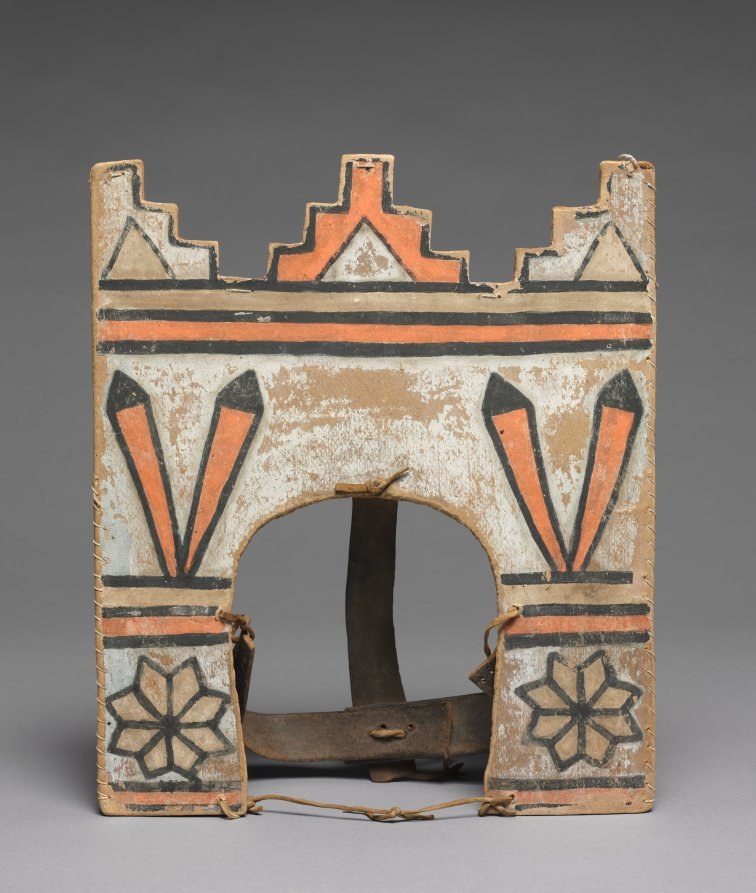
This is a wooden architectural ornament shaped like a fortress or gateway structure, designed to sit atop a dancer's head during ceremonial performance. The piece is a rectangular frame with crenellated (notched) upper edges, painted in ochre, black, and white in geometric patterns. The front face features a large arch opening for the dancer's head to pass through, flanked by two vertical columns decorated with orange and black striped designs and lotus-flower motifs in black outline. The upper register shows triangular mountain or pyramid forms in ochre and white, separated by an orange central peak. Horizontal stripes in black and orange run across the middle register. The back shows a curved iron support structure—likely a metal band or yoke—that would distribute weight across the wearer's shoulders. The paint is heavily worn and aged, with areas of loss revealing the underlying tan wood, but the geometric decoration remains legible.
The dancing
This is not a figure study but a sculptural costume element. The headdress was designed to be worn erect on a dancer's head, held in place by the iron yoke structure at the back. The weight distribution and the central arch opening indicate that a dancer wearing this would stand upright, with their head passing through the frame and the structure rising 12–14 inches above. The ornament would require a strong neck and stable posture; the dancer's body would form the vertical axis around which this architectural form displayed itself.
The dance depicted
This is a Tablita (also spelled Tablet or Tableta), a traditional headdress worn by female dancers in Pueblo ceremonies, particularly among Tewa, Tano, and Keres Pueblos of the Rio Grande valley in New Mexico. The Tablita frames and accentuates the upper body and head during sacred and social dances, including the Corn Dance and other seasonal ceremonies. The geometric designs—mountains, terraces, and floral motifs—reference landscape features and agricultural fertility symbolism central to Pueblo cosmology. The structure transforms the dancer's silhouette into a monumental architectural form, making the individual body part of a sacred landscape.
How it was made
This is a carved and painted wooden headdress with iron reinforcement. The wood has been shaped into an architectural form, and the design was executed in mineral and plant-based pigments typical of Pueblo artistry. The curvilinear iron support at the back (visible in the image) was added to distribute weight and secure the piece to the wearer's shoulders, suggesting practical engineering developed over generations of use. The wear patterns and paint loss show this was an active, functional object subjected to repeated use in performance and storage.
About this work
The Tablita is a monumental headdress worn in Pueblo Indian dances, transforming the dancer's body into a living monument to land, sky, and harvest. It belongs in a dance collection not as a decorative object but as evidence of a coherent choreographic system in which costume and sacred geometry are inseparable from movement. The Pueblo peoples have maintained these dances continuously for centuries, and the headdress is essential to their meaning—it is not worn for display but as part of a religious and social practice that integrates movement, visual art, and cosmological teaching.
How to look at it
Examine the upper edge: the crenellations resemble the roofline of pueblo architecture, connecting the dancer's crowned head to the landscape of adobe dwellings. The large arch opening is the practical necessity, but also the focal point—the dancer's face becomes the focal point of the headdress, not hidden but framed. The worn paint reveals the age and use of the object; note the areas of loss, which show how the wood has been handled and where the wearer's head and shoulders exerted pressure. The iron support is ingenious engineering designed to be invisible during performance, allowing the heavy wooden structure to appear almost weightless.
The artist
This Tablita is likely the work of a Pueblo artisan, but the catalogue record does not identify the maker. Tablitas were (and are) created by individual dancers, families, or pueblo craftspeople, often over many years and generations. The tradition is living; contemporary Pueblo artists continue to make and wear Tablitas in ceremonies and public dances. Attribution to individual artists is not typical in this tradition, which emphasizes community and ceremonial continuity rather than individual artistic signature.
The period
The date of this headdress is unknown, but Tablitas have been documented in use since at least the 19th century and likely much earlier. The style and wear patterns suggest this is a 20th-century example, possibly from the mid-century period when Pueblo dances became more visible to outsiders through ethnographic documentation and the growth of tourism in the Southwest. The geometric design language—particularly the bold use of ochre, black, and orange—is consistent with the Pueblo Revival movement in Southwestern art and architecture, though Tablita design predates that movement and continues independently.
Where it lives
This Tablita is held in the Cleveland Museum of Art's collection. The source record identifies it as part of the museum's dance-related art collection but provides no information on accession date, previous ownership, or the pueblo of origin. Museums that hold Tablitas and other sacred Pueblo objects increasingly work with tribes on repatriation and collaborative display.
Dance in this work
Questions about this work
Is this a mask?
No. The Tablita is a headdress that sits on top of the head, not over the face. The dancer's face remains visible and expressive. The opening in the center allows the dancer's head to pass through, and the structure rises vertically above the crown.
Which pueblo made this?
The catalogue record does not specify. Tablitas are used across multiple Pueblos in northern New Mexico, including the Tewa, Tano, and Keres. The geometric design does not uniquely identify the pueblo of origin without additional documentation or comparison with known examples from specific communities.
What does the design mean?
The stepped or terraced forms at the top represent mountains or agricultural terraces. The lotus flowers or feather motifs represent fertility, water, and the sacred landscape. Each pueblo and family may have variations in design that carry specific meanings tied to their ceremonies and history. The colors—ochre (earth), black (night or charcoal), and orange-red (fire or clay)—are drawn from the natural materials of the Pueblo landscape.
Do Pueblo dancers still wear Tablitas?
Yes. The Tablita remains an active element of Pueblo ceremonial and social dances, particularly the Corn Dance and other seasonal ceremonies. Contemporary Pueblo artisans continue to make new Tablitas, and the tradition is a living practice, not a historical artifact.
More dance artwork