49 works in this view — arrow keys or swipe to move between them.
Dance in Art
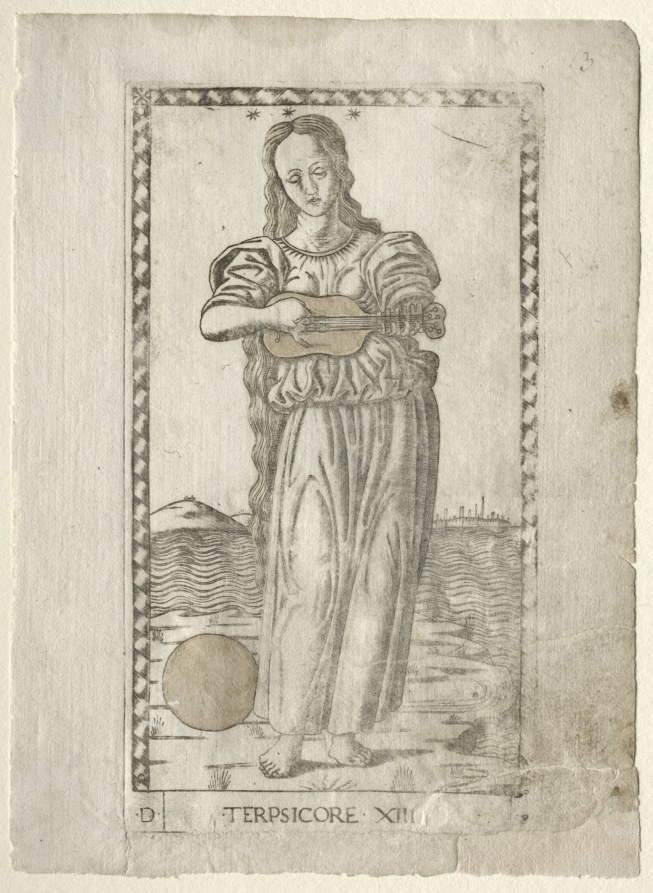
Terpsichore dancing and song from the Tarocchi series D
Master of the E-Series Tarocchi (Italian, active 1460s)
- Source:
- Cleveland Museum of Art
- Rights:
- Public domain — free to use, share and adapt.
- Recorded as:
- CC0 (Public Domain)
For historians of Renaissance visual culture and classical learning, this engraving documents how educated Europeans represented dance through mythological allegory rather than lived movement. For dance historians, it reveals the gap between how dance was imagined in elite visual culture—static, musical, muse-associated, classical—and how it was actually performed.
What you are looking at
A single figure stands barefoot in classical drapery against a landscape background, holding a lyre or similar stringed instrument across the body. The woman wears a chiton with gathered sleeves and a peplos-style garment, rendered in the linear style typical of Renaissance engravings. She stands in contrapposto, one leg bearing weight while the other relaxes slightly. The background shows undulating water or terrain to either side, with a distant cityscape or fortification visible along the horizon. A large circular object—possibly a shield or celestial sphere—rests at the figure's feet. The entire composition is framed by a decorative border of repeated small ornamental marks. The inscription at the base reads "TERPSICHORE," identifying the figure as the classical muse of dance.
The dancing
The figure occupies a relaxed standing pose with minimal dynamic tension—the weight settled onto one leg in a pose closer to rest than to active movement. The arms position the lyre as an object to be displayed rather than actively played, held at waist level with the instrument visible in profile. There is no sense of the body caught mid-gesture or mid-step; instead, the presentation is frontal and statuesque, emphasizing the figure's iconographic identity as a muse rather than a dancer in motion.
The dance depicted
This is an allegorical representation of Terpsichore, the muse of dance in classical mythology, not a depiction of actual dance practice or movement. The work identifies her by inscription and attribute (the lyre), following Renaissance conventions for representing abstract concepts and mythological figures. The static, heraldic pose and emphasis on symbolic objects over bodily movement suggest this is about the idea of dance and its cultural authority rather than the experience of dancing.
How it was made
This is an engraving, identifiable from the fine parallel line work (hatching and cross-hatching) used to model form and create tonal variation, the crisp linear definition of drapery folds, and the overall black-and-white tonality. The decorative border and inscription suggest this is part of a didactic or allegorical series—the catalogue reference to the "Tarocchi series" confirms it belongs to a set of printed cards or prints. Engravings circulated widely in Renaissance and early modern Europe, making this an accessible and reproducible image of classical learning.
About this work
This engraving represents Terpsichore, the classical muse of dance, as a standing figure in idealized Greco-Roman dress holding a lyre. It is part of the Tarocchi series, a Renaissance set of allegorical engravings that combined classical and contemporary references, often functioning as an educational or moral framework. The image uses pose, costume, and inscription to anchor the viewer's understanding: Terpsichore is not shown dancing but standing as an emblem of dance itself—of its cultural status, its connection to music, and its place within the classical canon. This conflation of the muse with her attribute reflects a common Renaissance practice of making abstract concepts visible through idealized human form.
How to look at it
Notice the absence of motion: the figure stands still, weight settled, the lyre held passively rather than actively played. Contrast this with how dance was actually depicted in other Renaissance prints, where figures twist, leap, and interact. Observe the classical references—the drapery, the lyre, the inscription—which signal that this is an image of an idea about dance (its antiquity, its connection to music and the muses) rather than dance itself. The didactic framing and the series format suggest this print was meant to teach: here is Terpsichore, here is her symbolic identity, here is how we honor dance through classical form.
The period
The Tarocchi series belongs to the Renaissance explosion of allegorical prints and cards, a genre that flourished in Italy and Northern Europe in the fifteenth and sixteenth centuries. These works combined classical references recovered through humanism with contemporary concerns, often organized around themes like virtues, vices, muses, or classical deities. The series served educational, decorative, and sometimes divinatory purposes. In this period, dance itself was undergoing significant change—court dance was becoming more formalized and documented, yet in visual art, dance remained often represented through classical mythology and static allegory rather than through the lively, structured choreography that was actually being practiced.
Where it lives
This engraving is held by the Cleveland Museum of Art as part of its collection of dance-related artworks. It is identified as part of the Tarocchi series, a group of Renaissance allegorical engravings; no individual artist has been recorded in the catalogue.
Dance in this work
Questions about this work
Is this figure actually dancing?
No. The pose is static and contemplative, not caught mid-movement. This is an allegorical representation of the idea or muse of dance, not a depiction of the act of dancing. The figure stands as a symbol or emblem.
What is the Tarocchi series?
Tarocchi were sets of allegorical engraved cards or prints produced in Renaissance Italy and beyond, often depicting classical deities, virtues, vices, or other abstract concepts. They served educational and decorative purposes and sometimes had divinatory functions. This engraving is one card from such a series.
Why is she holding a lyre?
The lyre is Terpsichore's traditional attribute in classical and Renaissance art, linking dance to music and to Apollo (god of music and poetry). It symbolizes the close connection between dance and musical accompaniment, and also the muse's role as a source of inspiration.
More dance artwork