49 works in this view — arrow keys or swipe to move between them.
Dance in Art
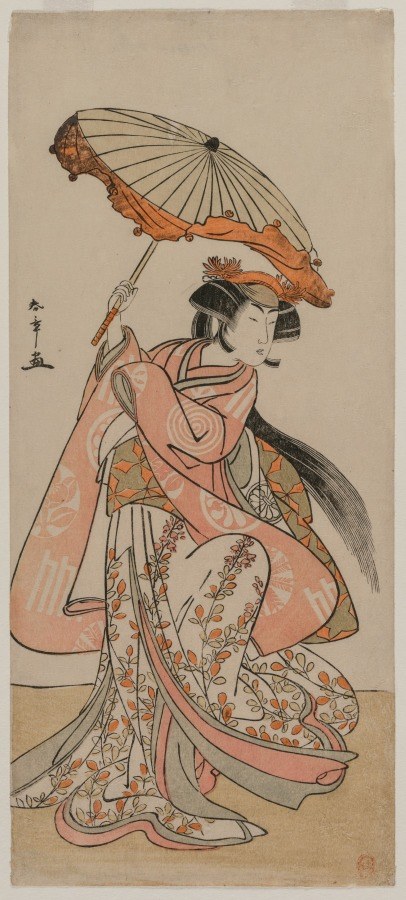
The Actor Segawa Kikunojo II Dancing with a Parasol
Katsukawa Shunshō (Japanese, 1726–1792)
- Source:
- Cleveland Museum of Art
- Rights:
- Public domain — free to use, share and adapt.
- Recorded as:
- CC0 (Public Domain)
This work documents a non-Western dance practice and aesthetic at a moment (Edo period) when kabuki dance was a major urban art form. It shows how parasols and props function in Japanese theatrical dance as both beauty objects and instruments of bodily expression, challenging Western notions of what constitutes dance imagery.
What you are looking at
A single figure, a woman in elaborate kabuki costume, stands in a posed moment against a plain ground. She holds an ornamental parasol tilted above her left shoulder, the handle descending diagonally across her body to her right hand. Her costume consists of layered silk robes in coral and cream, densely patterned with flowering plants rendered in gold leaf and ink. A flowing outer robe drapes extensively to the ground, creating a complex silhouette of nested rectangular shapes. Her hair is styled in an elevated topknot secured with ornamental pins, and her face is painted with the white base and dark linear features of kabuki makeup. The parasol itself is constructed in the ukiyo-e manner—rendered with geometric precision, its paper stretched across radiating spokes that taper to a focal point. The composition is frontal and portrait-like, isolating the figure against the neutral silk support with no architectural or landscape context.
The dancing
The dancer stands in a composed upright stance with weight evenly distributed, not in active motion but in a moment of display. Her left arm is raised and extended to support the parasol shaft; her right arm is bent at the elbow to grasp the handle. The pose is essentially static and formal—a presentation rather than a moment of footwork or dynamic movement. The body is elongated and frontal; the elaborate costume overwhelms the visibility of the body beneath it, typical of kabuki where the robe itself is the primary visual element.
The dance depicted
This is a portrait of Segawa Kikunojo II, a celebrated female impersonator (onnagata) of the Edo period, posed in character with a parasol (wagasa). The parasol is a prop associated with certain kyōgen and dance pieces in kabuki theatre. The pose suggests a moment from a dance scene rather than narrative drama—a poised, still tableau that displays the actor's costume and feminine bearing. Kabuki dance (buyo, kabuki-buyo, or nihon-buyo) traditionally emphasizes grace, elongation, and the beauty of costume in motion and repose; this image captures the latter, the studied composure expected of the female character type.
How it was made
This is a Japanese woodblock print (ukiyo-e), likely a single-sheet color woodcut (hanga) from the 18th century. The print demonstrates the characteristic technique of the form: multiple carved blocks applied in sequence to build color and detail, with hand-applied metallic elements (gold and silver leaf) added after printing to heighten the costume's luxury. The medium was designed for rapid circulation, affordable reproduction, and the documentation of kabuki performance and celebrated actors. The precision of the parasol's geometric construction and the delicate linear detail in the costume patterns are hallmarks of the woodcut technique's capacity for both bold design and intricate ornament.
About this work
This is an actor portrait (yakusha-e) from the Japanese kabuki theatre tradition, documenting a celebrated performer in a moment of choreographed stillness. Segawa Kikunojo II was renowned for his embodiment of female roles; this image fixes him in the composed grace expected of the onnagata, posed with a parasol that may reference a specific dance piece or character type. The work belongs to the tradition of kabuki documentation in ukiyo-e, which served as both a record of performance and a marketable image for fans. It exemplifies how, in Japanese theatre, dance and costume are inseparable—the parasol is both prop and dance accessory, and the pose is choreographed dignity rather than narrative moment.
How to look at it
Notice the parasol's geometric precision and how it is integrated into the figure's pose—it is not incidental decoration but a compositional element that creates diagonal movement through an otherwise vertically organized frame. Observe how the costume's pattern and the actor's posture work together: the layering of robes creates a sculptural silhouette, and the raised arm and tilted parasol suggest an ideal of graceful bearing rather than active movement. This is a portrait of stillness within the dance tradition—the moment a dancer holds a pose for the audience's admiration.
The artist
The artist's name is not recorded on this work, which is typical of many ukiyo-e prints from the Edo period. The print belongs to the tradition of actor portraiture (yakusha-e), one of the major subject categories of woodblock printing, which emerged in the 17th century and flourished through the 18th and 19th centuries. Printmakers in this tradition worked collaboratively with block carvers and printers, and attribution was often secondary to the marketability of the image itself.
The period
This work dates to the 18th century, a period when kabuki was the dominant theatrical form in Japan and onnagata (male actors playing female roles) held celebrity status comparable to modern film stars. Kabuki dance developed during this period as a major component of theatrical performance, blending pantomime, gesture, and formalized movement with costume display. In the visual arts, ukiyo-e ('pictures of the floating world') was at its commercial and artistic height, with actor portraiture as one of its central genres. The parasol as a costume element reflects kabuki's engagement with everyday luxury goods and their transformation into theatrical signifiers of refinement and femininity.
Where it lives
This work is part of the Cleveland Museum of Art's dance-related collection, held as a woodblock print from the ukiyo-e tradition. The catalogue record notes the subject and artist attribution but lacks information on the medium, date, and provenance—gaps that can be partially inferred from the visual evidence of style and technique.
Dance in this work
Questions about this work
What is an onnagata and why would a male actor play female roles?
An onnagata is a male actor specializing in female roles in kabuki theatre. This convention developed in the 17th century when female performers were banned from the stage; it became an elite artistic practice in which onnagata trained from childhood to embody an idealized femininity through movement, costume, and gesture. The role required exceptional skill in dance and physical control.
Is this print a record of an actual performance or a stylized portrait?
It is both. Yakusha-e (actor prints) documented celebrated performers and specific roles, but they were also idealized portraits that enhanced the actor's beauty and status. This print likely references a character or a celebrated pose associated with Segawa Kikunojo II, but it is not a literal transcript of a single performance moment.
What role does the parasol play in kabuki dance?
Props in kabuki, including parasols, are integral to choreography and character portrayal. The parasol can suggest refinement, courtship, outdoor leisure, or specific narrative situations. Here it appears to be both a costume element and a tool for bodily display—its angle creates a frame for the figure and suggests grace and poise.
What makes this a dance image rather than just a portrait?
The pose and costume are drawn from kabuki dance conventions. The parasol, the elongated posture, and the composed stillness all reference buyo (kabuki dance) aesthetics. This is a portrait of a dancer in character, not a purely representational likeness.
More dance artwork