49 works in this view — arrow keys or swipe to move between them.
Dance in Art
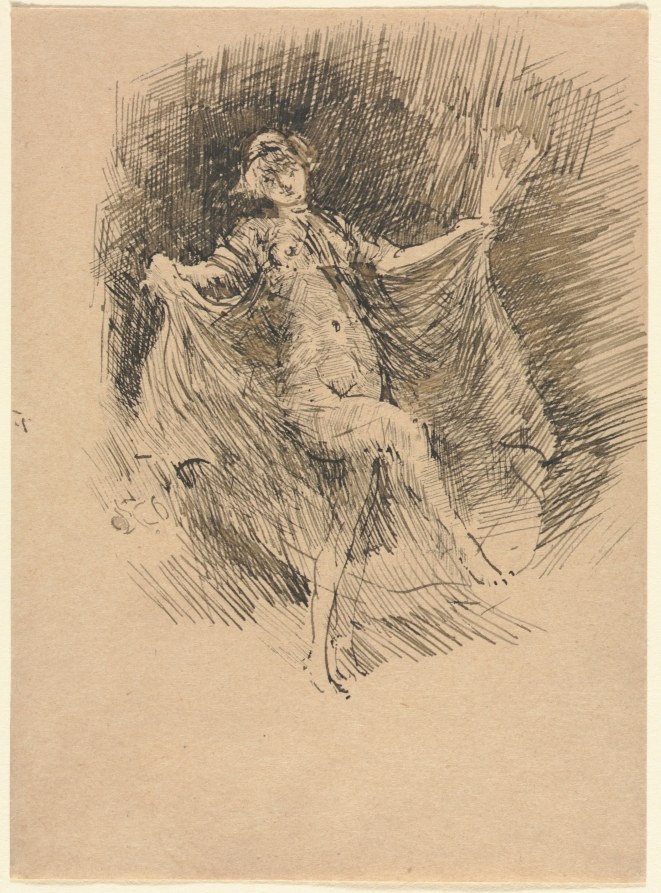
The Dancer No 1
James McNeill Whistler (American, 1834–1903)
- Source:
- Cleveland Museum of Art
- Rights:
- Public domain — free to use, share and adapt.
- Recorded as:
- CC0 (Public Domain)
This work bears witness to the early modern dance revolution and the influence of classical aesthetics on modernist performance. For historians and dancers, it offers a concrete record of how the body was positioned and understood in early 20th-century avant-garde work—not as a mechanism for steps or patterns, but as a vessel for emotion and visual beauty. The sketch's informality and focus on a single, vulnerable moment suggest intimacy between artist and performer, the kind of studio practice that shaped modernism in dance.
What you are looking at
A single female figure dominates this intimate sketch, reclining or reclining against dark cross-hatched shadow that fills the upper two-thirds of the composition. She lies at an angle, her body elongated and graceful, with her head tilted back and one arm extended outward in a gesture of abandon or reverie. The other arm drapes across her torso. Her legs extend downward and to the right, rendered in lighter strokes that taper toward delicate feet. The figure wears only a gauzy fabric—perhaps a veil or translucent drape—that clings to her form and swirls around her in suggested motion. The artist has used bold, directional pen strokes to create volume and movement in this drapery, which becomes increasingly loose and gestural toward the lower portion of the composition. The background remains undefined; the heavy hatching creates an almost dreamlike atmosphere, drawing all attention to the solitary dancer's pose and the fluid play of fabric.
The dancing
The dancer's body presents a full recline or near-recline, weight settled onto her back or supported arm, with the head thrown back in a posture of release or ecstasy. Her extended arm reaches outward with fingers splayed or relaxed, suggesting a moment of unguarded emotion. The torso is fully exposed and frontal, rendered with anatomical care. The pose reads as passive or yielding rather than active—this is not a moment of propulsive movement but of suspension, repose, or the aftermath of exertion. The single figure eliminates any question of partnership or social dance; this is an interior or solo moment.
The dance depicted
This appears to be a study of theatrical or interpretive dance, most likely from the late 19th or early 20th century, when reclining or ecstatic poses became prominent in avant-garde performance. The pose and sensibility suggest the influence of Isadora Duncan or similar modern dance pioneers who rejected ballet rigidity in favor of naturalistic, emotionally expressive movement derived from classical drapery and Hellenic imagery. The figure is neither in classical ballet position nor in any codified social dance form; instead, she embodies a Romantic or Symbolist ideal of the dancing body as a vehicle for inner feeling. Without more context, it is impossible to identify a specific dance, but the vocabulary is unmistakably modern theatrical dance rather than folk, social, or classical ballet.
How it was made
This is a pen-and-ink drawing, likely a sketch or study, executed with rapid, assured line work and extensive cross-hatching to build tone and shadow. The technique is economical—the artist has minimized detail and outline in favor of suggestive, gestural marks that convey both form and emotion. The fine, parallel lines used for shadow are characteristic of printmaking or preparatory drawing practice, though the work appears to be a finished drawing rather than a print itself. The medium allowed the artist to capture movement and drapery fluidly, with less commitment than painting would require, making this likely a studio sketch, a gift, or a study toward a larger work.
About this work
This ink drawing captures a single moment of modern theatrical or interpretive dance: a female dancer in a reclining pose of apparent surrender or release, her body half-draped in gauzy fabric that swirls around her in gestural, calligraphic strokes. The work is undated and unattributed in the record, but the style and subject place it firmly in the early modernist period when dancers began to reject the formality of classical ballet in favor of emotionally expressive, often Hellenically inspired movement. The sketch is a study of the body in repose—not a narrative or social scene, but an exploration of how a dancer's form and drapery can convey inner states. It belongs in a dance art gallery because it documents a moment when visual artists and performers were collaborating to reimagine what dance could express.
How to look at it
Attend to the moment the artist has chosen to freeze: not a moment of active step or turning, but one of rest or surrender, with the body fully exposed and the face hidden. Notice how the artist has rendered drapery not as static fabric but as a living extension of the body—the cross-hatched lines and gestural strokes make the veil seem to move independently. The weight of the figure is deliberately passive and supported; this is a pose that could only be held briefly or in performance, which is part of its power. The rough, energetic mark-making contrasts with the smooth, idealized form of the dancer herself, suggesting the artist's intense engagement with capturing both the physical body and the emotional charge of the moment.
The period
The late 19th and early 20th centuries saw a revolutionary shift in dance aesthetics. Isadora Duncan, the Ballets Russes, and other avant-garde performers rejected the rigid conventions of classical ballet in favor of freer, more natural, and emotionally expressive movement. Visual artists responded with equal enthusiasm, producing countless sketches and studies of dancers in motion and repose. The reclining or ecstatic pose seen here draws on Romantic and Symbolist art traditions—the languorous, semi-clothed figure became a symbol of artistic liberation and feminine sensuality. Such poses also referenced classical Greek and Roman sculpture, an allusion that modernist dancers actively cultivated to legitimize their break with ballet tradition.
Where it lives
This drawing is held by the Cleveland Museum of Art. The work is catalogued as part of the museum's dance-related art collection, a designation that reflects a broader institutional interest in documenting the visual culture of performance.
Dance in this work
Questions about this work
What dance is this?
The drawing does not depict a specific named dance. Instead, it captures the aesthetic and body language of early modern or interpretive dance, a movement that emerged in the late 19th and early 20th centuries as dancers rejected classical ballet in favor of more natural, emotionally expressive movement. The reclining pose and Hellenic drapery suggest the influence of Isadora Duncan or similar pioneers of modern dance.
Who is the dancer?
The artist and the identity of the dancer are not recorded in the museum's catalogue. Without a signature or inscription visible on the work, it is impossible to determine who created this drawing or who modeled for it.
When was this made?
The date is unknown, but the style and subject matter—the modern theatrical vocabulary, the emphasis on emotional expression, and the aesthetic of the pen work—all suggest the late 19th or early 20th century, during the height of the modern dance revolution.
Is this a finished work or a sketch?
This appears to be a finished drawing, though it retains the freshness and immediacy of a studio sketch. The artist has applied sufficient care and detail to suggest intent, but the economical technique and apparent spontaneity suggest it may have been created quickly, either during or shortly after observing the dancer, or as a study toward a larger work.
More dance artwork