49 works in this view — arrow keys or swipe to move between them.
Dance in Art
The Dance
Carl Wilhelm I Kolbe (German, 1757–1835)
- Source:
- Cleveland Museum of Art
- Rights:
- Public domain — free to use, share and adapt.
- Recorded as:
- CC0 (Public Domain)
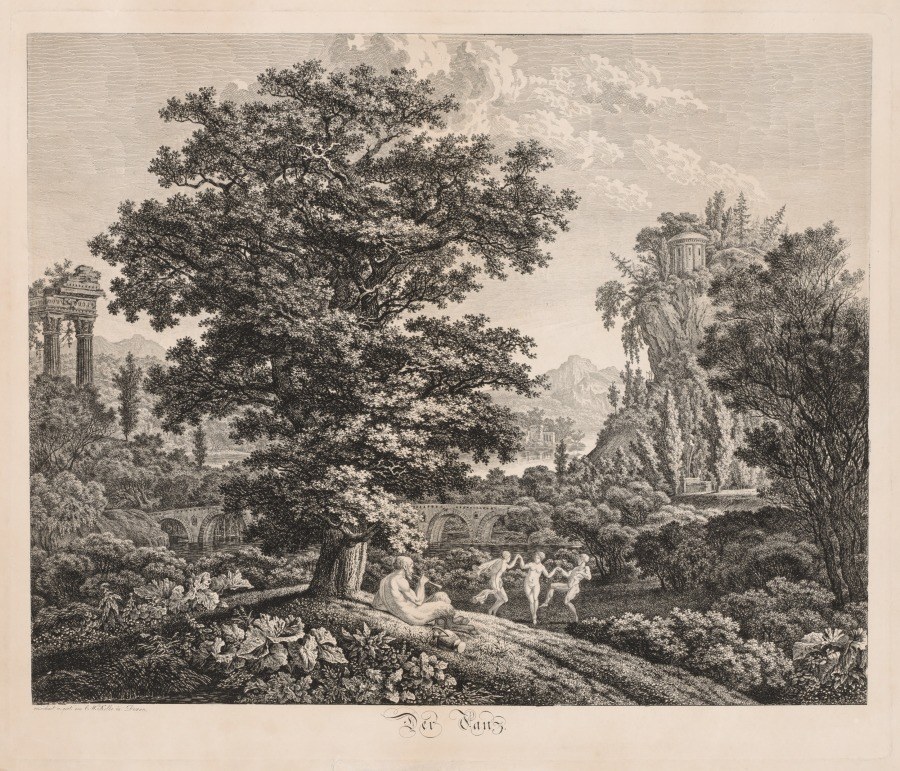
This engraving is an invaluable document of how 18th-century elites envisioned courtly dance: not as technical exhibition but as an expression of ease, social concord, and aesthetic refinement. The pastoral framing reveals how dance was understood as participating in a larger philosophy of nature, taste, and cultivated pleasure—essential context for understanding the social meaning of Baroque and Rococo dance beyond the technical record.
What you are looking at
An arcadian landscape engraving presents a garden scene organized in depth: foreground figures recline among flowering plants and roses, mid-ground shows a small stone bridge spanning a stream, and background figures—some dancing, others standing—populate a clearing ringed by tall cypress trees and classical architecture. The composition balances a reclining woman in diaphanous drapery (lower left) with dancing figures across the stream, their bodies silhouetted against clouded sky. The light is even and cool, typical of engraving technique. Mountains rise in the distance. The entire scene embodies the pastoral idyll: cultivated nature, architectural ornament, leisured movement, and the marriage of landscape to human figure that defines 18th-century rococo aesthetics.
The dancing
At least four figures occupy the mid-ground clearing in what appears to be a sprightly group dance or promenade. Their postures suggest upright, buoyant movement—bodies held erect, arms extended. The nearest visible dancers appear to be in loose contact or proximal positioning rather than a formal closed hold. One figure's arm gesture is extended outward. The scale and distance make precise footwork invisible, but the overall carriage and spacing suggest a social, courtly form rather than a folk or theatrical display. The foreground reclining woman and seated companions establish a viewing frame: we witness the dance from the vantage of leisured onlookers.
The dance depicted
The image depicts an elegant social or courtly dance, most likely a Baroque or early Rococo garden entertainment. The classical setting, upright postures, small group formation, and the leisured context all point to historic-baroque courtly dance. The arcadian framing—pastoral garden, classical ruins, distant mountains—suggests this is an idealized representation of court diversion rather than a literal record. The freedom and apparent informality of the group formation, combined with the outdoor setting and the presence of statuary and architectural elements, may indicate this is a gavotte, minuet, or similar social dance of the 17th–18th centuries adapted to arcadian romance. Without inscription or documentary caption, the specific dance cannot be named with certainty, but the visual language is unambiguously that of refined European court society.
How it was made
This is an engraving, executed with fine linear hatching and cross-hatching to model form and shadow. The technique allows for the delicate rendering of foliage, drapery, and architectural detail that defines rococo sensibility. Engravings of this type were widely circulated through print culture, reaching educated amateurs and collectors across Europe; the composition and refined subject matter suggest this was aimed at a cultivated audience familiar with pastoral literature and court aesthetics. The print's circulation would have made this image a vehicle for disseminating idealized visions of courtly leisure and dance practice.
About this work
This engraving captures the 18th-century ideal of the dance as courtly refinement set within Arcadian nature. A small group of elegantly dressed figures engages in a social dance before an ornamental landscape: classical ruins, cypress groves, and cultivated flowers frame the scene. Foreground figures—reclining in pastoral repose—frame our view of the dancers, establishing the dance as an object of refined leisure rather than spectacle. The work belongs to a rich visual tradition in which dance serves as an emblem of grace, social harmony, and the harmonizing of human culture with idealized nature.
How to look at it
Observe how the engraver has arranged the scene in distinct zones: the reclining observers in the foreground invite us into a position of leisure; the stream and bridge create spatial recession; the dancing figures are small and distant, viewed almost as part of the landscape. This compositional choice is deliberate: the dance is not a spectacle demanding close attention but an element of a larger harmony. Notice too the postures of the dancers themselves—upright, buoyant, seemingly effortless—and the spacing that suggests a social, not competitive, occasion. The classical ruin in the background connects human dance to ideals of eternal beauty and order.
The period
The work dates stylistically to the 18th century, when engraved representations of courtly life, pastoral scenes, and garden entertainment proliferated across European print culture. This was the height of Rococo sensibility, when the courtly dances of the Baroque—minuets, gavottes, and courantes—were still performed in elite circles but increasingly idealized and romanticized in visual art. The emphasis on arcadian setting reflects the period's fascination with a fantasized, harmonious nature as the proper stage for refined human conduct. Dance in such imagery served a philosophical purpose: it demonstrated the possibility of human grace and social order mirroring natural beauty.
Where it lives
The work is held in the Cleveland Museum of Art and entered their collection as part of their holdings of dance-related imagery. The catalogue record provides no artist attribution, date, or medium specification; all of these details have been inferred from the visual evidence of the engraving itself.
Dance in this work
Questions about this work
What dance are they doing?
The image does not include an inscription naming the dance, and the distance and small scale of the figures make it impossible to identify specific footwork or formations. Based on the 18th-century courtly setting, refined postures, and small-group formation, it is almost certainly a Baroque social dance such as a minuet, gavotte, or courante. The pastoral, idealized context suggests this is a romantic representation of courtly leisure rather than a literal record of a specific dance occasion.
Why is the dance so small in the composition?
The scale reflects the engraver's larger artistic purpose: to present the dance as one element within an idealized arcadian landscape, not as the primary subject demanding close scrutiny. The foreground figures—reclining at leisure—establish our viewing position and frame the dancers as an ornament to refined pastoral life. This compositional choice tells us something important about how 18th-century elites understood dance: not as technical display but as an expression of grace and social harmony within a larger vision of cultivated nature.
What is the building in the background?
It appears to be a classical garden structure—possibly a rotunda, pavilion, or temple—consistent with 18th-century aristocratic estates. Such ornamental buildings were standard features of rococo gardens and served both as focal points for the landscape composition and as symbols of refined taste and learning. The presence of classical architecture connects the human activity of dance to ideals of eternal order and beauty.
More dance artwork