49 works in this view — arrow keys or swipe to move between them.
Dance in Art
The prince meets a carefree dancing dervish whose good fortu
Unknown artist
- Source:
- Cleveland Museum of Art
- Rights:
- Public domain — free to use, share and adapt.
- Recorded as:
- CC0 (Public Domain)
This work documents how Islamic mystical devotional practice—specifically the physical and ecstatic dimensions of Sufi spiritual life—was understood and represented in high literary and visual culture. It shows that dervish movement was not confined to ritual contexts but was recognized as a subject worthy of aesthetic representation in court manuscripts, and that the viewers and makers of such objects recognized spiritual ecstasy as a legitimate and valued human state.
What you are looking at
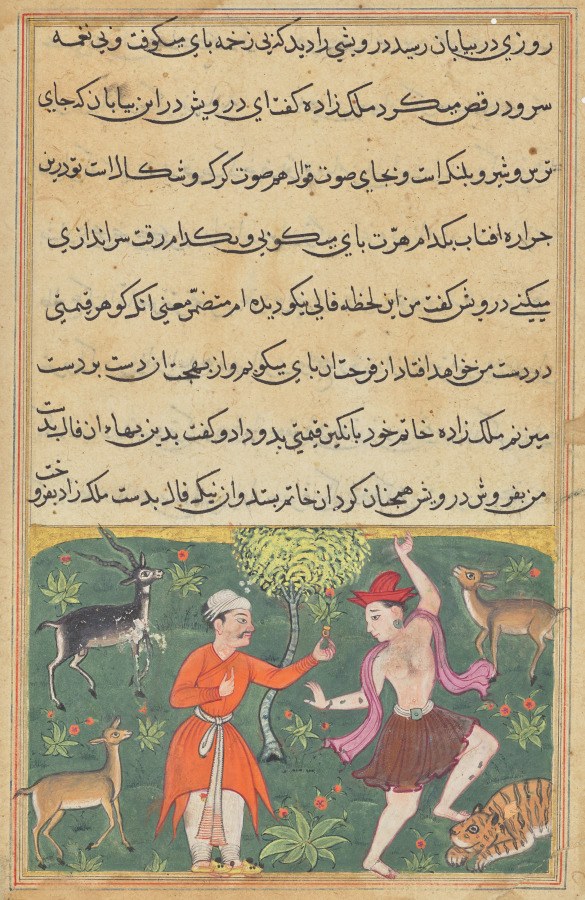
A richly illustrated page from a Persian or Islamic manuscript shows a garden scene with a figure in red robes dancing or moving expressively at the center. The dancer wears a tall red hat and orange-red garment, their body in dynamic motion with one arm raised high toward a flowering tree laden with blossoms. A companion in simpler dress, shirtless and wearing a red cap, stands to the right observing or participating. The scene is populated with elegant animals: a gazelle or antelope to the left, another to the right, and what appears to be a tiger or large cat in the lower right corner. The setting is an idealized garden with flowering plants, trees, and an intimate scale appropriate to court or aristocratic leisure. The manuscript page is framed with a decorated border in gold and red, and filled with dense Persian or Arabic script in the upper two-thirds, indicating this is a narrative illustration accompanying a literary text. The color palette is warm: golds, reds, greens, and blues, with the illumination suggesting a precious, high-status object.
The dancing
The central figure demonstrates a full-bodied, ecstatic posture: the spine appears extended or arched, the left arm is raised high with apparent abandon, and the body seems caught mid-spin or sway. The weight appears to shift through the lower body in a rotational or swaying motion. The second figure stands in a more stable, observational stance. Both figures are solitary dancers rather than a couple in hold; the gesture is individual and expressive rather than formal or geometric.
The dance depicted
The title indicates this depicts a dervish—a Sufi religious figure known for spiritual devotional practices. The ecstatic, whirling-like posture and raised arm suggest the physical expression of spiritual trance or dhikr (remembrance), the ritual repetitive movement central to certain Sufi traditions, notably the Mevlevi sema or whirling dervish ceremony. The garden setting, the idealized animals, and the sense of joy and liberation align with mystical poetry and the spiritual liberation sought through movement and music in Islamic mystical practice. The relative informality and the apparent joy distinguish this from the highly codified, ceremonial whirling of the Mevlevi order—this appears instead to be a depiction of a wandering, 'carefree' dervish as the title states, engaging in ecstatic movement outside formal ritual context.
How it was made
This is a manuscript illumination, likely executed in gouache or similar pigments on paper or parchment, characteristic of Persian or Islamic court manuscript production from the 15th to 17th centuries. The technique allowed for fine detail in both the script and the figurative illustration, with gold leaf or paint enhancing the luxurious appearance. The presence of both text and image indicates this is a page from a bound narrative text—likely a divan (poetry collection), a historical chronicle, or a tale such as those found in the Shahnameh tradition. Such manuscripts were expensive, time-consuming productions made for elite audiences, suggesting the subject matter held literary or cultural significance worthy of such investment.
About this work
This is a manuscript illumination from a Persian or Islamic literary text, depicting a dervish in a state of spiritual ecstasy or devotional movement within an idealized garden. The figure's posture—raised arm, apparent rotation or sway of the body—indicates an understanding of the physical dimension of Sufi mystical practice, wherein movement and music serve as vehicles for encountering the divine. The scene places the spiritual practice within a courtly, literary context, suggesting the audience for this text understood the dervish as both a religious figure and a figure of literary interest, embodying themes of spiritual liberation, intoxication with divine love, and the transcendence of worldly social constraint. The work belongs to a long tradition in Islamic art and literature of depicting mystical and spiritual themes through narrative illustration.
How to look at it
Attend first to the posture of the central figure: the raised arm and the implied rotational energy of the body convey a state distinctly different from formal, geometric court dances. The artist has chosen a moment of peak intensity, capturing not a static pose but the energy of movement itself. Note the harmony between the human figures and the garden animals—the gazelles and tiger are not threatening or separate but part of an idealized, harmonious natural world. The manuscript context is essential: this image does not stand alone but illustrates a text, so the movement depicted is inseparable from the narrative or poetic content that precedes and surrounds it on the page.
The period
This illumination dates stylistically to the Islamic manuscript tradition at its height, likely 15th–17th century, when Persian and Islamic courts supported major scriptoria producing illustrated manuscripts of poetry, history, and narrative. During this period, Sufi mysticism was a dominant spiritual and intellectual force across the Islamic world, particularly in Persia, and mystical poetry—with its imagery of intoxication, dance, beloved, and transcendence—was the primary literary form of the court elite. The visual representation of dervishes, ascetics, and mystical figures in manuscript illustration reflected the prestige and cultural centrality of Sufi thought. The artistic tradition of depicting narrative scenes with figured gardens, animals, and human figures in dynamic interaction was well established and highly developed.
Where it lives
This page is held in the Cleveland Museum of Art's collection of dance-related works. The manuscript is an illustrated narrative text from the Islamic world, likely Persian in origin. It represents the category of precious, hand-made court manuscripts that integrated calligraphy, illumination, and figural narrative.
Dance in this work
Questions about this work
What is a dervish?
A dervish is a member of a Sufi Islamic spiritual order, often associated with ascetic practice, poverty, and devotional ritual. The term can refer both to members of formal organized orders (like the famous Mevlevi whirling dervishes) and to wandering holy men who adopted similar practices. Sufi spirituality emphasizes direct mystical experience of the divine, often cultivated through music, poetry, movement, and repetitive devotional practice (dhikr).
Is this the same as whirling dervish dancing?
Related, but not identical. The Mevlevi sema (whirling dervish ceremony) is a highly formalized, ritualized practice with specific music, dress, and movement vocabulary, performed in controlled settings. This image shows what the title calls a 'carefree' dervish—an informal, ecstatic expression of spiritual movement outside the ceremonial context. The artist has captured the spiritual principle—movement as a path to divine connection—rather than the specific ceremonial form.
Why are there animals in the picture?
The garden with animals represents an idealized, timeless space beyond ordinary reality—a common motif in Islamic art and literature. In the context of Sufi mystical poetry, nature and animals often symbolize stages of spiritual realization or aspects of the divine. Their presence alongside the ecstatic human figure suggests a harmony of creation united in spiritual awareness.
What text does this illustrate?
The title and provenance do not identify the specific manuscript. Based on the style and content, this likely comes from a divan (poetry collection), a narrative such as the Shahnameh, or a prose work containing mystical teachings. The dense script visible at the top of the page would identify the text, but that text is not currently transcribed or translated in the museum record.
More dance artwork