49 works in this view — arrow keys or swipe to move between them.
Dance in Art
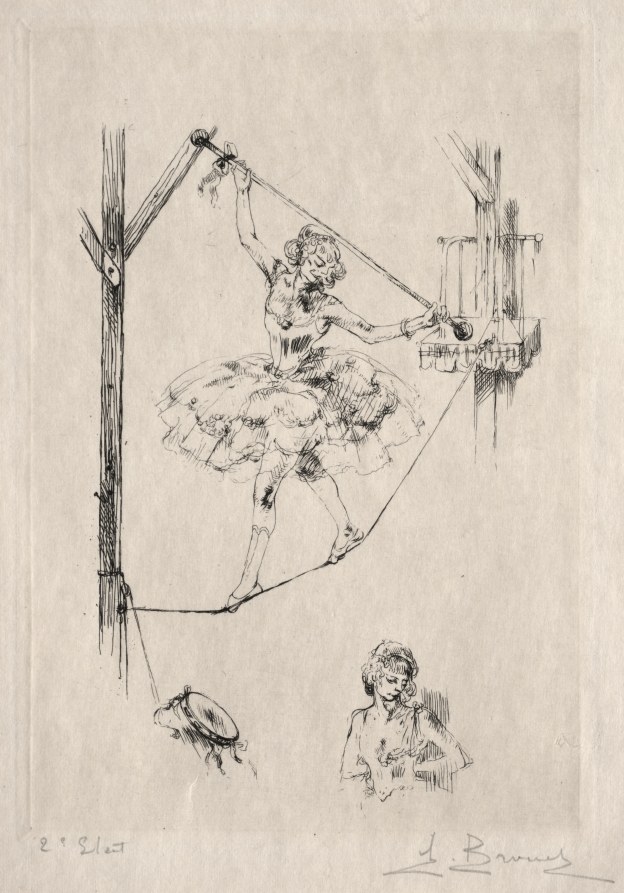
Tightrope Dancer
Auguste Brouet (French, 1872–1941)
- Source:
- Cleveland Museum of Art
- Rights:
- Public domain — free to use, share and adapt.
- Recorded as:
- CC0 (Public Domain)
This work is evidence of the range of physical performance that occupied the same theatrical spaces and audiences as ballet in the early twentieth century. For historians of circus, music-hall, and popular entertainment, it documents both the costume and the physical technique of wire-walking at a moment when such performance was widely celebrated. It also shows an artist's attention to the actual biomechanics of the body under physical constraint—not the idealized geometry of classical dance, but the real asymmetry required to stand on a rope.
What you are looking at
A lightly sketched ink drawing depicting a female performer balanced on a tightrope, captured mid-performance. The figure wears a short, voluminous tutu and has curled hair styled in the fashion of the late nineteenth or early twentieth century. She holds a parasol or balance pole extended to one side, her body leaning into the asymmetrical posture required by tightrope work. The rope itself is suggested by fine lines extending from the wooden supports on either side of the composition—sturdy wooden posts with cross-bracing at left and right. The sketch is economical but assured, with hatching used to indicate form and fabric. Two smaller figure studies appear below the main composition: a seated or reclining figure to the left, and a bust-length portrait of a young person to the right, both rendered in the same rapid ink technique.
The dancing
The principal figure stands upright on the rope with her weight clearly shifted to one leg, her torso angled away from vertical. Her free leg is lifted or extended, and her arms are positioned to maintain balance—one raised high with the parasol or balance pole, the other extended for counterweight. Her posture shows the acute physical adjustment required by tightrope performance: the body cannot remain symmetrical. The figure's relatively small scale against the architectural frame of the wooden supports emphasises both the height and the performer's vulnerability. The two smaller studies do not appear to show tightrope or aerial work.
The dance depicted
This is documentation of tightrope walking, a circus and music-hall performance genre that flourished in the nineteenth and early twentieth centuries. The artist has captured the specific physical vocabulary of the tightrope: the asymmetrical stance, the balance implement (here a parasol or pole), and the costume typical of female tightrope performers of the era. While tightrope walking is not balletic in training or aesthetic, it was a popular theatrical attraction and was sometimes incorporated into revue and music-hall performances. The sketch suggests a live performance observed by an artist interested in capturing the moment and the physical challenge rather than documenting a formal choreographic work.
How it was made
This is a pen and ink sketch on paper, likely executed rapidly from life or memory with confident, economical linework. The artist has used fine parallel hatching to suggest volume and form, and has left much of the paper white, allowing the composition to read with clarity despite minimal detail. The technique—quick, observational, without colour or heavy shading—suggests this is a study or sketch rather than a finished work, the kind a theatre artist or illustrator would make to capture a fleeting moment. The casual presence of secondary figure studies on the same sheet indicates the working practice of a professional draughtsman rather than a formal commissioned portrait.
About this work
This is a sketch of a female tightrope performer captured in the act of balancing, executed in pen and ink with the economy and directness of a theatre study. The work dates stylistically to the late nineteenth or early twentieth century, when tightrope and wire-walking were popular music-hall and circus attractions. The drawing shows an artist's eye for the physical logic of performance—the asymmetrical posture, the balance aids, the costume—rather than an idealized vision of dance. It belongs in a dance collection not because tightrope walking is dance in the classical sense, but because it is a theatrical performance of the body in motion, captured by an artist working in the tradition of theatre documentation. The sketch preserves a moment in the history of popular performance that has largely vanished from living memory.
How to look at it
Attend to the asymmetrical posture and the precise placement of the balance pole: the artist has caught the performer not in a moment of rest or static display, but in the active, continuous adjustment required by tightrope work. Notice how the figure's upper body leans away from vertical while the lower body maintains contact with the rope—this is not a stable pose but a dynamic one, frozen in the instant of performance. The wooden framework surrounding the figure is indicated with spare but deliberate lines; the artist could have omitted it, but chose to show the height and the engineering that made the performance possible. The small studies below are reminders that this sheet is a working document, not a finished exhibition piece.
The artist
The artist is not recorded. The signature at the lower left of the sheet is not fully legible in reproduction. The drawing style—assured, economical, clearly the work of a trained hand—suggests a professional theatre artist, illustrator, or sketch-maker working in the European tradition of late nineteenth-century figure drawing. The presence of multiple studies on one sheet and the lack of elaborate finish suggest these are working sketches rather than exhibition pieces, the kind an artist would accumulate during regular attendance at performance venues.
The period
Tightrope and wire-walking were major attractions in European and American music halls, circuses, and outdoor festivals throughout the nineteenth and early twentieth centuries. Female tightrope performers, often billed as aerialists or wire-walkers, commanded significant audiences and celebrity. This sketch dates to the era when such performance was at peak popularity, before cinema and later entertainments displaced live circus from the mainstream. In the visual arts, theatre sketching—rapid studies of performers in costume and action—was an established practice among illustrators and artists documenting contemporary life. The drawing reflects both the fashion and the theatrical culture of this period.
Where it lives
The work is held by the Cleveland Museum of Art and is part of the museum's dance-related art collection. No accession number, acquisition date, or previous ownership is recorded in the available catalogue information.
Dance in this work
Questions about this work
Is tightrope walking considered dance?
Not in the formal sense—tightrope walking is a circus art with different training, aesthetics, and traditions from ballet or choreography. However, it is a theatrical performance of the moving body in space, and it shared the same venues, audiences, and cultural moment as other forms of stage performance. This collection includes it as part of the broader history of how bodies have been trained and displayed for theatrical effect.
Who was the performer depicted?
The artist is not identified, so neither is the performer. The sketch is a study of a type of performance—a tightrope act—rather than a record of a named individual. The absence of a caption or identification was common for theatre sketches of this era, which were made for the artist's own reference or for publication in periodicals, not as documentation of specific individuals.
What is the parasol for?
The parasol (or similar pole) functions as a balance implement, extending the performer's reach and shifting their center of gravity to aid stability on the rope. It is both a practical tool and part of the visual spectacle—the parasol adds silhouette and style to the performance. Tightrope performers of this era routinely used such aids, and some incorporated them as deliberate costume elements.
When was this made?
The style of dress, the fashion of the hair, and the drawing technique all point to the late nineteenth or early twentieth century, but an exact date cannot be established from the available record. The work has not been firmly attributed or dated.
More dance artwork