49 works in this view — arrow keys or swipe to move between them.
Dance in Art
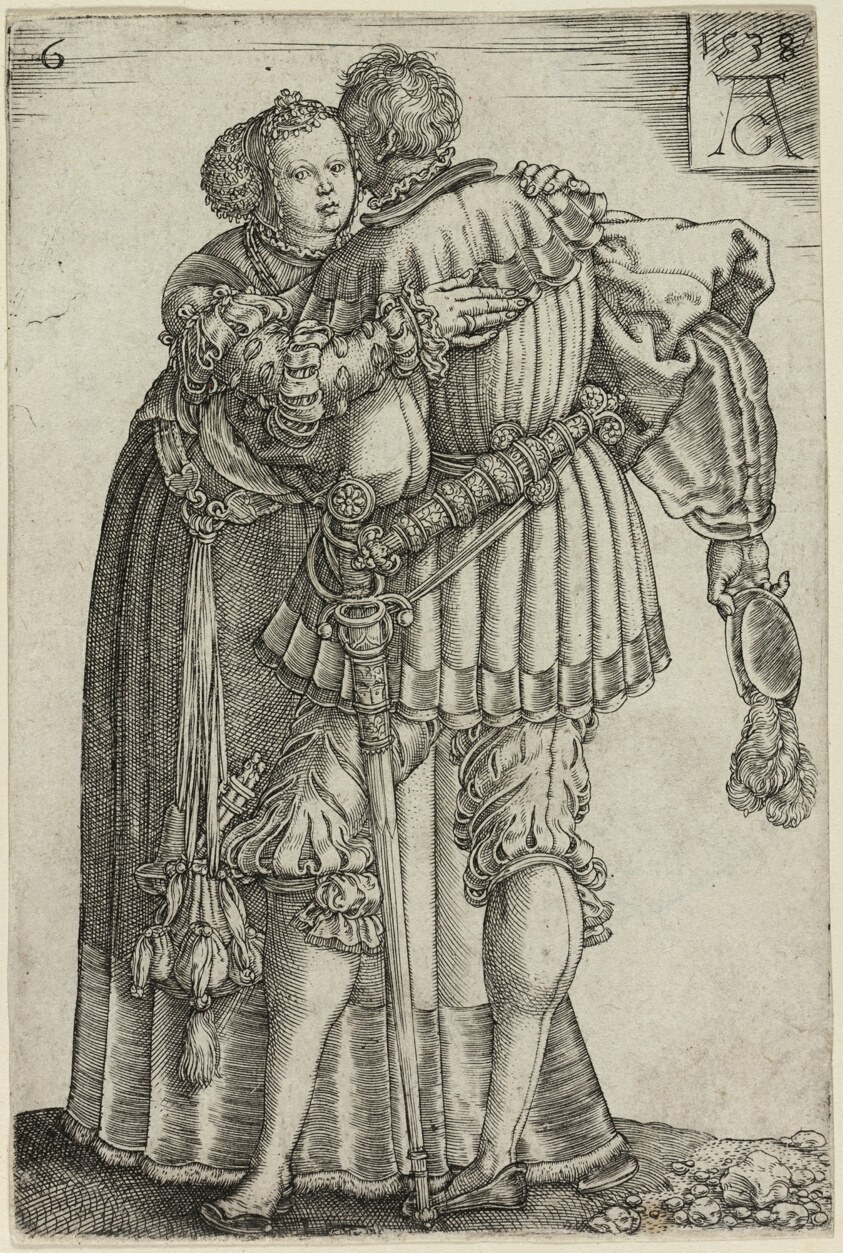
Couple Embracing plate six from The Large Wedding-Dancers
Heinrich Aldegrever
- Source:
- Art Institute of Chicago
- Rights:
- Public domain — free to use, share and adapt.
- Recorded as:
- CC0 (Public Domain)
This image is documentary evidence of how Renaissance couples held each other in courtly dance and social settings, freezing a moment that danced masters wrote about but that we can rarely see. It shows the physical reality behind the verbal descriptions in treatises like Arbeau's *Orchésographie* and Caroso's *Il Ballarino*, making visible the actual postures, the weight distribution, and the quality of contact that Renaissance dance required. For anyone studying the history of partner dance, courtship, or the body in Renaissance society, this engraving is primary source material.
What you are looking at
A man and woman stand facing each other in an intimate embrace, the woman on the left turning her head toward the man's shoulder. Both wear elaborate Renaissance-era costume: the man is dressed in a richly decorated short doublet with puffed sleeves, ornate armor plating across the chest and arms, and jeweled fastenings down the front; the woman wears a long dark gown with a white linen undershirt, her hair arranged in an elaborate coiffure with what appears to be jeweled netting or cauls. The man's right arm encircles the woman's waist while his left hand rests near her shoulder; her arms are at her sides or gently touching him. Both figures are rendered with careful attention to the texture and drape of their costly fabrics. The composition is set against a plain background with only pebbles or stones scattered at the base of the figures, suggesting neither a specific interior nor exterior locale. The scene captures a moment of courtly tenderness or perhaps a figure study of the embrace itself.
The dancing
The man stands with his weight evenly distributed, his torso slightly forward in a posture of attentive engagement. The woman's posture is more yielding; her head turns away from the viewer, creating a sense of intimacy and trust. The embrace is neither stiff nor acrobatic—it reads as a social or courtly hold rather than a performance movement. The woman's arms hang naturally, and the man's upper body curves toward hers in a gesture of care rather than support or lift. Both figures maintain an upright carriage typical of Renaissance court bearing.
The dance depicted
This image most likely documents or imagines a Renaissance court dance or perhaps a posed moment from the *ballo* tradition, in which couples would move through stately, choreographed patterns often involving changes of hold and position. The embrace shown here—a moment of contact and mutual regard—was a feature of certain Renaissance dances such as the *volta* or *galliard*, both of which permitted physical closeness unusual in earlier medieval courtly dance. However, the image may also represent a non-dance moment of courtly affection, a painted record of dancing manners, or an illustration for a dancing master's manual. Without inscription or clear narrative context, the exact dance cannot be named with certainty.
How it was made
This is a fine engraving, likely made from a copper plate. The parallel lines (hatching) used to create shadow and volume are characteristic of sixteenth-century engraving technique. The medium permitted fine detail in costume, jewelry, and facial features—crucial for a work that seems intended as a record of courtly dress and deportment. Engravings of this kind circulated widely in print form, making them accessible to dancing masters, courtiers, and those aspiring to learn courtly manners across Europe. The plate's small size and portable nature suggest it may have been part of a series or bound with a text on dance or courtesy.
About this work
This engraving preserves a moment of Renaissance courtly embrace, likely from a dance manual or pattern book intended to teach genteel behavior and movement to the nobility. The work sits at the intersection of dance instruction, fashion documentation, and courtly conduct; it shows us not just a dance step but a social ideal—the proper bearing of a couple, the sanctioned proximity between man and woman, the costly dress that announced their status. The image belongs to a long tradition of printed instruction in dance, deportment, and courtesy that flourished in sixteenth-century Europe, particularly in Italy, France, and the Low Countries.
The work demonstrates the engraver's skill in rendering rich costume and human intimacy at a small scale, and it preserves for us the visual language of Renaissance dance before the court ballets and theatrical forms of the seventeenth century. Such engravings were tools of cultural transmission: they taught, they documented, and they circulated ideals of grace and nobility to readers who might never see a court dance performed.
How to look at it
Notice the precision with which the engraver has rendered the textures of cloth—the soft pleats of the woman's gown, the jeweled studs of the man's armor, the sheen of silk. This attention to costume is not incidental; in Renaissance society, dress was a primary language of status and identity. Look at the posture and the hands: the man's arm curves around the woman's waist in a gesture that is both protective and demonstrative, while the woman's head turns away in a posture of yielding that was considered modest and graceful. The composition is formal and symmetrical, like a pattern or a lesson, not a snapshot of movement. The artist has chosen a moment of stillness within the dance—perhaps a moment of contact or a held position—rather than attempting to show dynamic movement. This was the convention of dance instruction: freeze a position so it could be studied and learned.
The period
This work dates to the sixteenth century, a period of intense codification and publication of dance instruction in Europe. The rise of the printed book and the spread of engraving technology made it possible to circulate images of dance and courtly behavior far beyond the courts themselves. In Italy and France particularly, dancing masters and courtiers were beginning to record their knowledge in printed form—among them Thoinot Arbeau (whose *Orchésographie* appeared in 1588) and Fabritio Caroso (whose *Il Ballarino* was published in 1581). These works combined text with woodcuts and engravings showing figures in various dance positions and holds. The Renaissance court dance itself was at its height: the *ballo*, *pavan*, *galliard*, and *volta* were the fashionable dances of the nobility, and the *volta* in particular was famous—and slightly notorious—for the close physical contact it required between partners, including the lift and turn that made it thrilling and transgressive.
Where it lives
The work is recorded in the collection of the Art Institute of Chicago. It is part of the broader tradition of Renaissance and early modern prints—engravings and woodcuts—that served as instruction manuals and cultural documents circulating throughout educated European society.
Dance in this work
Questions about this work
Is this a real dance or an imagined one?
It is almost certainly a real dance or a real moment of courtly comportment, documented by the engraver as a guide for learning. Renaissance dancing masters created and published illustrated manuals teaching the steps, holds, and positions of the dances of the court. This image has the character of such instruction material—it shows a specific posture and hold, not a fantasized or theatrical scene. However, without an inscription or title we cannot name the exact dance with certainty.
Why are they dressed so elaborately?
Elaborate dress was a requirement of courtly dance and a marker of social status. Renaissance nobility danced in full court costume, often including jeweled belts, ornate sleeves, and carefully arranged hair. The costliness of the garments shown here—the jeweled doublet, the fine linen, the netting—would have been visible and important to contemporaries, signaling that these were persons of rank and refinement. The engraver's attention to costume detail reflects this social reality.
What can we learn about Renaissance dance from this image?
This engraving shows us that Renaissance courtly dance permitted close physical contact between partners—a significant fact, since earlier medieval dance kept partners at a distance. It also demonstrates the upright, dignified posture that was required: neither figure slouches or leans heavily. The hold itself—the man's arm around the woman's waist, his other hand near her shoulder, her arms at her sides—was a standard position in many Renaissance dances. Such images are crucial historical evidence for understanding how bodies moved and related to each other in the past.
More dance artwork