49 works in this view — arrow keys or swipe to move between them.
Dance in Art
Dancer at the Bar on Point
Hilaire Germain Edgar Degas
- Source:
- Art Institute of Chicago
- Rights:
- Public domain — free to use, share and adapt.
- Recorded as:
- CC0 (Public Domain)
The barre has become so central to ballet pedagogy that we forget it was not always standard practice; this drawing documents the moment when it became the indispensable tool of ballet training. For dancers and historians of technique, it shows the specific arm positions and postural alignment that defined classical ballet in the 19th century. For art historians, it represents the growing interest among visual artists in the mechanics and training of dance, not just its performance.
What you are looking at
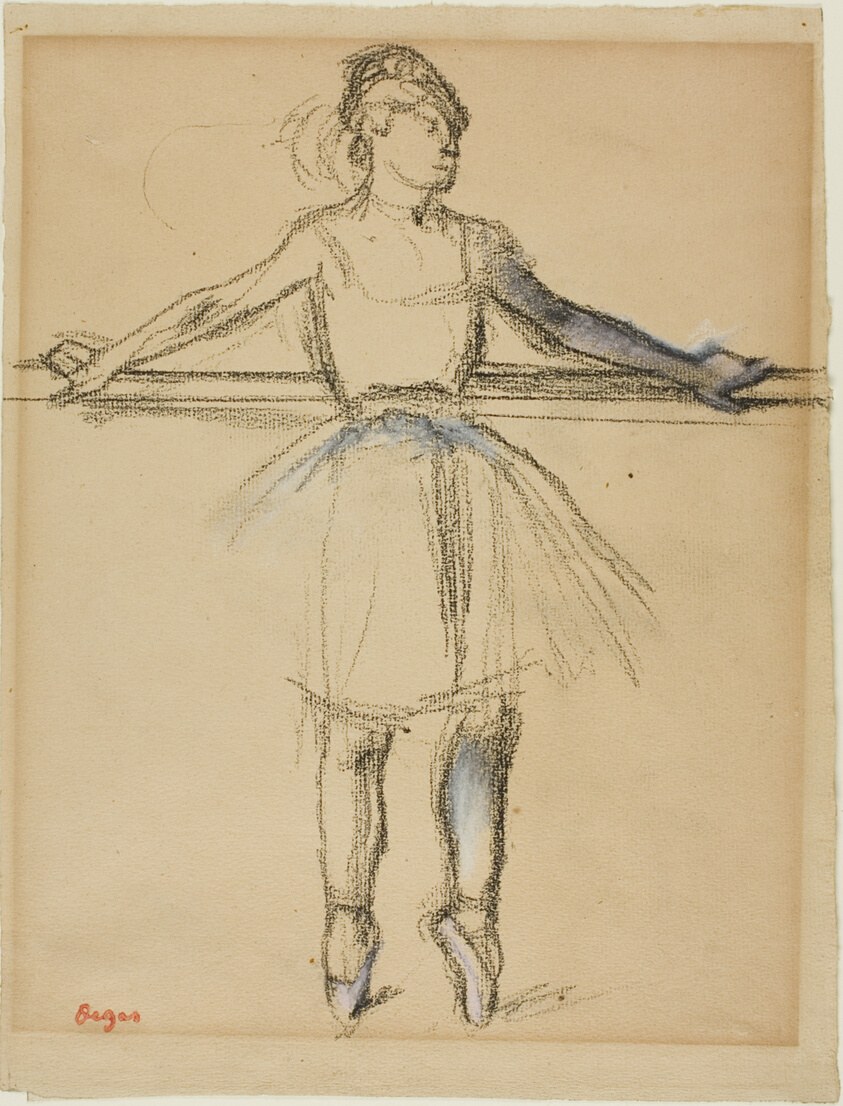
A single female dancer, shown in a three-quarter standing pose against a plain background, dominates the composition. She wears a fitted bodice with short sleeves and a full, voluminous skirt that extends to mid-calf, rendered in soft blue wash. Her head is tilted slightly upward and to the side in a graceful, introspective attitude. Her arms are extended horizontally in a classical ballet port de bras, with the right arm fully extended and the left arm raised, creating an open, expansive frame. The artist has used loose, hatched pen work to define musculature and form, with selective blue watercolor wash adding volume and dimension to the skirt and suggesting stage lighting. The paper is aged cream, and the drawing has the quality of a study or rehearsal notation rather than a finished exhibition piece.
The dancing
The dancer stands on two feet in what appears to be a turned-out position, the classical ballet stance. Her weight appears centered, with both legs straight and engaged. The extended arms and lifted head create the impression of suspension or elevation, even though both feet remain grounded. The torso is held upright with lengthened spine, characteristic of academic ballet training. The arm positions—one extended fully to the side at shoulder height, the other raised—show understanding of ballet's geometric clarity and the deliberate control of limbs in space.
The dance depicted
This is a study of classical ballet technique, most likely depicting a moment in an academic class or rehearsal rather than a finished choreographic sequence. The pose does not correspond to a specific named step but rather represents the fundamental carriage and port de bras of 19th-century ballet. The bar referenced in the title—indicated by a faint horizontal line running across the composition at waist height—would be the wooden support used in ballet training, where dancers develop control and strength. The dancer's position at the bar, with arms in second position, is a foundational exercise in ballet vocabulary.
How it was made
This is a pen and ink drawing with watercolor wash, a medium favored by 19th-century artists for its speed and expressiveness. The hatched pen lines build form through careful cross-hatching, a technique that allows the artist to suggest three-dimensionality and muscle tension. The selective application of blue watercolor, particularly to the skirt, creates atmospheric depth and focuses the viewer's attention; this selective coloring was economical and common in working drawings or studies made for reference rather than exhibition. The aged cream paper and loose, working quality suggest this is a studio study or visual note rather than a formal finished work.
About this work
This is a carefully observed study of a ballet dancer at the barre, a standard element of classical ballet training that emerged and solidified as essential pedagogy in the 19th century. The work demonstrates technical knowledge of ballet posture and the vocabulary of arm positions, rendered with the economy and precision of an artist-observer familiar with dance practice. The informal medium and working quality suggest it may be a study document—perhaps created during a class or rehearsal—rather than a finished artwork intended for exhibition. It is a valuable record of how ballet training was understood and visualized in the 19th century, when the barre had become the disciplinary anchor of academic ballet technique.
How to look at it
Observe how the artist has frozen the dancer in a moment of stillness and control rather than dynamic movement. The extended arms and lifted gaze create an impression of quiet dignity and disciplined grace. Notice how the blue wash is applied selectively to the skirt, creating volume and suggesting the weight of fabric, while the upper body remains more linearly defined—this differential rendering directs attention to the ballet dancer's essential alignment and posture. The faint horizontal line of the barre is deliberately understated, anchoring the composition while remaining subordinate to the figure.
The artist
The catalogue attributes this work to an unknown hand, and without a signature or additional documentation visible in the image, attribution remains open. The style and technique are consistent with mid-to-late 19th-century practice in France or Western Europe, where ballet training and its documentation were receiving increased artistic attention. The loose, observational quality suggests an artist with direct access to the dance studio or classroom—possibly a dancer, choreographer, or a visual artist specifically commissioned to document training methods.
The period
In the 19th century, particularly after 1830, ballet underwent a profound transformation toward increasing technical virtuosity and standardized pedagogy. The barre, initially a simple rehearsal aid, became codified as essential to classroom practice. By the mid-19th century, visual artists began to take serious interest in dance practice and training, not merely performance. This was partly due to the rise of Romantic ballet, which placed new physical demands on dancers, and partly due to a broader 19th-century fascination with documenting human movement and labor. Photography was emerging as a documentary tool, but drawing and watercolor remained the preferred medium for studio observation, where the artist could work quickly and selectively.
Where it lives
The work is held in the Art Institute of Chicago, catalogued in their collection. Its acquisition history and previous provenance are not recorded in the available catalogue data.
Dance in this work
Questions about this work
What is the bar the title mentions?
The barre is a horizontal wooden rail, waist-height, used in ballet training. Dancers hold it while performing exercises to develop strength, control, and alignment. By the 19th century it had become a standard element of ballet pedagogy, and by the period of this drawing it was already indispensable to professional training.
What is the dancer doing?
She is executing a basic port de bras (carriage of the arms) exercise at the barre, holding a turned-out standing position. The arms are in second position—extended to the sides at shoulder height. This is foundational ballet vocabulary, a controlled exercise in arm placement and épaulement (the placement and movement of the shoulders) rather than a performance step.
Is this a finished artwork or a study?
The medium and working quality suggest it is a rehearsal study or artist's note rather than a finished exhibition piece. The loose pen work, selective watercolor application, and informal composition are consistent with working drawings made on-site in the dance studio. This does not diminish its value—such studies often contain careful observation and technical knowledge.
Who made this?
The artist is unknown. The style is consistent with 19th-century French or Western European practice, and the artist's familiarity with ballet technique suggests either direct involvement in dance or close collaboration with dancers or choreographers.
More dance artwork