49 works in this view — arrow keys or swipe to move between them.
Dance in Art
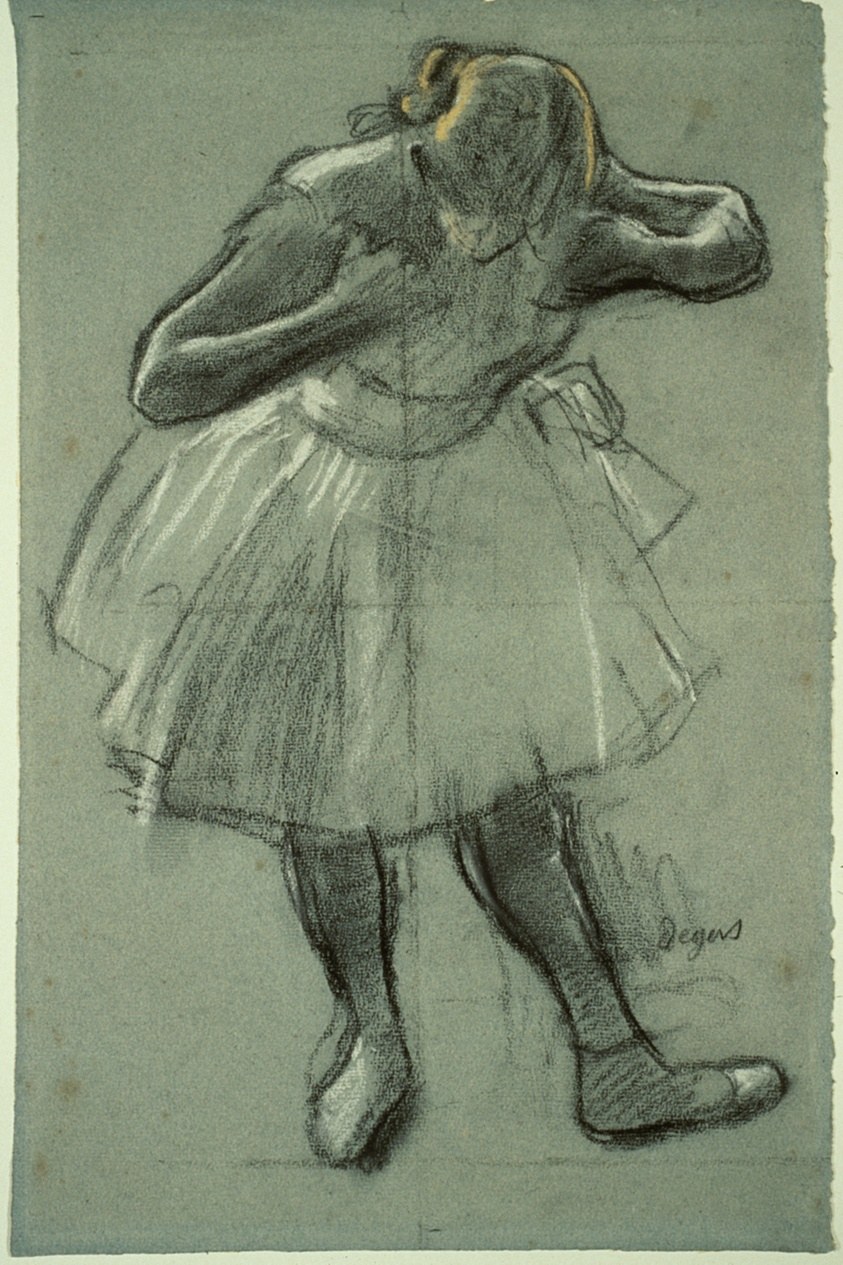
Dancer Bending Forward
Hilaire Germain Edgar Degas
- Source:
- Art Institute of Chicago
- Rights:
- Public domain — free to use, share and adapt.
- Recorded as:
- CC0 (Public Domain)
This drawing documents a historical moment in dance training and performance when the female body's flexibility and extension had become central to ballet vocabulary. For dancers and historians, it offers precise visual evidence of how bodies moved and what was demanded of them, captured by an artist trained to see and record movement with accuracy. It also demonstrates how dance became a subject worthy of serious artistic study in its own right—not as narrative or spectacle, but as form and human capability.
What you are looking at
A young female dancer captured mid-movement in a charcoal and chalk drawing on toned paper. She bends sharply forward from the waist, her upper body angled toward her knees in a posture of dramatic flexion. She wears a short skirt with deep pleats that fall in clean vertical lines, creating a bell shape around her legs, and the fabric catches light along its folds. Dark stockings and shoes anchor her lower half. Her head tilts back slightly as her body folds, creating a striking S-curve from her extended arms to her lowered torso. The artist has rendered the figure with particular attention to the play of light on the pleated skirt and the muscular tension implied by the bent torso. The pose suggests a moment of suspension—neither fully descending nor recovering—caught with the specificity of a rehearsal study or a moment seized from live movement.
The dancing
A single dancer shown in isolation against an empty background. Her weight is shifted forward onto her legs, which remain nearly straight, while her upper body folds deeply at the hips. Her arms are raised and extended, with one arm visible on the far side suggesting a frame of controlled reach rather than flailing. The posture demands significant flexibility and core strength; the artist has captured the moment of deepest fold, not the beginning or end of the movement. The rendering of her limbs suggests a trained body, and her proportions and deportment are consistent with professional dance training.
The dance depicted
The posture and flexibility required suggest classical or theatrical ballet, where deep forward folds and extensions are fundamental vocabulary. The specific moment—a fully executed penché or arabesque variation, or possibly a moment from a contemporary movement vocabulary layered over classical training—is difficult to pinpoint without knowing the choreographic source. The short skirt and fitted bodice are consistent with late 19th or early 20th century theatrical dance costume. The drawing's style and the dancer's physique suggest this is either a study from live performance or a portrait of a professional dancer in her characteristic movement vocabulary, rather than an imaginary or allegorical figure.
How it was made
Charcoal and chalk (likely white or light chalk for highlights) on gray or blue-green toned paper. This technique, traditional for figure studies and ballet documentation, allows for rapid capture of movement and nuanced modeling of form through tonal gradation. The immediacy of the medium—capable of being worked quickly and reworked—suggests this is either a life study or a professional sketch made from performance or rehearsal observation. The unsigned but marked lower right suggests a signature or artist's mark in a style consistent with late 19th or early 20th century practice. The technique and finish indicate this was a finished study intended for exhibition or collection, not a casual sketch.
About this work
This is a virtuoso study of a female dancer in a moment of profound spinal flexion, rendered in charcoal and chalk on toned paper. The drawing captures not just the pose but the physical fact of trained flexibility and muscular control—the knowledge of how ballet bodies work. The date and artist remain unknown, but the style, costume, and execution point to the late 19th or early 20th century, a period when dance studies became an artistic and documentary subject in their own right. The work represents a convergence of observational art and dance documentation, made by an artist with genuine understanding of both the visual form and the physical labor of theatrical dance.
How to look at it
Attend to the moment the artist chose: the deepest point of the fold, where the drama of the movement is most extreme. Notice how the pleated skirt is rendered—each fold catches light differently, describing the fabric's fall and the body's three-dimensional shape beneath it. The artist has exaggerated neither the drama nor softened it; the proportions and anatomy are accurate to what a trained dancer's body actually does. Consider whether you can see the thought in the posture—the intentionality of the movement—or whether it reads as mere display of flexibility. The signature or mark at lower right suggests this was a work of professional standing, made to be seen and preserved.
The period
The late 19th and early 20th centuries saw an explosion of interest in capturing movement through visual media—photography, drawing, sculpture, and early film all competed to document and analyze human motion. In dance specifically, this was the era of the Romantic ballet's decline and classical ballet's solidification under Russian imperial influence, when dancers' technique became increasingly demanding and extensibility a primary marker of professional status. The turn toward modernism in visual art coincided with modernism in dance; artists were drawn to movement as a fundamental subject. Ballet, with its codified vocabulary and rigorous training, offered both technical challenge and aesthetic interest to serious draftsmen.
Where it lives
The work is held in the Art Institute of Chicago. It is recorded as a catalogue entry from that collection, suggesting it entered at some point during the museum's history of acquiring works on paper. The source designation (aic) indicates it is a museum object, not a private collection piece, and has been considered significant enough for accession and preservation.
Dance in this work
Questions about this work
What dance is this?
The specific ballet or choreography cannot be determined from the image alone. The posture—a deep forward fold with raised arms—is consistent with classical ballet vocabulary of the late 19th and early 20th centuries, but without documentation of the original context, it cannot be attributed to a particular work or artist.
Is this a real person or an idealized figure?
The specificity of the anatomy, the truthfulness of the proportions, and the precision of the rendering all suggest this is a study from life—either from a living dancer observed in rehearsal or performance, or from a professional model who was also a trained dancer. The artist clearly understood trained bodies.
Why was this drawing made?
It may have been made as a study for a larger work, as a record of a particular dancer's capabilities or a particular choreography, or as a professional drawing intended for exhibition or sale. The finish and care of execution suggest it was considered a finished work rather than a preparatory study.
More dance artwork