49 works in this view — arrow keys or swipe to move between them.
Dance in Art
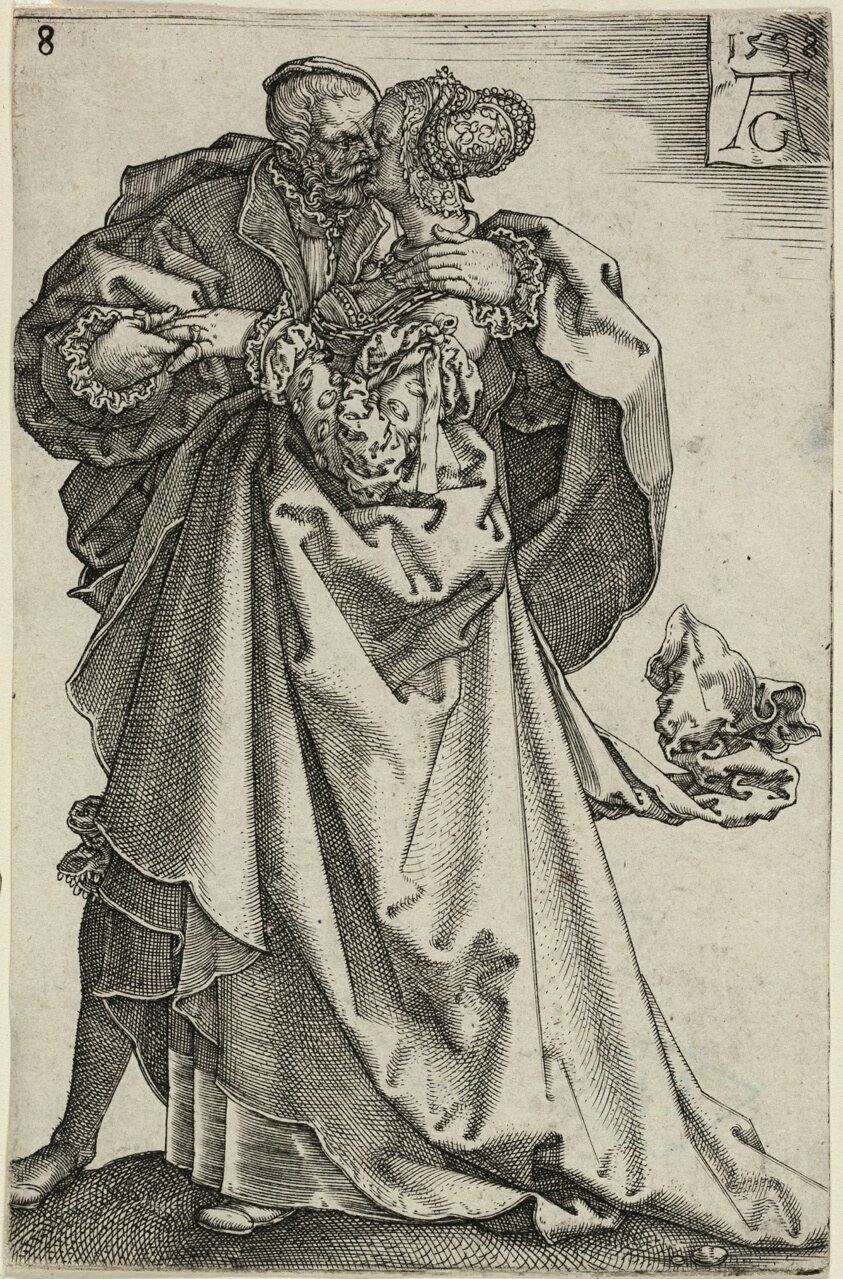
Dancing Couple plate eight from The Large Wedding-Dancers
Heinrich Aldegrever
- Source:
- Art Institute of Chicago
- Rights:
- Public domain — free to use, share and adapt.
- Recorded as:
- CC0 (Public Domain)
This is one of the earliest detailed, carefully rendered images of European courtly dance in actual performance. It shows us not what dance masters said dances should look like (as in written manuals) but how artists understood and conveyed the lived experience of a dance: the weight, the embrace, the precision of dress and posture. For historians of Renaissance court culture, costume, and social practice, it is invaluable evidence of how an educated European noblewoman and nobleman moved together in their own world.
What you are looking at
A bearded man in early 16th-century dress—a dark wool coat with fitted sleeves and voluminous skirts, white linen collar and cuffs—dances with a woman in an elaborate gown of pale linen, her bodice richly embroidered and her skirts full and sweeping. The woman wears a jeweled headdress with trailing ribbon or veil. Both figures are caught mid-movement in what appears to be a courtly embrace or turning figure. The man's weight is forward on one leg, his arm raised and bent, while the woman leans into the dance, her body curved, her skirts billowing. A small figure—perhaps a child or attendant—peers from behind or between them. The composition is tightly framed, almost intimate, against a plain background with fine parallel shading lines that give depth. The engraving is meticulously detailed: every stitch of embroidery is rendered, every fold of fabric modeled with hatching. The mood is one of elegant formality, though the bodies are fluid and the moment captured one of active movement.
The dancing
The couple holds a close, formal frame typical of Renaissance court dance: the man's right arm is raised and bent, likely holding the woman's hand or arm, while his left arm may support her waist or back. The woman's posture curves into the turn, her weight shifted, one leg extended as the skirts swing. The man's forward-stepping stance and the woman's responding lean suggest a turning or processional movement. A third figure, much smaller and in shadow, suggests either a pageboy attendant or a child participant, adding social context to what appears to be a formal dance at court.
The dance depicted
This is almost certainly a basse danse or pavane—the principal courtly dances of the early 16th century. The close hold, the formal dress of the highest nobility, the processional yet turning quality, and the deliberate, measured posture all align with Renaissance court dance as documented in Arbeau and other dance masters' manuscripts. The image shows the slow, stately dignity for which these dances were known: no jumping or vigorous movement, but a careful interweaving of processional steps with turns and reverences. The presence of what may be a young attendant suggests a court or noble household context, where such dances were learned and performed as part of genteel education.
How it was made
This is an engraving on paper or vellum, executed with fine parallel hatching lines to create tone and volume. The technique allows for extraordinary detail—every thread of embroidery is distinct, every fold of cloth is modeled—and suggests the work was made for circulation among the educated elite, probably as part of a printed album or manual. The precision and the plate mark visible at the edges suggest professional production, likely by a printmaker familiar with dance iconography, though the artist's name is not recorded. Engravings of this period were expensive objects, owned by courts, nobles, and wealthy merchants; they served both as records of fashion and social practice and as instruction in courtly behavior.
About this work
This engraving depicts a couple performing a Renaissance court dance, almost certainly a basse danse or pavane, sometime in the early 16th century. The work is one plate from a series titled *The Large Wedding-Dancers*, a printed album likely intended to instruct or commemorate courtly dance practice. The image captures the formal, processional character of early Renaissance dance: slow, measured, intimate in its frame yet ceremonious in its bearing. It is a record of how the nobility danced and dressed when dance was an essential skill and public art form of the court.
How to look at it
Pay attention to the posture of the couple's bodies: notice how the woman's weight shifts into the turn, how her arm and his are held in a formal frame, how both figures seem to pause at a moment of transition. The artist has frozen the dance at a moment when it is neither static nor explosive—a courtesy, a turn, or a reverential step. Observe how the dress itself is part of the dance: the woman's skirts, swinging and full, are rendered as actively as her body. The background shading and the careful hatching create a sense of forward momentum and spatial presence that makes this couple seem to move even in stillness.
The artist
The artist is not recorded in the catalogue. The work belongs to a tradition of printmaking and dance documentation in the German-speaking territories of the early 16th century, where woodcut and engraving workshops were producing both technical manuals (like those of Hans Burgkmeyer the Elder) and series of social and courtly scenes. The precision of execution and the sophisticated rendering of fabric and light suggest a trained reproductive engraver, possibly working from a drawing by a painter; such collaborative practice was common in major printmaking centers like Augsburg, Nuremberg, or Basel.
The period
The early 16th century was the height of the basse danse and pavane in European courts. These dances, which had evolved over the 15th century from earlier court traditions, were codified in printed manuals (most famously by Antonius Arena in 1536 and Thoinot Arbeau in 1588). Dancing was a compulsory accomplishment for any noble or courtier; a young man or woman who could not dance well was considered ill-educated. The clothing depicted here—the richly embroidered bodice, the jeweled headdress, the wool coat with slashed sleeves (visible in the man's garment)—dates to the reign of the early Tudors or the contemporary courts of the Habsburgs or Valois. Printmaking was simultaneously becoming the major vehicle for circulating images of courtly life, fashion, and manners to a broad audience of merchants and minor nobility who aspired to court culture.
Where it lives
The work is catalogued at the Art Institute of Chicago and is identified as plate eight from a printed series titled *The Large Wedding-Dancers*. The series appears to be a 16th-century German or Flemish production, likely a multi-plate engraving sold as an album or portfolio of courtly dance scenes. The survival of individual plates from such series is common; complete sets are rare.
Dance in this work
Questions about this work
What is the couple dancing?
Almost certainly a basse danse or pavane, the two most important courtly dances of the Renaissance. Both were slow, stately, processional dances performed by couples in formal court dress. The basse danse (literally 'low dance') was known for its smooth gliding steps and formal reverence; the pavane was a stately procession. Both required training and were marks of noble status.
Why is this couple's dress so elaborate?
In Renaissance courts, dance was not entertainment—it was a formal social practice and a display of status, education, and wealth. The woman's embroidered bodice, jeweled headdress, and flowing skirts, and the man's fine wool coat and linen would have cost a fortune and been worn only for court occasions. The clothing itself was part of the performance.
Who made this engraving?
The artist is not recorded. It is one of a series called *The Large Wedding-Dancers*, likely produced in a German or Flemish printmaking center in the early 16th century. The precision and technical skill suggest a professional reproductive engraver, possibly working from a drawing by another artist.
What was 'The Large Wedding-Dancers'?
A printed album or portfolio of engravings depicting courtly dances, almost certainly intended for circulation among the educated elite—nobles, merchants, and minor courtiers who aspired to courtly knowledge. It served both as a record of fashionable court practice and as a form of instruction in courtly behavior.
More dance artwork