49 works in this view — arrow keys or swipe to move between them.
Dance in Art
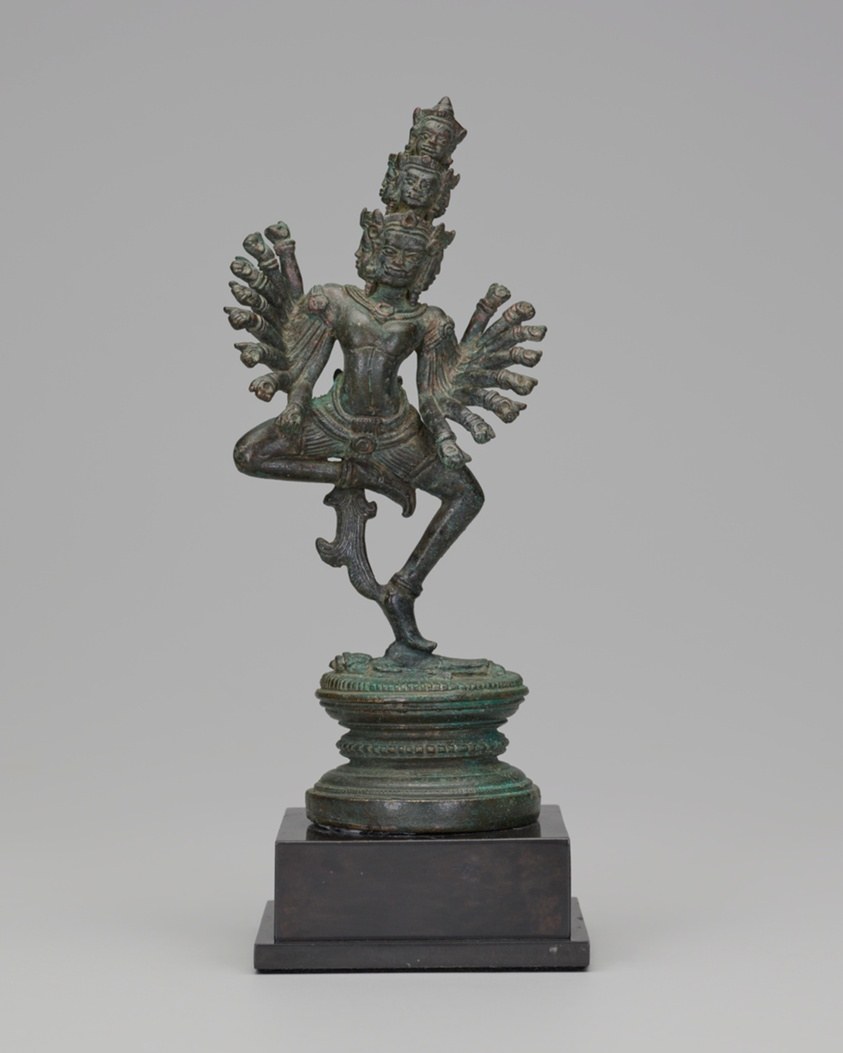
Dancing Hevajra emArdhaparyankaem
Khmer
- Source:
- Art Institute of Chicago
- Rights:
- Public domain — free to use, share and adapt.
- Recorded as:
- CC0 (Public Domain)
This work documents a conception of dance radically different from Western theatrical traditions: dance as sacred movement intrinsic to religious practice, where the fixed pose captures an eternal moment of divine ecstasy. For dance historians, it demonstrates how cultures outside the ballroom and concert stage used the moving body to embody spiritual states and philosophical concepts. The sculpture's presence in an art museum raises important questions about how sacred objects are classified and displayed once removed from their ritual context.
What you are looking at
A bronze sculpture of a multi-armed dancing figure stands on a tiered circular base. The figure is rendered in the classical South Asian style, with an elegant, tilted contrapposto stance and a face framed by an ornate tall crown or headdress composed of stacked, abstract forms. The body is bare-chested and wears a decorative belt; the stance shifts weight onto one leg while the other bends. The figure's arms extend outward in various positions—some raised at shoulder height with palms open in characteristic gestures, others at different angles—creating a sense of dynamic symmetry around the central axis of the body. The patina shows rich greens and browns typical of aged cast bronze. The base is decorated with repeating circular patterns and sits on a modern black stone plinth, suggesting this is a museum mounting of what is likely a historic Indian sculpture.
The dancing
The figure employs a fundamental contrapposto stance with the weight shifted to the right leg, the left knee bent in relief. All four arms are arranged in sculptural symmetry, with hands in open, articulate positions suggesting mudras (ritualized hand gestures). The upper arms extend laterally from the shoulders; the lower arms angle downward and forward. The torso twists slightly to engage with the spatial demands of the multiple limbs. The posture is upright and formally composed rather than naturalistic, emphasizing the geometric ordering of the body in three dimensions.
The dance depicted
This appears to be a representation of Hevajra, a deity from tantric Buddhism, depicted in dancing form—consistent with the catalogue title. Hevajra is traditionally portrayed as a multi-armed dancing figure, often in a posture of dynamic ritual movement (often called ardhaparyankaasana or a variation thereof). The four arms are characteristic of Hevajra iconography. The dance is not a social or theatrical form but rather a sacred or ritual enactment embedded in religious practice and visualization. The sculpture captures the moment of divine ecstatic movement, translated into bronze as a fixed but energetic pose. The figure embodies the union of wisdom and method central to tantric Buddhist philosophy.
How it was made
This is a hollow bronze casting, likely created using the lost-wax technique characteristic of Indian metal casting, particularly in South Asian workshop traditions. The fine detail in the face, crown, and hand gestures, along with the precise surface patination, indicates skilled craftsmanship of considerable sophistication. The monumental scale and assembly on a formal museum base suggest this was either a ritual object of significant status or a prestige work created for a temple or wealthy patron. Bronze casting allowed for the creation of multiple arms and intricate spatial relationships that would be difficult to achieve in stone.
About this work
This is a bronze sculpture representing Hevajra in dancing posture, a subject drawn from tantric Buddhist iconographic tradition. The figure's four arms, elaborate headdress, and dynamic stance are characteristic of Himalayan or Indian metal sculpture traditions, likely dating to the medieval period or later. It represents not a theatrical or social dance but a sacred form of divine movement embedded in Buddhist ritual visualization and philosophy. The work sits at the intersection of religious art and dance representation—the sculpture preserves in bronze a pose that would have been performed or mentally visualized in tantric Buddhist practice.
How to look at it
Examine the four-armed figure as a moment frozen in perpetual motion. Notice how the artist has organized the limbs symmetrically around the vertical axis of the body, creating stability in apparent movement—a formal principle that distinguishes sacred dance sculpture from naturalistic depiction. Study the hand positions: each palm is articulated with care, suggesting that these are not random gestures but specific mudras carrying meaning. The headdress, rather than being mere ornament, is a crown of symbolic form. The slight twist of the torso and the engaged contrapposto stance indicate that this figure is conceived as actively dancing, not passively standing.
The period
This sculpture belongs to a long tradition of South Asian bronze casting that flourished particularly in medieval India and Tibet, and continued into later periods. The Chola bronzes of South India (10th–12th centuries) established the technical and aesthetic standards that influenced tantric Buddhist sculpture across the Himalayan region. Hevajra became an increasingly important figure in tantric Buddhism from the 11th century onward, and his dancing form became a favored subject in Tibetan and Nepalese metalwork. The style and iconography suggest this could date anywhere from the medieval period to the 18th–19th centuries, depending on regional production centers.
Where it lives
The work is held by the Art Institute of Chicago, one of the major repositories of South Asian sculpture in the United States. No accession number, acquisition date, or prior provenance is recorded in the available catalogue entry. The sculpture is mounted on a modern museum base, indicating it was professionally installed within a Western collecting and display context.
Dance in this work
Questions about this work
What does the title 'Ardhaparyankaasana' mean?
Ardhaparyankaasana refers to a pose in which one leg is drawn up while the other is extended or in contact with the ground—a classical yoga and dance posture. In the context of Hevajra, this pose is part of the formal iconographic language indicating divine ecstatic movement. The Sanskrit term points to the Indian philosophical and physical traditions that inform this type of sculpture.
Why does Hevajra have four arms?
In tantric Buddhist iconography, multiple arms serve symbolic and narrative functions. Each arm may hold or gesture toward different ritual objects or directions, collectively expressing the deity's powers and aspects. The four arms suggest totality, balance, or the encompassing of multiple divine functions—a visual language that operates very differently from naturalistic human representation.
Is this a dance from a real performance tradition?
Hevajra is not a theatrical or social dance, but rather a form of sacred movement described in tantric Buddhist texts and performed in ritual contexts and yogic visualization practices. Monks and practitioners would embody or visualize this pose as part of meditation and ceremonial practice. The sculpture preserves a sacred posture rather than a choreographed dance.
How old is this sculpture?
The catalogue record does not provide a date. The style and casting technique are consistent with South Asian and Himalayan bronze sculpture traditions spanning several centuries (roughly 11th–19th centuries). A specialist in Indian metal sculpture would be needed to narrow this significantly.
More dance artwork