49 works in this view — arrow keys or swipe to move between them.
Dance in Art
Ghost Dance The Vision of Life
Ralph Albert Blakelock
- Source:
- Art Institute of Chicago
- Rights:
- Public domain — free to use, share and adapt.
- Recorded as:
- CC0 (Public Domain)
The Ghost Dance was a transformative moment in Indigenous American history—a movement of spiritual renewal and resistance to colonization and cultural erasure. This artwork is a rare instance of the Ghost Dance as a subject in fine art, capturing not its ceremonial choreography but its meaning as vision and collective spiritual practice. For dance historians and scholars of Indigenous cultures, the painting raises essential questions about how non-Indigenous artists represent Indigenous sacred practice, and how abstraction and expressionism can honor visionary experiences that resist literal documentation.
What you are looking at
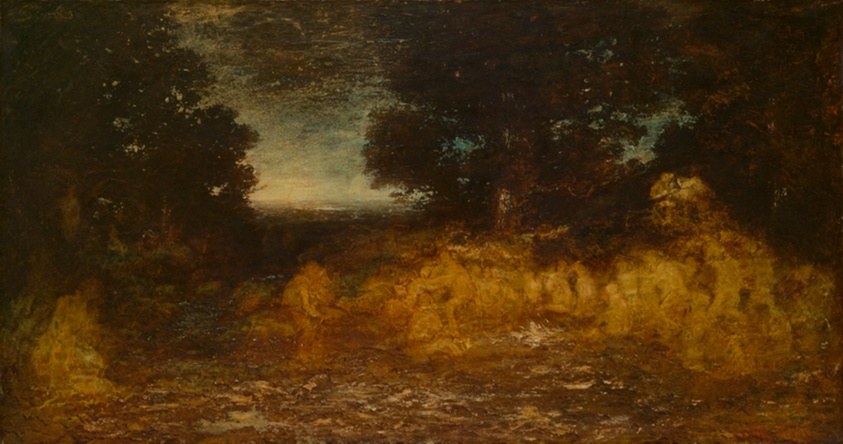
A nocturnal landscape dominated by warm ochre and brown tones, rendered with heavy impasto and atmospheric haze. Bare or sparsely leafed trees frame both sides of the composition, creating a natural corridor that recedes toward a distant horizon where a pale sky glimmers. The foreground is occupied by undulating, ghostly forms rendered in thick golden-brown pigment—these appear to be multiple figures in motion, their bodies blurred or merged together, creating an impression of movement or transcendence rather than anatomical clarity. The forms suggest collective rapture or spiritual ecstasy, rising and swaying rather than standing still. The lighting is dreamlike and chiaroscuro, with the pale central distance contrasting sharply against the darker, more densely worked foreground and flanking trees. The overall effect is visionary and ethereal rather than documentary.
The dancing
The figures in the foreground lack clear anatomical definition; instead, they read as massed, undulating forms rising from the earth. The bodies appear to be in states of elevation, swaying, or trance-like movement, with arms and limbs suggested rather than precisely depicted. There is no formal dance hold or frame; instead, the impression is of spontaneous, ecstatic bodily expression—bodies moving upward and inward, perhaps in a circle or gathered mass. The lack of definition amplifies the sense of spiritual or visionary experience over technical choreography.
The dance depicted
The work's title, *Ghost Dance The Vision of Life*, directly references the Ghost Dance, the late 19th-century spiritual and resistance movement among Indigenous North American peoples, particularly the Lakota Sioux and other Plains nations. The Ghost Dance was a ritual dance believed to restore the dead, ensure renewal, and resist colonial dispossession. The painting appears to visualize this movement as a visionary or trance state rather than a documentary depiction: the ghostly forms rising from the earth embody the spiritual essence of the dance—communal, ecstatic, visionary—rather than its formal steps. The ethereal treatment reflects how the Ghost Dance itself was often understood by outsiders as mystical or supernatural, though it was a coherent spiritual and political practice.
How it was made
The work appears to be oil on canvas, executed with heavy, expressionistic brushwork and impasto that creates texture and atmosphere. The artist has used warm earth tones—ochre, burnt sienna, dark brown—applied thickly in the foreground and more thinly in the distance to suggest aerial perspective and spiritual dissolution. The technique of obscuring and merging forms rather than depicting them clearly suggests an early-to-mid modernist sensibility, possibly early 20th century, which would align with a period when the Ghost Dance and its history were subjects of artistic and literary interest in the United States. The expressive, non-naturalistic approach indicates the artist's interest in conveying emotional or spiritual truth rather than factual representation.
About this work
This is an visionary landscape painting addressing a major episode in Indigenous North American spiritual and political history. Rather than depicting the Ghost Dance as a documented event or a sequence of recognizable steps, the artist renders it as an ecstatic, transcendent experience—bodies rising from the earth in a collective vision of renewal and resistance. The work sits at the intersection of Indigenous subject matter and modernist artistic practice, representing how early-to-mid 20th-century artists engaged with Indigenous spiritual traditions, sometimes with reverence and sometimes with romantic projection.
The painting's lack of precise anatomical detail and its emphasis on mass movement, light, and emotional atmosphere position it within a broader early modernist preoccupation with spiritual art and non-Western traditions. It offers a form of testimony to the Ghost Dance through abstraction and expressionism rather than realism, suggesting the movement's power as collective vision rather than as a reconstructable sequence of steps.
How to look at it
The viewer should attend to the distinction between the foreground figures and the background landscape: the thick, golden-brown forms in the lower half of the composition are not individual dancers but a collective mass in motion or elevation. Observe how the bodies merge and blur together—the artist is not interested in steps or individual gestures but in the sense of shared, rising ecstasy. Note the contrast between the warm, heavily worked foreground and the pale, luminous distance: this difference of treatment suggests the distance between the physical world and the spiritual vision the title evokes. The painting asks you to feel the experience of the Ghost Dance as transcendent and collective rather than to see and reconstruct its choreography.
The period
The Ghost Dance originated among the Northern Paiute peoples around 1889 and spread rapidly across the Plains, becoming a major force of spiritual renewal and resistance during a period of catastrophic dispossession, reservation confinement, and cultural suppression. The movement reached its most intense expression among the Lakota Sioux of the northern Plains before being violently suppressed—the massacre at Wounded Knee in 1890 killed hundreds of Lakota practitioners and marked a devastating turn for the movement.
In the early-to-mid 20th century, the Ghost Dance became a subject of anthropological study, literary interest, and artistic fascination. Modernist artists, influenced by developments in abstract and expressionist painting as well as by broader intellectual currents of interest in non-Western spirituality and Indigenous traditions, sometimes took up Indigenous subjects as vehicles for exploring abstraction, emotion, and spiritual truth. This painting likely dates from the early-to-mid 20th century, a period when the Ghost Dance was historically remote enough to be treated as a visionary or legendary event rather than a living practice.
Where it lives
The work is held in the Art Institute of Chicago. The catalogue record provides minimal documentation—neither artist, date, nor medium are recorded—which suggests either recent acquisition, limited scholarly study, or that the work was catalogued before such information was systematically preserved. This lack of documentation itself is historically telling: major Indigenous subject matter sometimes entered art historical collections with minimal attribution or contextual information.
Dance in this work
Questions about this work
What is the Ghost Dance and why does it matter to dance history?
The Ghost Dance was a sacred dance and spiritual movement that emerged among the Northern Paiute in 1889 and spread across the Plains, especially among the Lakota Sioux, as an act of spiritual renewal and resistance to colonization. Dancers believed the practice would restore the dead, revive the buffalo, and restore the world as it had been before white settlement. The movement was brutally suppressed, culminating in the massacre at Wounded Knee in 1890. For dance history, the Ghost Dance represents a moment when dance was not entertainment or courtship but survival and prophecy.
Why does the artist not show the actual steps of the Ghost Dance?
The title calls this 'The Vision of Life'—the artist is depicting the spiritual experience of the Ghost Dance rather than its choreography. The Ghost Dance itself involved relatively simple circular steps performed in a trance-like state, often lasting many hours. What was sacred about it was not technical complexity but collective participation, trance, and the vision of renewal it promised. By rendering figures as ghostly, merged, rising forms, the artist conveys the movement's spiritual power and transcendence.
Is this painting made by a Native artist or a non-Native artist?
The catalogue record does not attribute an artist, so we cannot tell. The expressionist, modernist style and the timing (likely early-to-mid 20th century) suggest a professional artist with training in European and American fine art traditions. Without artist information, we cannot determine whether the work comes from an Indigenous perspective or from a non-Indigenous artist's interpretation of Indigenous spiritual practice—a distinction that significantly shapes how we read the work.
How do we know this is about the Ghost Dance and not some other Indigenous ceremony?
The title explicitly names it: *Ghost Dance The Vision of Life*. The Ghost Dance is the only major Indigenous North American spiritual movement known by this name, though 'vision' is central to many Indigenous spiritual practices. The title is our primary evidence, and without additional documentation we rely on it. If you encounter this work in the Art Institute or in any catalogue, the title should be verified and the artist identified to understand the work's intent and historical context.
More dance artwork