49 works in this view — arrow keys or swipe to move between them.
Dance in Art
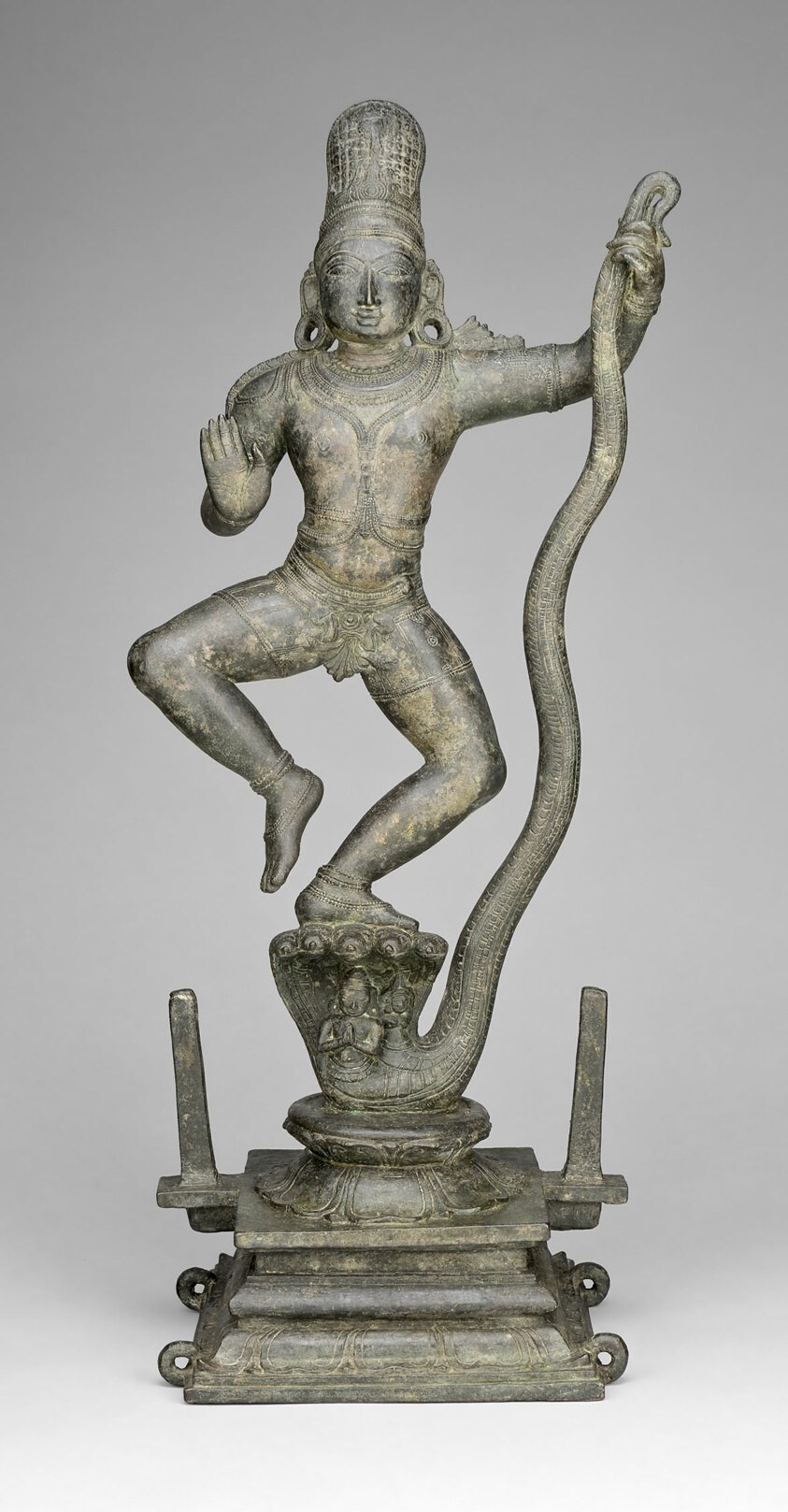
God Krishna Dancing on the Head of the Snake Demon Kaliya K
Unknown artist
- Source:
- Art Institute of Chicago
- Rights:
- Public domain — free to use, share and adapt.
- Recorded as:
- CC0 (Public Domain)
This sculpture offers rare three-dimensional evidence of how classical South Indian dance movement and divine embodiment were understood and valued in their historical context. It bridges mythology, sacred practice, and dance technique—showing that the two were inseparable. For dance historians and practitioners, it demonstrates that the virtuosic, weight-shifted postures and rapid weight transfers taught in Bharatanatyam and related systems are not modern inventions but traces of an ancient continuous tradition.
What you are looking at
A bronze sculpture depicts a dynamic divine figure in an energetic contrapposto stance, balanced on one leg atop a serpent's head. The figure wears elaborate ornamentation typical of South Asian sacred sculpture: a tall cylindrical crown (kirīṭam), large circular earrings, a beaded necklace, and a jeweled hip-belt. The torso is bare and idealized, the musculature defined with precision. The right leg is raised high, knee bent, as if mid-leap or in a pivoting movement; the left leg is straight and weight-bearing. The right arm extends upward, holding the serpent's raised tail like a staff or balance-pole; the left hand is raised in a blessing or restraining gesture. The serpent (Kaliya, a multi-headed cobra demon) coils beneath, its body forming the base and primary support. The figure stands on an ornate lotus-topped pedestal, itself mounted on a rectangular base with relief carving and flanked by two vertical finials. The patina is aged greenish-bronze, the surface worn and weathered.
The dancing
A single standing figure in a high-energy weight shift: the supporting leg is nearly straight, the free leg raised with knee bent at an acute angle, the torso tilted slightly forward in counterbalance. The raised arm reaches upward along the serpent's length; the opposite arm gestures outward at shoulder height. The posture suggests a moment of controlled instability—a dance movement frozen mid-phrase. The figure's musculature is articulated with anatomical accuracy, and the limbs are proportioned for an idealized divine body. The serpent plays a choreographic role: its coiled and raised form both supports and frames the dancer.
The dance depicted
This is Kṛṣṇa (Krishna) in Kathakali or South Indian classical temple dance iconography, specifically the episode of his victory dance on the demon serpent Kaliya. The dynamic lifting and pivoting pose reflects the exuberant, martial joy of divine triumph. The raised leg and twisting torso are characteristic of the vigorous footwork and body articulation taught in classical South Indian dance systems (Bharatanatyam, Kuchipudi, Odissi), in which such episodes are performed as narrative sequences (nṛtta-nāṭya). The pose captures not a static mudra but a kinetic moment—likely a tatkaralam (rhythmic footwork phrase) or a triumphant leap. The serpent underfoot transforms a dance into a cosmological statement: the dancer commands the demon through movement and grace.
How it was made
This is a cast bronze sculpture, likely created using the lost-wax process (cire perdue), which allowed the artist to model clay or wax into complex forms before casting. The technique is evident from the refined surface detail—the incised jewelry patterns, the precisely defined musculature, and the flowing curves of the serpent. Lost-wax casting was the dominant metalworking method in South India from at least the Chola period (9th–13th centuries) onward, and remained so for sacred and ceremonial bronzes. The work bears no maker's mark or signature; it was likely made for a temple or wealthy household rather than for individual artist attribution.
About this work
This bronze depicts the culminating moment of a sacred narrative from Hindu mythology—Kṛṣṇa's ecstatic, wrathful dance of victory over the demon serpent Kaliya—rendered as a sculpture in the round. The work belongs to a continuous South Indian temple-bronze tradition stretching back over a millennium, in which mythology is embodied through dynamic, anatomically precise figures. What makes this work important to dance history is that it captures the kinetic language of classical South Indian dance: a real movement phrase (or sequence from one), frozen in bronze. The raised leg, the pivoting stance, the counterbalancing arm positions, and the engagement with another figure all reflect actual choreographic practice. The work thus serves as both devotional image and dance documentation.
How to look at it
Observe the exact moment of weightlessness the sculptor chose: the figure is neither landing nor fully suspended, but at the pivot-point of a rapid directional change. The raised leg is not merely decorative but functionally critical to balance; the extended arm along the serpent acts as both psychological and physical fulcrum. Notice too the face: serene and frontal, the expression does not match the body's dynamism. This is the paradox of divine dance in South Asian tradition—the body is ecstatic and vigorous, the face composed and eternal. The ornament (crown, earrings, belt) is not separate from the dance but integral: the jingle and weight of jewelry is part of the percussion of movement.
The period
South Indian bronze sculpture reached its stylistic and technical peak during the Chola dynasty (9th–13th centuries), when temples across Tamil Nadu and beyond were decorated with hundreds of cast-bronze processional icons. Though the date of this work is unknown, its style—the proportional system, the ornamental vocabulary, the stance—is consistent with Chola or Chola-influenced work, or with later Tamil Nadu bronze-casting traditions that maintained continuity with Chola methods and aesthetics. During this period, the classical dance forms were already associated with temples and royal courts, and narrative episodes like Kṛṣṇa's deeds were central to both sculptural and performance repertoires. The conflation of dance movement with divine manifestation was culturally normalized: to dance well was to embody divinity.
Where it lives
The work is held at the Art Institute of Chicago, sourced through the institution's ongoing acquisition of South Asian sculpture. The record provides no accession number, date of acquisition, or prior provenance.
Dance in this work
Questions about this work
Why is Kṛṣṇa dancing on a snake?
In Hindu mythology, Kaliya is a poisonous serpent demon who polluted the River Yamuna. Kṛṣṇa defeated and subdued him through a fierce, exuberant dance—a demonstration of divine power expressed through movement and grace. The episode celebrates the triumph of dharma (order) over chaos, and is a beloved subject in South Indian temple art and classical dance performance.
Is this pose from a specific classical dance form?
The pose reflects the vocabulary of Bharatanatyam, Kuchipudi, and other South Indian classical systems, in which such dynamic, weight-shifted stances are fundamental. While no single 'name' for this exact pose is certain without expert consultation, the compositional logic—the raised leg, the pivoting torso, the counterbalancing arms—matches the kinetic grammar taught in these traditions. The work may document a historical variant of such movement.
When was this sculpture made?
The catalogue record does not provide a date. The style is consistent with South Indian bronze-casting traditions spanning roughly the 10th to 18th centuries, with strongest affinities to work from the Chola period (9th–13th centuries) or later dynasties that maintained Chola aesthetic and technical standards. A conservator or specialist in South Asian metalwork could narrow the range through metallurgical or stylistic analysis.
What is the tall crown the figure is wearing?
The cylindrical crown is a kirīṭam, a standard element of divine iconography in South Indian sculpture and Bharatanatyam costume. It marks the figure as deity. In performance, the kirīṭam would be a rigid, ornate headdress, often towering several inches above the crown of the head, adding visual majesty and demanding postural discipline from the dancer.
More dance artwork