49 works in this view — arrow keys or swipe to move between them.
Dance in Art
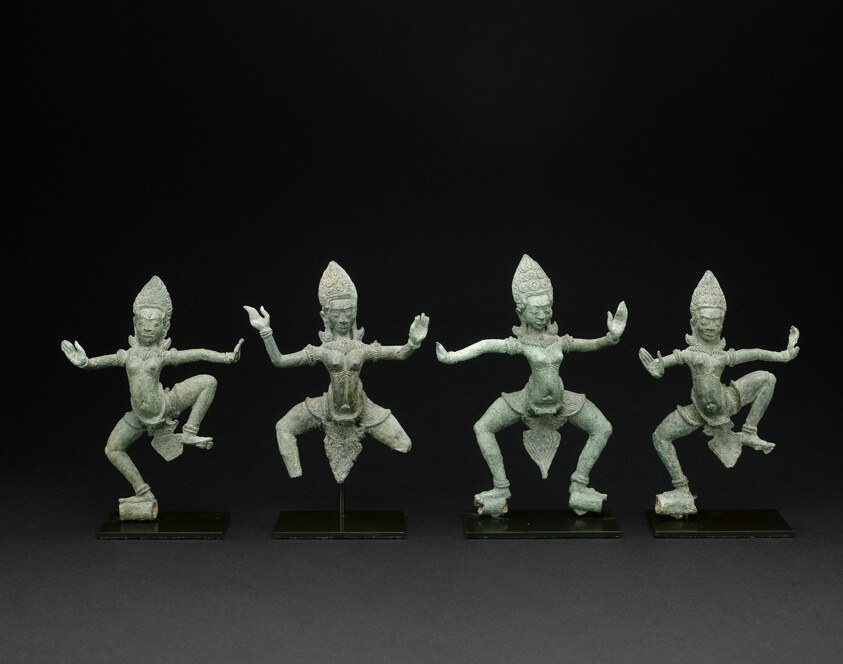
Group of Four Celestial Dancing Beauties
Khmer
- Source:
- Art Institute of Chicago
- Rights:
- Public domain — free to use, share and adapt.
- Recorded as:
- CC0 (Public Domain)
Apsara sculptures like these are among the world's oldest and most influential dance imagery, directly shaping the vocabulary and philosophy of classical Asian dance for over a millennium. They encode specific ideas about the relationship between the divine, the body, female agency, and ecstatic movement that remain active in Khmer, Thai, and Indian dance today. Understanding these poses and the contexts in which they appear is essential to reading both classical Asian dance and Western Orientalist responses to it.
What you are looking at
Four identical bronze or greenish-patinated metal figures stand in a row against a black ground, each mounted on a dark rectangular base. The figures are celestial or divine dancers rendered in a South or Southeast Asian sculptural tradition. Each wears an elaborate conical crown or headdress and minimal dress—likely a pleated lower garment and jewelry—exposing the torso. The figures are captured in dynamic, virtuosic poses: two are caught mid-leap with one leg raised high and arms spread wide in open gestures of celebration or invocation; the other two adopt deep squatting positions with legs bent nearly at right angles, arms similarly extended outward in expansive frames. The figures are perfectly symmetrical in composition, alternating between the leaping and squatting positions. The patina and uniform casting suggest these are either ancient bronzes or skilled modern casts of ancient originals. The stark black background isolates the figures entirely, allowing full attention to the articulation of the bodies and the virtuosity of their poses.
The dancing
Each figure demonstrates extreme flexibility and control. The leaping dancers extend one leg nearly horizontal while the other lifts beneath the torso, with both arms flung wide in an open, celebratory frame—a posture requiring both athletic power and balance. The squatting dancers achieve a near-full-depth plie with knees splayed outward and arms held in the same open lateral extension, showing deep hip and ankle mobility. The repeated poses create a visual rhythm across the four figures. The execution suggests training in a classical system that values lifted torsos, engaged cores, and precise articulation of the limbs even in extreme positions.
The dance depicted
These figures almost certainly represent apsaras—the celestial dancing maidens of Hindu and Buddhist cosmology—as depicted in the sculptural traditions of medieval Southeast Asia, particularly Cambodia (Khmer), or possibly South Asian temple sculpture. The poses reflect the mudra system and classical Indian dance vocabulary, specifically characteristics associated with Devadasi temple dancers or the formalized movements seen in classical Khmer court dance. The alternating leap-and-squat sequence suggests a cyclical, ritualistic movement vocabulary rather than social dance. The extreme range of motion and the confident, unmodest display of the body point to sacred or court contexts in which such display was sanctioned and even required.
How it was made
These are cast bronze sculptures, likely created by the lost-wax process, as evidenced by the crisp definition of the jewelry, musculature, and facial features. The uniform greenish patina indicates considerable age or skilled patination. Whether these are ancient originals, colonial-era casts, or modern reproductions cannot be determined from the image alone. The mounting on individual modern bases and the presentation as a set of four suggest these were assembled for display rather than excavated as a group—a common practice in Western collections of Asian antiquities.
About this work
This is a set of four bronze apsara figures, celestial dancers from Hindu-Buddhist cosmology, rendered in the sculptural tradition of medieval Southeast Asia or South Asia. The four figures, presented in a symmetrical rhythm of leaping and squatting poses, demonstrate the physical vocabulary of classical Indian and Khmer court dance traditions. The works belong in a gallery of dance in art because they are not merely representational but are themselves scores—frozen notations of a specific movement vocabulary that shaped centuries of ritual, court, and sacred performance across Asia. The apsara cult influenced every major dance form from classical Khmer to Indian temple dance to Southeast Asian court performance, making these figures foundational visual documents of global dance history.
How to look at it
Attend to the precision of the joints and the control evident even in extreme positions: the raised heel in the leap, the turned-out hip in the squat, the exact angle of each finger. Notice how the sculptor has understood and rendered the transition between positions—these are not static poses but moments in a continuous sequence. The repetition across four figures suggests that these dancers were understood as interchangeable, immortal, and collectively performing a ritual rather than as individual personalities. Compare the open, frontal address of the figures with the inward-focused, closed positions of Western classical ballet: apsaras are made to be seen from all angles and to radiate outward.
The artist
The artist is not recorded. These sculptures were likely created by anonymous court or temple artisans working within a highly codified sculptural and kinetic tradition. Whether they are ancient originals, 19th-century casts, or modern reproductions remains unclear from the image.
The period
Apsara imagery flourished during the Angkorian period in Cambodia (9th–15th centuries) and across South Asian temple sculpture from the Classical period onward. These figures represent a moment when divine and secular dance were unified under a single, highly formalized vocabulary taught to both Devadasi temple dancers in India and court dancers in Southeast Asia. The celestial dancer was understood as the ideal form of human movement—a perfect fusion of mathematics, eroticism, spirituality, and power. By the 19th century, when Western museums began collecting such figures, apsaras had become the primary visual symbol through which the West encountered Asian dance, often misinterpreting their sacred and courtly contexts through an Orientalist lens.
Where it lives
The work is held in the Art Institute of Chicago and sourced through the AIC collection database. The mounting and presentation suggest these are museum acquisitions rather than in-situ temple or palace pieces, though the record provides no further provenance information.
Dance in this work
Questions about this work
What is an apsara?
Apsaras are celestial nymphs in Hindu and Buddhist mythology, often depicted as divine dancers who entertain the gods. In sculptural and performance contexts, they represent an idealized, immortal female body in motion. The role was performed by Devadasi temple dancers in India and court dancers across Southeast Asia, making the apsara both a mythological and a lived social role.
Why are there four identical figures?
The repetition may reflect the way such sculptures were displayed in temple or palace settings, where multiple identical figures created a sense of divine multiplicity and eternal recurrence. Alternatively, the four figures may have been originally part of a larger architectural program and were later assembled as a museum display set.
How old are these sculptures?
The record does not specify. They could be medieval originals (9th–15th century), colonial-era casts, or modern reproductions. The patina and style are consistent with ancient Khmer or South Asian temple sculpture, but determining authenticity and date would require technical analysis and documentation of provenance.
Is this dance still performed today?
Yes. Classical Indian dance forms like Bharatanatyam and Khmer court dance directly descend from the movement vocabulary encoded in apsara sculptures. Modern performances often deliberately reference and cite these ancient poses, creating a living link between these sculptures and contemporary stage dance.
More dance artwork