49 works in this view — arrow keys or swipe to move between them.
Dance in Art
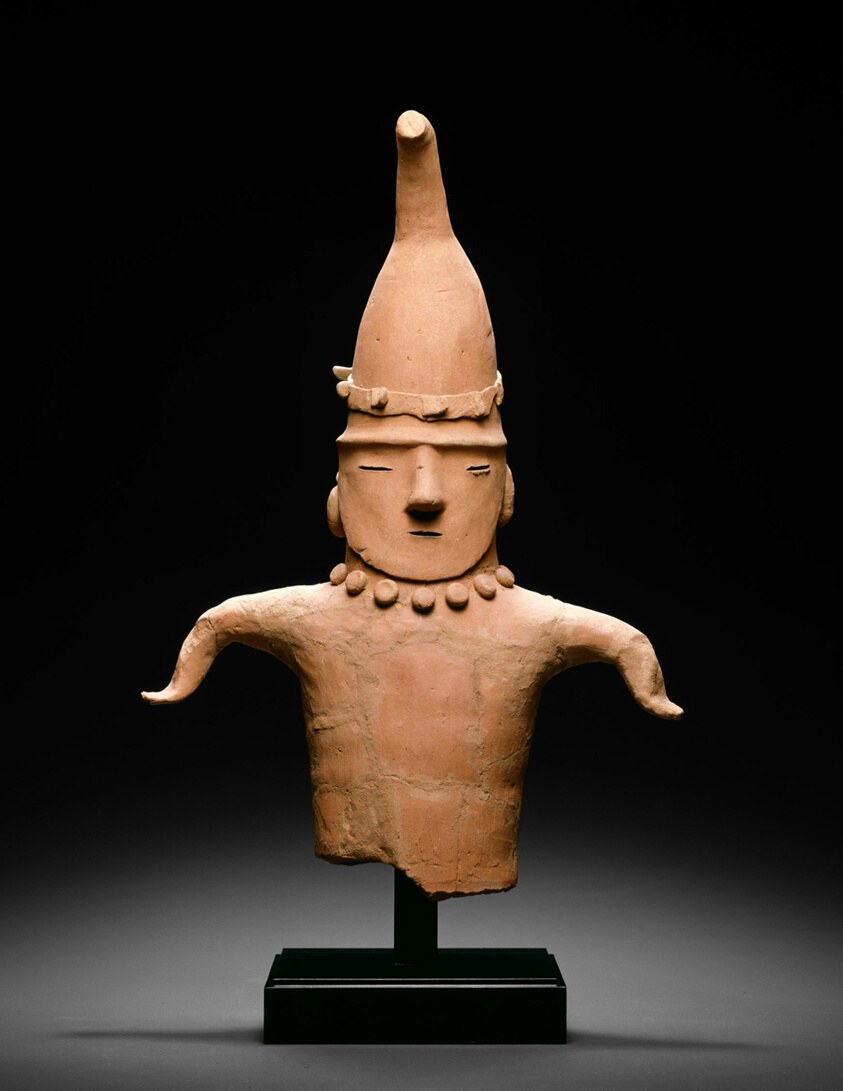
Head and Torso of a Dancing Figure
Unknown artist
- Source:
- Art Institute of Chicago
- Rights:
- Public domain — free to use, share and adapt.
- Recorded as:
- CC0 (Public Domain)
This work is rare material evidence that movement—specifically upright, gestural, ritualized movement—held ceremonial and spiritual importance in pre-Columbian Mesoamerican cultures. For dancers and cultural historians, it documents a non-European tradition of codifying movement through sculpture, showing how an ancient society recorded the postures and gestures associated with sacred practice. The work reminds us that dance history extends far beyond documented traditions and written records; movement itself was sacred enough to be preserved in permanent materials.
What you are looking at
A terracotta sculpture of a standing figure with highly stylized proportions and features. The work shows a human torso rendered with a simplified, geometric form, with short curved arms extended outward at roughly shoulder height. The figure wears a broad collar or pectoral ornament composed of raised nodules or spheres around the neck. The head is disproportionately small relative to the body, with a flat face featuring minimal facial features—a simple rectangular mouth opening and almond-shaped eyes. Most striking is the tall, conical or pointed headdress rising from the crown, tapering upward to a rounded knob at its apex. The entire figure is rendered in warm buff terracotta, and the piece is mounted on a modern black display base. The sculptural style is highly abstract and archaic, with no indication of specific clothing beyond the collar; the body is treated as a geometric solid.
The dancing
The figure stands with weight distributed equally on both legs (which are not visible but implied). The arms are raised and curved, bent at the elbows with the forearms extended upward and outward in a gesture of expansion or elevation. The posture suggests openness and upward motion rather than a grounded stance. The proportions—tiny head, broad shoulders, geometric torso—are characteristic of pre-Columbian Mesoamerican sculpture, where the body is treated architecturally rather than naturalistically. The raised arms and lifted chest create a sense of ritual animation despite the figure's static material form.
The dance depicted
This appears to be a representation of ritual or ceremonial movement from a pre-Columbian Mesoamerican culture, likely from the Veracruz or adjacent regions based on the stylistic markers. The raised arms and open chest gesture suggest a posture associated with sacred or ceremonial dance, possibly connected to ritual performance, supplication, or celebration. The elaborate headdress implies a figure of status or ritual significance—a priest, shaman, or deity representation. While the work cannot be confidently assigned to a specific documented dance tradition in the historic record, the sculptural language indicates that movement and bodily gesture were central to the culture that produced it.
How it was made
This is a hand-modeled terracotta sculpture, a material and technique fundamental to pre-Columbian Mesoamerican art. Terracotta allowed for both architectural monumentality and portable ritual objects. The technique of hand-modeling permitted the exaggerated abstraction visible here—the artist used the plasticity of clay to emphasize symbolic features (the headdress, the collar, the raised arms) rather than to achieve anatomical accuracy. The work's small scale and the presence of a modern display base indicate it was created as a portable sculptural object, likely for ritual, ceremonial, or votive purposes rather than architectural embellishment. The material's durability across centuries has preserved the work intact.
About this work
This terracotta sculpture embodies pre-Columbian Mesoamerican visual language for ritual movement and ceremonial performance. The raised arms, open chest, and elaborate headdress convey a figure engaged in or prepared for sacred action—possibly dance, prayer, or ritual supplication. The work represents a culture for which sculpture served as a record of embodied practice and ceremonial significance, preserving gestural language that would otherwise exist only in performance. As an artifact of a non-literate visual tradition, it offers rare sculptural evidence of how movement was valued and represented in ancient Mesoamerica. The figure's geometric abstraction and ritual apparatus suggest a sophisticated understanding of how to encode sacred motion in clay.
How to look at it
Observe the figure's upward orientation: the raised arms, the lifted chest, and the vertical thrust of the headdress all work together to create an impression of ascent or elevation. The headdress is not merely decorative but serves as a vertical axis that organizes the entire composition, drawing the eye upward. Notice how the artist simplified the body into geometric forms—not from lack of skill, but as a deliberate choice to emphasize structure and symbol over anatomy. The raised arms are particularly important: they are not relaxed or naturalistic but consciously deployed, suggesting a moment frozen mid-gesture, a posture meant to be held and observed as part of ritual performance. The figure's smallness and portability suggest it may have been handled, moved, or placed in processional or ceremonial arrangements.
The period
This work emerges from a Mesoamerican tradition spanning centuries before European contact, likely from the Classic or Postclassic period (100 BCE – 1500s CE). Terracotta figurines served multiple functions in these societies: as votive offerings, as components of ritual assemblies, as representations of deities or ancestors, and as records of ceremonial dress and movement. The emphasis on elaborate headdresses and distinctive bodily posture reflects the ritual importance of visual display and embodied performance in Mesoamerican religious practice. Movement was integral to these societies' spiritual worldview, and sculpture—particularly small-scale terracotta—captured the sacred gestures and costumes that defined ritual specialists and divine beings.
Where it lives
The work is documented in the Art Institute of Chicago's collection and identified only as coming from unknown era and unknown artist. The catalog record provides no date, accession number, or detailed provenance. The terracotta material, stylistic elements, and absence of European influence strongly suggest pre-Columbian Mesoamerican origin, though the record does not specify a culture, region, or date range.
Dance in this work
Questions about this work
What culture made this sculpture?
The catalog record does not specify. Based on the terracotta material, the stylized headdress, the geometric body forms, and the ritual posture, this appears to be pre-Columbian Mesoamerican, possibly from Veracruz or a neighboring region, but without archaeological context or documentation the specific culture remains uncertain.
Is this a dancer?
The raised arms and open-chested posture strongly suggest movement or ritual gesture rather than a static standing pose. The elaborate headdress indicates a figure of ceremonial significance—a priest, shaman, or deity. Whether this represents an actual dancer or a ritual specialist engaged in sacred movement cannot be determined from the sculpture alone, but the embodied nature of the pose suggests performance was part of the figure's function.
How old is it?
The catalog record lists the date as unknown. Terracotta figurines in this style were produced across centuries of pre-Columbian Mesoamerican history. Without archaeological context—such as the site where it was found or associated artifacts—a precise date cannot be assigned.
What does the headdress mean?
In pre-Columbian Mesoamerican cultures, elaborate headdresses signaled status, ritual authority, and divine or supernatural association. The tall, conical form here emphasizes verticality and elevation, suggesting connection to the sky, ancestors, or deities. Headdresses were central to ceremonial dress and likely worn by priests or figures who performed ritual dances or other sacred acts.
More dance artwork