49 works in this view — arrow keys or swipe to move between them.
Dance in Art
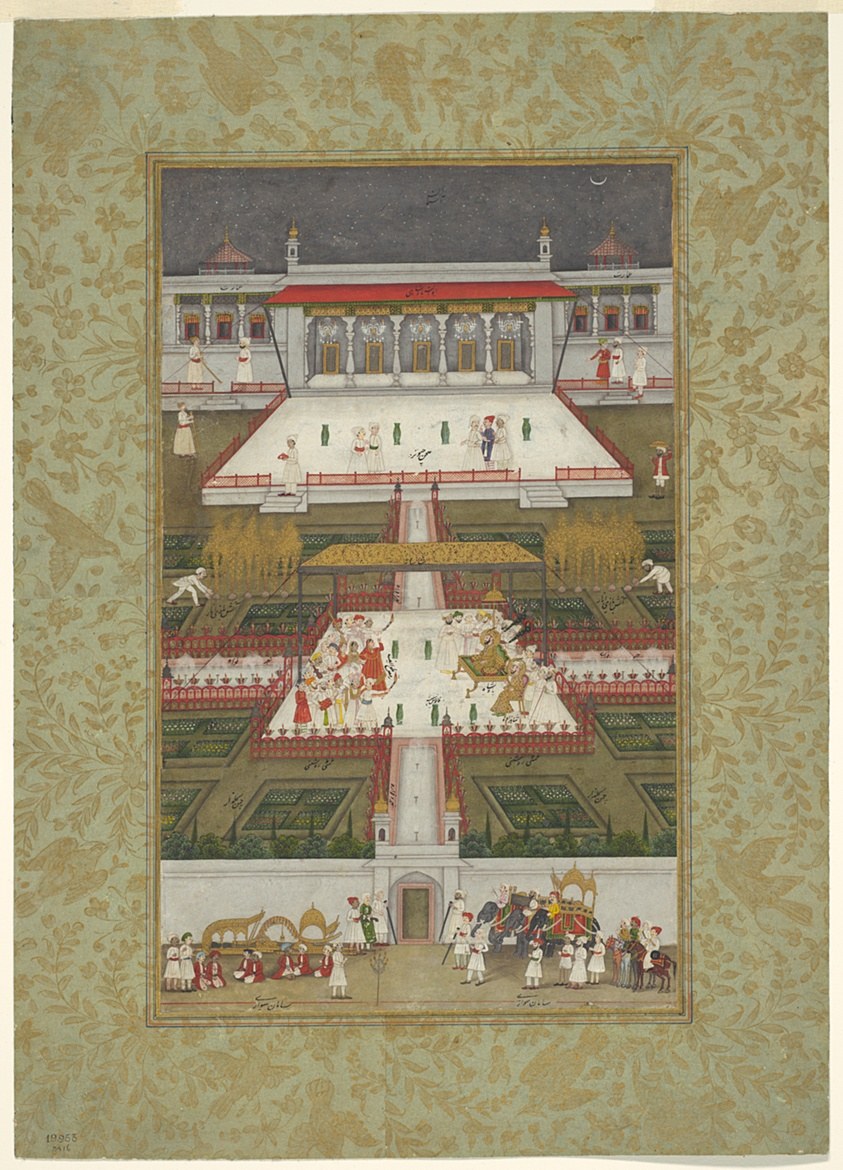
Ruler Entertained by Dancers in a Paradise Garden
Unknown artist
- Source:
- Art Institute of Chicago
- Rights:
- Public domain — free to use, share and adapt.
- Recorded as:
- CC0 (Public Domain)
This is one of the rare surviving visual documents of Mughal court entertainment practice, showing the spatial and social organization of such events. It confirms that sophisticated dance or movement performance was central to elite Mughal culture and documentation, providing essential context for understanding the development of kathak and other classical dance forms that emerged from or coexisted with the Mughal court. For historians of Indian dance and court culture, such paintings are among the primary visual sources available before photography.
What you are looking at
This is a vertical cross-section painting of a Mughal palace or garden complex, rendered in the characteristic style of 16th or 17th century Indo-Persian manuscript illumination. The composition stacks three distinct levels vertically: at the top, an open courtyard with a red-roofed portico and columned hall, sparsely populated; in the middle, two terraced garden levels separated by a white pathway, with dense crowds of courtiers and attendants in jewel-toned dress arranged in formal groups; and at the base, an interior chamber where musicians and performers gather before a central figure of authority. The night sky visible above the roofline, marked with a crescent moon and stars, suggests this is a nocturnal entertainment. The gardens show the characteristic Mughal chahar bagh layout of quadrilateral divisions with water channels and planted beds. Throughout, figures in Mughal court dress—long fitted coats, turbans, and distinctive postures—populate the scene. The palette is rich: deep reds in the architectural elements, ochres and greens in the gardens, and the warm cream of the paper showing through in pathways and open spaces.
The dancing
The figures throughout are depicted in a flattened, linear perspective typical of Mughal miniature painting, standing or moving in small clusters rather than as engaged couples. In the garden levels, groups appear to be arranged in conversational or processional formations, facing one another or the central axis. Several figures adopt what might be described as a gentle sway or slight bend at the waist. In the lower chamber, some bodies show a more pronounced curved posture. The scale of figures is consistent, suggesting they are meant to be read as an assembled court rather than highlighted performers. Arms are often held at the sides or in gestures of respect or attention. The density of figures and their distribution creates a sense of hierarchical viewing rather than intimate participation.
The dance depicted
This is almost certainly a depiction of entertainment at a Mughal court, likely Mughal dance or courtly entertainment, though the specific form is difficult to isolate from the painting alone. The flattened, processional quality of the figures and the architectural framing suggest courtly performance rather than folk or devotional dance. The night setting, the formal garden arrangement, and the gathered court audience point to organized entertainment for elite consumption. However, the distance and formal register of the painting—it documents the event rather than anatomically capturing movement—means the precise dance form (whether it was kathak, a form of Mughal court dance, or another tradition) cannot be determined from visual evidence alone. The painting documents that such entertainment occurred and the social context in which it was valued.
How it was made
This is a watercolor or ink painting on paper, rendered in the Indo-Persian miniature tradition that flourished in Mughal courts. The technique employs translucent pigments, careful line work in black or dark ink, and gold leaf detail in the architectural elements and possibly in jewelry and borders. The saturated colors—the red roof, the jewel tones of clothing—are characteristic of mineral pigments used in this tradition. The formal border in gold and cream patterning frames the scene in the manner of manuscript illumination. The technique permitted immense detail and narrative complexity within a bounded rectangular field, making it ideal for palace documentation and courtly chronicle. Such works circulated among the Mughal elite and potentially in the collections of European trading companies by the 17th century.
About this work
This is a Mughal court painting documenting an evening entertainment in a palace or garden complex, rendered as a vertical architectural section showing multiple levels of activity simultaneously. The painting combines the practical goal of architectural and administrative record-keeping with the courtly pleasure of documenting refined entertainment. The composition follows Indo-Persian conventions of simultaneous multiple viewpoints and flattened perspective, allowing the viewer to see all significant spaces and figures at once rather than from a single vantage point. The work belongs to a substantial tradition of Mughal miniature painting that recorded court life, palatial layouts, and social hierarchies through visual narrative.
For a dance historian, the work documents the context in which courtly performance occurred in Mughal India: the architectural grandeur, the assembled elite audience, the nocturnal timing, and the formal organization of space. It confirms that dance or movement-based entertainment was a standard element of court culture and worthy of inclusion in official palace documentation. While the painting does not permit detailed analysis of movement vocabulary or technique, it provides essential context for understanding how such performance was framed, valued, and witnessed.
How to look at it
Approach this painting as an architectural and social document as much as a dance image. Follow the vertical hierarchy: note how the topmost level is sparse and formal, while the middle garden levels densely concentrate courtiers and attendants, and the lower chamber frames intimate performance. The small scale of the figures and the flattened perspective mean that individual movements are generalized rather than forensically recorded; what you are seeing is the formal arrangement of bodies in space, not technique in the Western sense. Look for the moment of stillness and formal arrangement rather than dynamic action—Mughal court art emphasizes composure and hierarchy over individual virtuosity.
The period
This painting dates from the height of the Mughal empire, likely 16th or 17th century, a period when Indo-Persian artistic traditions were synthesized with Indian courtly practice to create a distinctive aesthetic. The Mughal courts under emperors such as Akbar, Jahangir, and Shah Jahan were major centers of dance patronage and innovation, supporting both Persian court traditions and Indian classical forms. Court painting in this period served both administrative and celebratory functions, documenting the ordered splendor of imperial life. The simultaneous presence of multiple performance genres and the emphasis on formal arrangement in such scenes reflects the cosmopolitan character of Mughal court culture, which drew on Persian, Central Asian, and Indian traditions.
Where it lives
The work is identified as part of the Art Institute of Chicago collection. It represents a form of object—the Mughal palace or garden painting—that was created for courtly elites and sometimes entered European collections through trade and diplomatic exchange.
Dance in this work
Questions about this work
Is this a single painting or a manuscript page?
This appears to be a painting on paper formatted and mounted as a manuscript folio, following Indo-Persian conventions. The decorative border in gold and cream is typical of such pages. It may have been bound with others in a palace chronicle or book of courtly scenes.
What kind of dance is depicted?
The painting does not provide enough detail to identify a specific dance form with confidence. The formal courtly context, Mughal architectural setting, and assembled elite audience suggest organized court entertainment, possibly kathak or Persian court dance traditions, but the flattened pictorial style does not allow anatomical confirmation. The work documents that such entertainment existed and mattered to the court.
Why show the palace in section view rather than as a floor plan or elevation?
The section-view (or 'transverse cut') composition is characteristic of Indo-Persian painting and allows the viewer to see all significant spaces and their relationship simultaneously. It serves both documentary and narrative purposes: we see the architecture, the gardens, and the activity within them all at once, emphasizing the hierarchical organization of courtly space.
Are the women visible in this scene dancers?
Some of the figures in the middle and lower portions are likely female, indicated by dress conventions, but the formal register and flattened perspective of the painting do not permit confident identification of professional dancers versus courtiers or attendants. In Mughal courts, female performers and female family members occupied distinct social spaces; this painting documents gathering without necessarily specifying roles.
More dance artwork