31 works in this view — arrow keys or swipe to move between them.
Dance in Art
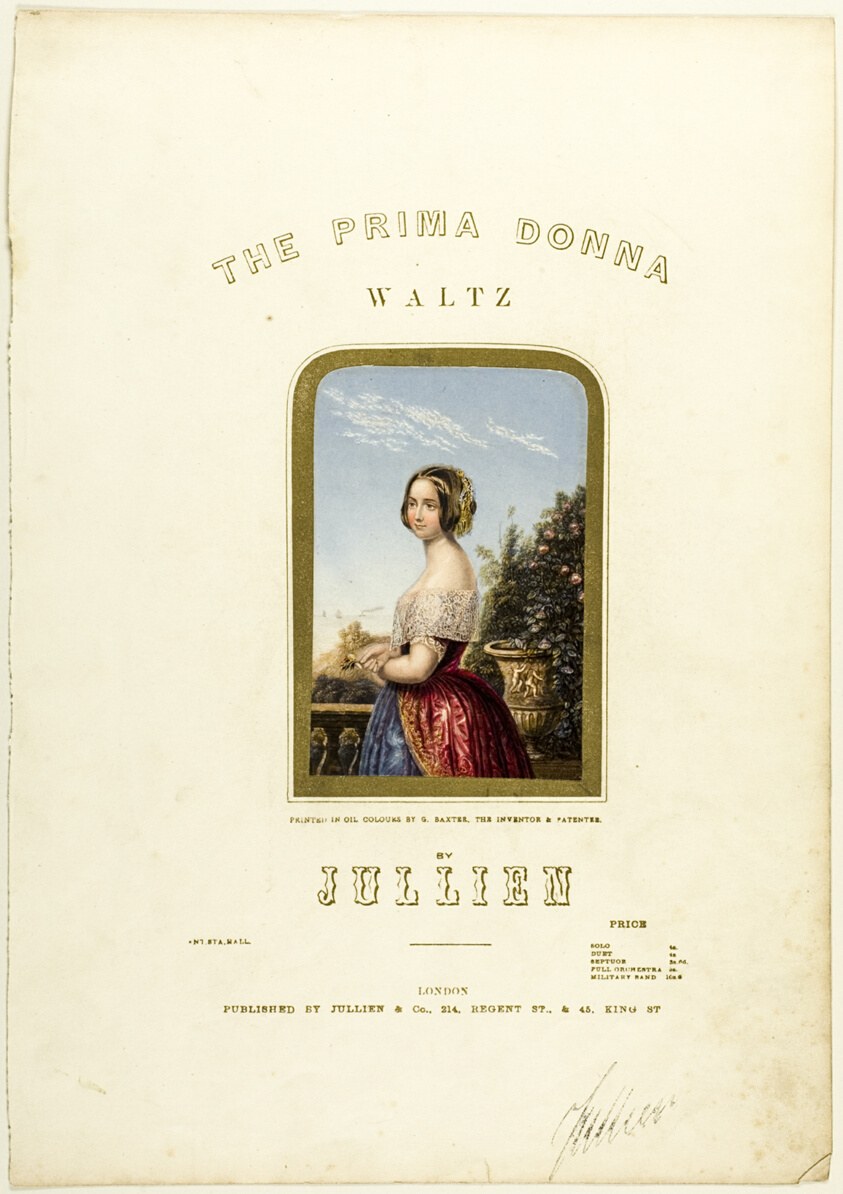
The Bride cover for The Prima Donna Waltz sheet music
George Baxter
- Dance:
- Waltz
- Source:
- Art Institute of Chicago
- Rights:
- Public domain — free to use, share and adapt.
- Recorded as:
- CC0 (Public Domain)
Sheet-music covers are primary evidence for how dance was marketed, consumed, and understood in the nineteenth century. They show us which dances were fashionable, what body ideals were attached to them, and what audience manufacturers believed would purchase them. This image also demonstrates the intersection of visual art, music publishing, and fashion as integrated systems of domestic taste.
What you are looking at
This is the cover of sheet music for a waltz, showing a single elegantly dressed woman in a three-quarter-length portrait set within an ornamental gold frame. She wears a white lace bodice with short sleeves and a full skirt of deep crimson silk with a blue underskirt visible at the hem. Her dark hair is arranged in the midcentury fashion with a net or snood. She stands in a garden setting with classical stonework—a decorative urn or finial visible to her right—and trees in soft greens and golds behind her under a pale blue sky with white clouds. The woman gazes over her shoulder toward the viewer with a composed, dignified expression. The entire composition is printed in oil colours, a labour-intensive process that signals the prestige both of the waltz and of its intended market.
The dancing
The figure is stationary and posed rather than captured mid-movement. She stands with her weight evenly distributed, her body angled away from the viewer while her face turns back toward us—a classical three-quarter pose. Her arms are at rest, one hand resting near her body. There is no visible footwork or dynamic frame; she is presented as a lady of fashion rather than a dancer in action.
The dance depicted
The work is advertised as a waltz, a social dance that dominated ballroom culture from the early 1800s onward. The image offers no evidence of choreography or technique; it is not a dance scene but a fashion portrait serving as the cover of a musical publication. The waltz would have been danced by couples in closed position with a turning motion, but nothing in the pose or composition alludes to that. The cover markets the music through the elegance and appeal of its subject rather than through any depiction of dance itself.
How it was made
The notation states this was 'printed in oil colours by S. Baxter, the inventor & patentee'—a reference to the chromolithographic process developed by Samuel Prideaux Harris Baxter in the 1830s. This hand-coloured lithographic technique was expensive and labour-intensive, requiring separate stone plates for each colour layer. The result was vivid, subtle colour gradation and fine detail impossible in simple woodblock or engraving. Its use here for sheet-music covers signals a premium product aimed at middle-class and genteel households with both the means and leisure to purchase illustrated music.
About this work
This is a commercial music-cover design from the Victorian era, one of thousands produced to market popular dances to amateur musicians and dancers. It is not a documentation of waltz technique or a scene of the ballroom in action, but rather evidence of how the waltz was sold and consumed as a cultural product—through the image of a fashionable, desirable woman whose portrait was inseparable from the music itself. The work belongs in a dance gallery not because it depicts dancing, but because it reveals the visual and commercial machinery by which dance entered domestic space and middle-class leisure. The woman on the cover was both the fantasy and the promise: buy the music, buy the sheet, buy the dress, and you too can be her.
How to look at it
Attend to the pose and the dress. This is not action but presentation—the woman is a model of fashion and status, not a dancer mid-movement. Note the labour invested in the colour printing: the translucency of the white lace, the depth of the crimson skirt, the soft modelling of the sky. This is a premium object, designed to sit on a piano in a respectable drawing room. The title 'The Prima Donna Waltz' claims operatic prestige for a social dance; the woman's composed, almost mournful gaze suggests romantic or sentimental associations the music was expected to evoke.
The artist
The artist is not recorded. The cover was printed by Samuel Prideaux Harris Baxter, a lithographer and inventor of the Baxter process (oil-colour printing), which became the standard method for producing high-quality chromolithographic sheet-music covers and other domestic prints in Britain during the mid-nineteenth century. Baxter's firm produced thousands of such covers, making them objects of mass (if genteel) consumption.
The period
The waltz rose to prominence in the early 1800s and by the Victorian era had become the dominant dance of the genteel ballroom. Unlike country dances or cotillions, which involved groups and complex figures, the waltz was danced by couples alone, turning in closed position to triple-time music—a format that was both intimate and thrilling. The 1830s–1850s saw an explosion in waltz compositions and publications aimed at amateur musicians. Simultaneously, chromolithography and mass printing made illustrated sheet-music covers affordable and desirable. The cover image became inseparable from the music: elegance, fashion, courtship, and domestic refinement were all promised in the same purchase.
Where it lives
The work is held by the Art Institute of Chicago. It is a sheet-music cover, part of the vast ephemeral literature of domestic music publishing. Such covers were distributed widely but rarely preserved systematically; their presence in museum collections indicates how scholars and curators have come to value them as historical documents of taste, fashion, and social life.
Questions about this work
Is this a portrait of a real dancer or an imaginary figure?
It is almost certainly an idealized or generic figure—a 'prima donna' type rather than a specific performer. The cover was designed to market the music to amateur players and dancers, not to document a real person's likeness. The woman represents the aspirational identity the buyer was meant to imagine themselves inhabiting.
What does 'prima donna' mean in the context of a waltz?
Prima donna (first lady) originally referred to the leading female vocalist in an opera. By the mid-1800s, the term was applied more loosely to fashionable, celebrated women. Here it claims operatic glamour and status for a social dance, suggesting that dancing this waltz would confer refinement and distinction.
Why is there no dancing shown on a dance cover?
Sheet-music covers were not instructional or documentary; they were advertisements. Showing an elegant, desirable woman was more effective marketing than showing the actual mechanics of the dance. The music itself would teach the steps; the cover promised the fantasy.
What does the Baxter process allow that other printing methods didn't?
Oil-colour printing (chromolithography) allowed multiple layers of subtle, translucent colour to be applied by hand-pressing the paper against separate stone plates, one for each colour. This produced rich, naturalistic colour gradation and fine detail that made even modest prints look expensive and precious—crucial for marketing luxury goods to middle-class buyers.
More Waltz artwork