49 works in this view — arrow keys or swipe to move between them.
Dance in Art
The Morris Dancers
Israhel van Meckenem, the younger
- Source:
- Art Institute of Chicago
- Rights:
- Public domain — free to use, share and adapt.
- Recorded as:
- CC0 (Public Domain)
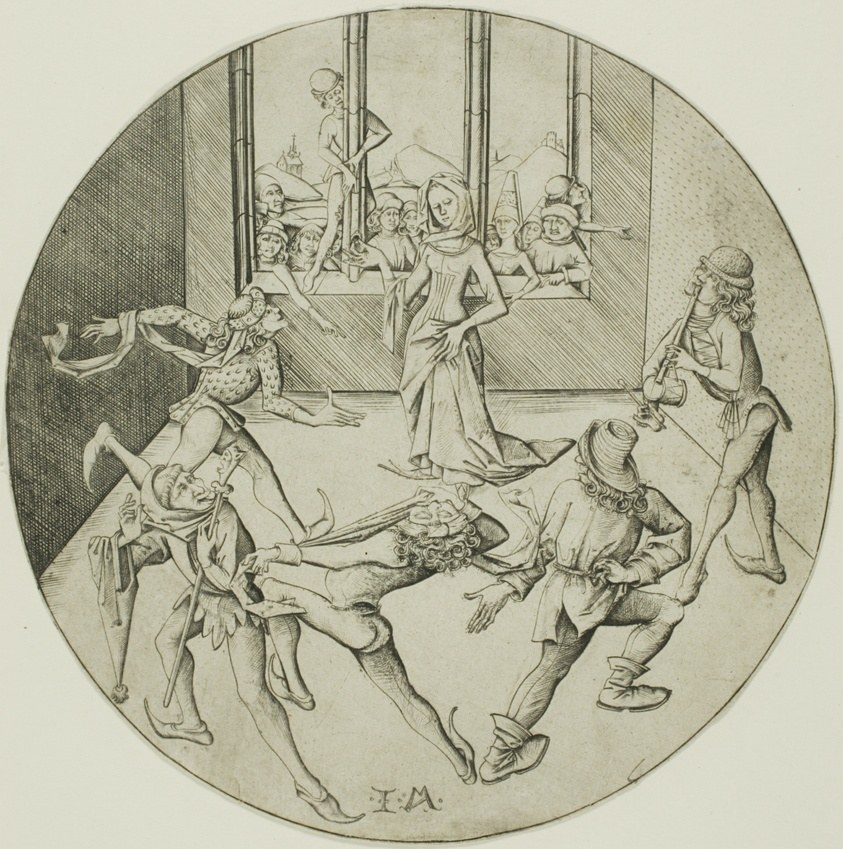
The galliard was the most celebrated dance of the 16th-century court, and images of it are rare. This engraving is one of the few visual records showing the galliard being danced, not merely described in a manual, and it captures the characteristic leap and the social setting in which the dance was performed and valorized. For anyone studying Renaissance court culture, the history of dance technique, or the relationship between movement and visual art, this work is essential evidence.
What you are looking at
A circular engraving depicts a lively indoor dance scene, likely from the 16th century. In the foreground, multiple figures in Renaissance dress dance energetically across a wooden floor. On the left, a man in hose and a feathered hat performs an exuberant leap or galliard step, his body extended dynamically. To the right, other dancers move in formation, their garments—long gowns for women, doublets and hose for men—caught mid-motion. In the background, through tall rectangular windows with panes, a crowd of onlookers watches from what appears to be a gallery or upper chamber. The composition is crowded and celebratory, with musicians likely present though not clearly visible. The circular frame creates an intimate vignette of court or noble entertainment, with light and shadow used to model the figures and give depth to the interior space.
The dancing
The dancers display the characteristic verticality and lifting of Renaissance court dance. A prominent male figure leaps with fully extended legs in a diagnostic galliard jump—the hallmark of this style. The women wear long full skirts that swirl with the motion of turning and traveling steps. Bodies are held upright with controlled upper bodies, legs and feet doing the articulate work. The dancers move in both couple and group formations, with some figures in close proximity suggesting partnered interaction. The artist has captured bodies at moment of suspension and extension, demonstrating knowledge of the balletic vocabulary of the period.
The dance depicted
This is almost certainly a depiction of Renaissance court dances, most probably galliard and related forms from the 16th century. The galliard's signature jump—a high aerial leap from a single supporting leg—is unmistakable in the figure at left. The dress, the indoor formal setting, and the grouping of dancers around onlookers all point to aristocratic court entertainment of the Northern European Renaissance. Galliards were central to court dancing and were often executed solo or in small groups before an audience, exactly as shown here. The presence of watching onlookers rather than participatory general dancing further suggests a court context where dance was a performance to be observed.
How it was made
This is an engraving rendered in fine lines to create tone and model form. The circular format was popular in Northern Renaissance printmaking, suggesting this may be part of a series or a single-leaf print intended for broad circulation. The technique allows sharp definition of the interior architecture and the ornament of dress—ruffs, feathers, hose—and registers the quick energy of the dancers through line direction and overlapping figures. Engravings of this type were relatively affordable and portable, distributed to courts, scholars, and collectors across Europe as records of social practice and artistic accomplishment. The initials 'I.M.' at lower left suggest a maker's mark, though the identity remains unclear.
About this work
This is a Northern European engraving of the 16th century depicting aristocratic court dancing of the Renaissance period. It shows a galliard—the most prestigious and acrobatic of court dances—being performed before an elite audience in an interior setting of architectural refinement. The work is a document of both dance practice and social ritual: it records not only the movement vocabulary of Renaissance dance but also its context as court spectacle, observed by a segregated and attentive audience. The choice of the galliard's most recognizable moment—the aerial leap—and the crowded, celebratory composition suggest both the artist's familiarity with the dance and an intention to capture its energy and status.
For historians of dance, this image is valuable precisely because it shows the galliard in performance, not in a theoretical manual. The bodies of the dancers reveal the posture, musicality, and athleticism expected of court performers. The setting and dress situate the dance in a specific social and architectural world. And the presence of onlookers—the watching courtiers in the gallery—reminds us that Renaissance dance was public, formal, and deeply bound up with status and observation.
How to look at it
Look first at the figure on the left: the leap with fully extended legs is the galliard's defining jump, a moment of suspension and athleticism that the artist has frozen at its apex. Notice the contrast between the men in the foreground—active, extended, in motion—and the women beside them, whose full skirts and more upright carriage suggest a different kind of contribution to the dance. Observe the architectural space: the tall windows and gallery create a frame within the frame, emphasizing that this is a formal, watched occasion, not casual movement. The crowding of figures and the overlapping of bodies convey energy and social presence. The engraver has chosen to show the galliard's most spectacular and recognizable moment, the moment that most displays the dancer's skill and courage.
The artist
The initials 'I.M.' appear at lower left, but the artist's identity has not been established with certainty. The style and technique place the work in the Northern European Renaissance, likely 16th century, in the tradition of engraving practiced in the Low Countries or German-speaking territories. The subject matter—court dance and aristocratic leisure—suggests an artist working for or familiar with courtly circles, though the maker may have been a professional engraver producing such scenes for broader distribution through print networks.
The period
The 16th century saw dance elevated to a central courtly art form, especially the galliard, which was technically demanding and considered a mark of noble accomplishment. Treatises on dance proliferated in the later 16th century—Arbeau's *Orchésographie* (1589) is the most famous—and visual representations of dancing also increased in prints, paintings, and tapestries. The Renaissance court was a space of careful observation and performance, and dance was one of the primary forms through which power, grace, and education were displayed and witnessed. Print culture allowed such images to circulate beyond the court itself, making dance and courtly practice visible to a wider audience of the literate and cultured.
Where it lives
Sourced from the Art Institute of Chicago. This is a single-leaf Renaissance engraving, likely 16th century, designed for circulation as a print rather than as part of a larger work. Such prints were collected, pasted into albums, and distributed as records of contemporary practice and as works of artistic merit in their own right.
Dance in this work
Questions about this work
Why is the man jumping so high?
That leap is the galliard's signature move—a step so demanding and prestigious that mastering it was a mark of courtly accomplishment. It required explosive power from the legs and precise control of the body in the air. The jump was also visually spectacular, which made it a favorite subject for artists depicting court dancing. Renaissance court dances were partly about display: showing off strength, grace, and training in front of an observing audience.
What are all those people in the background doing?
They are watching. Court dance in the Renaissance was not participatory for everyone present—it was a performance, carefully observed by the assembled courtiers. The gallery full of onlookers signals that this is a formal, ritualized moment, not a casual gathering. Dance was part of courtly spectacle and social hierarchy.
Is this what Renaissance dances actually looked like?
This is a careful record of Renaissance court dress and movement, though like all art it is an interpretation. We know from written treatises like Arbeau's *Orchésographie* that the posture, leg extensions, and balletic quality shown here are authentic to the period. The engraver appears to have understood the dance and to have aimed at accuracy, making this a valuable historical document as well as an artistic composition.
Who made this print?
The initials 'I.M.' appear at lower left, indicating the maker's mark, but the artist's identity has not been definitively established. It was produced in the Northern European Renaissance, likely 16th century, possibly in the Low Countries or German-speaking region. Without further research, we cannot say more about the maker's biography or workshop.
More dance artwork