49 works in this view — arrow keys or swipe to move between them.
Dance in Art
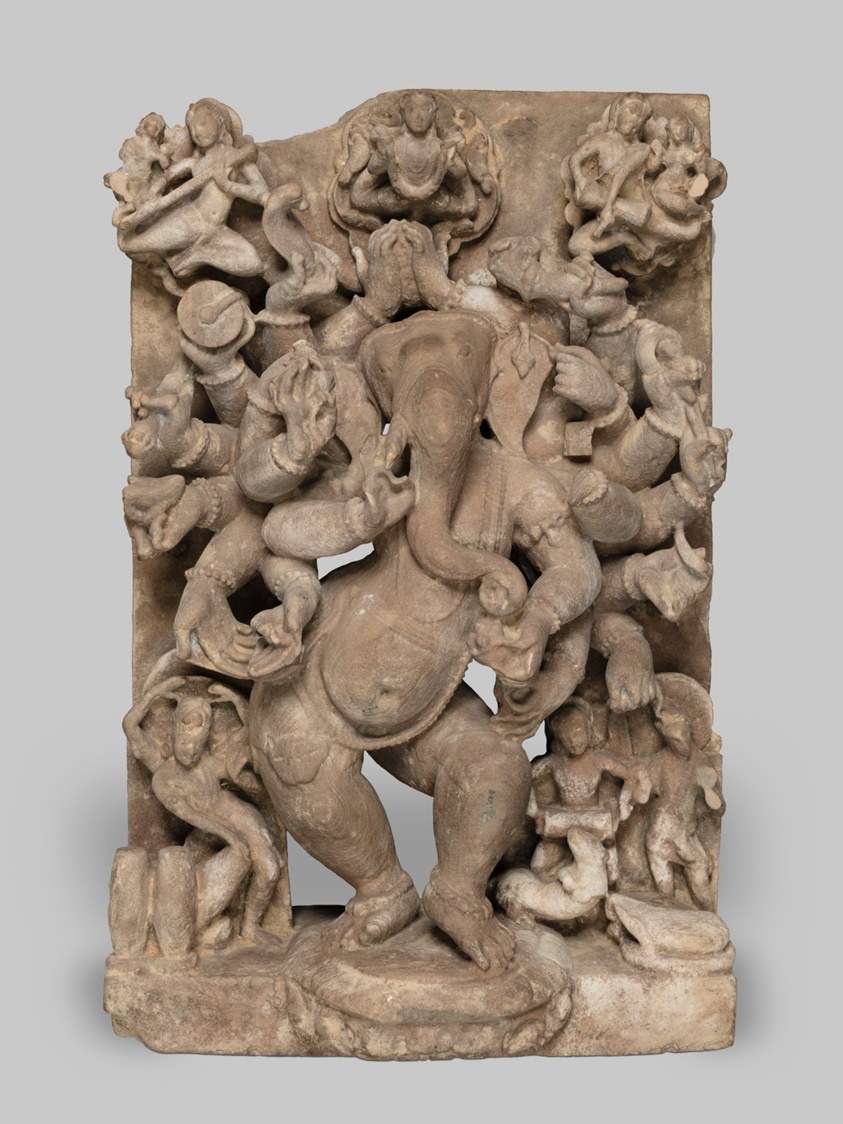
Twenty-Armed Dancing God Ganesha Remover of Obstacles
Unknown artist
- Source:
- Art Institute of Chicago
- Rights:
- Public domain — free to use, share and adapt.
- Recorded as:
- CC0 (Public Domain)
For dance historians, this sculpture demonstrates the fundamental continuity between South Asian classical dance forms and devotional visual art: both systems use the same mudra language, the same principles of weight and counterpose, and the same belief that the human (or divine) body can be trained to express cosmic order. The multiplied arms are not merely decorative but represent a visual equivalent to the polyrhythmic complexity and gestural density of traditions like *Bharatanatyam*.
What you are looking at
A stone relief panel depicts a central four-armed figure in dynamic motion, surrounded by smaller figures in dramatic poses. The central deity stands with legs apart in a wide, powerful stance, the body twisted in a swaying contrapposto. Multiple arms extend outward in varied gestures—some raised, some bent—creating a sense of animated movement radiating from the core figure. Smaller attendant figures, some appearing as cherubs or celestial beings, are arranged around the border of the composition in active poses: some seated, some reclining, some gesturing. The entire relief has the formal architectural character of a devotional temple sculpture, carved with sharp definition of musculature, flowing drapery, and ornamental detail.
The dancing
The central figure exhibits a distinctly choreographic stance: knees bent, torso swayed, weight distributed asymmetrically across both legs. The multiple arms (appearing to number between eight and twenty based on the title) extend in a radiating pattern—some bent at the elbow in gestures suggesting blessing or teaching, others held aloft in attitudes of celebration or divine power. The smaller figures demonstrate varied positions including seated meditation, reclining ease, and active standing poses with raised arms. The composition uses the multiplicity of limbs to suggest perpetual motion rather than static pose—the body itself becomes a mandala of gesture.
The dance depicted
This depicts Ganesha, the Hindu deity of beginnings and remover of obstacles, in a form emphasizing his divine dance or cosmic movement (*tandava*-related iconography). The multiplicity of arms is characteristic of Hindu and South Asian sacred sculpture, where each arm carries symbolic meaning through its mudra (hand gesture) and positioning. While not a human dancer, the work represents the visual language of South Asian sacred dance traditions, particularly *Bharatanatyam* and classical temple dance, which similarly employ elaborate hand positions, weighted stances, and the principle of the body as a vehicle for divine expression. The surrounding attendant figures suggest a cosmic or celestial dance context.
How it was made
This is stone relief carving, likely in sandstone based on the material's warm tan color and the surface texture visible in the photograph. The carving technique is subtractive, with figures modeled in three-dimensional form against the rectangular relief ground. The sculptor has used undercutting and deep shadow lines to create definition and movement, particularly between the central figure's limbs and the surrounding space. The precision of the carving—sharp edges on drapery folds, clearly defined facial features on small figures, and articulated joint definition—suggests skilled stone work, likely created for architectural integration into a temple or shrine structure.
About this work
This is a devotional relief sculpture representing Ganesha in a form emphasizing divine movement and cosmic power through the multiplication and choreography of the deity's body. It belongs within the visual language of South Asian sacred art, where sculptural representation of the divine body draws directly from the codified gestural vocabulary of classical dance traditions. The work exemplifies how dance grammar—the vocabulary of mudra, stance, weight distribution, and rhythmic composition—functions in Hindu sacred sculpture not as illustration of dance but as a philosophical system for representing divine embodiment and cosmic action.
How to look at it
Attend to the central figure's stance and the radiating arrangement of arms—this is a carefully composed choreography frozen in stone. Notice how the legs are planted but the torso swayed, creating a sense of contained movement. Follow each arm individually and observe how each occupies a different position and carries a different gesture; together they create a visual rhythm that suggests simultaneous multiple actions. Observe how the smaller figures echo and respond to the central figure's movement, creating a composition that reads as cosmic dance rather than static arrangement.
The artist
Unknown artisan, likely a temple sculptor working within a long South Asian sculptural tradition. The work reflects the collaborative, often unnamed labor of artisans working within established iconographic and technical conventions.
The period
While the specific date is unknown, the style suggests medieval South Indian sculptural practice (approximately 10th–13th century, though possibly later). This period saw the flourishing of temple architecture and devotional sculpture aligned with the rise of *bhakti* (devotional) Hinduism. Classical South Indian dance traditions as codified systems were developing in this same period, and both sculptural representation and live performance drew from shared iconographic and gestural vocabularies. The multiplication of divine arms was a well-established convention for representing omniscience and cosmic power.
Where it lives
The work is held by the Art Institute of Chicago and comes from their collection records; specific provenance details beyond holding institution are not documented in the available record.
Dance in this work
Questions about this work
What does the multiple arms mean?
In Hindu iconography, multiple arms represent divine omniscience, omnipotence, and the ability to act in multiple ways simultaneously. Each arm typically holds or gestures with specific symbolic meaning. Rather than representing a practical multiplicity, the arms function as a visual theology—a way of showing that the deity transcends human physical limitations and embodies cosmic principle.
Is this a depiction of dance or just a religious sculpture?
It is both. South Asian sacred sculpture and classical dance traditions draw from the same codified system of gesture and body positioning (mudra). The sculptor has deliberately composed the deity's body using the same principles a dancer would—weight, counterpose, rhythmic arrangement of limbs—making the divine body itself a kind of permanent dance.
What tradition is this from?
This is South Asian, almost certainly Hindu, and likely from South India based on the sculptural style. It represents a tradition stretching from medieval temple sculpture through contemporary classical dance forms like *Bharatanatyam*, all of which share the same gestural vocabulary and philosophical approach to embodiment.
Why is Ganesha depicted with so many arms?
The number of arms varies in different traditions and representations—in some texts four arms, in others many more. Each additional arm increases the deity's capacity for divine action and presence, visually expressing the concept that Ganesha removes obstacles not through single action but through infinite resourcefulness.
More dance artwork