49 works in this view — arrow keys or swipe to move between them.
Dance in Art
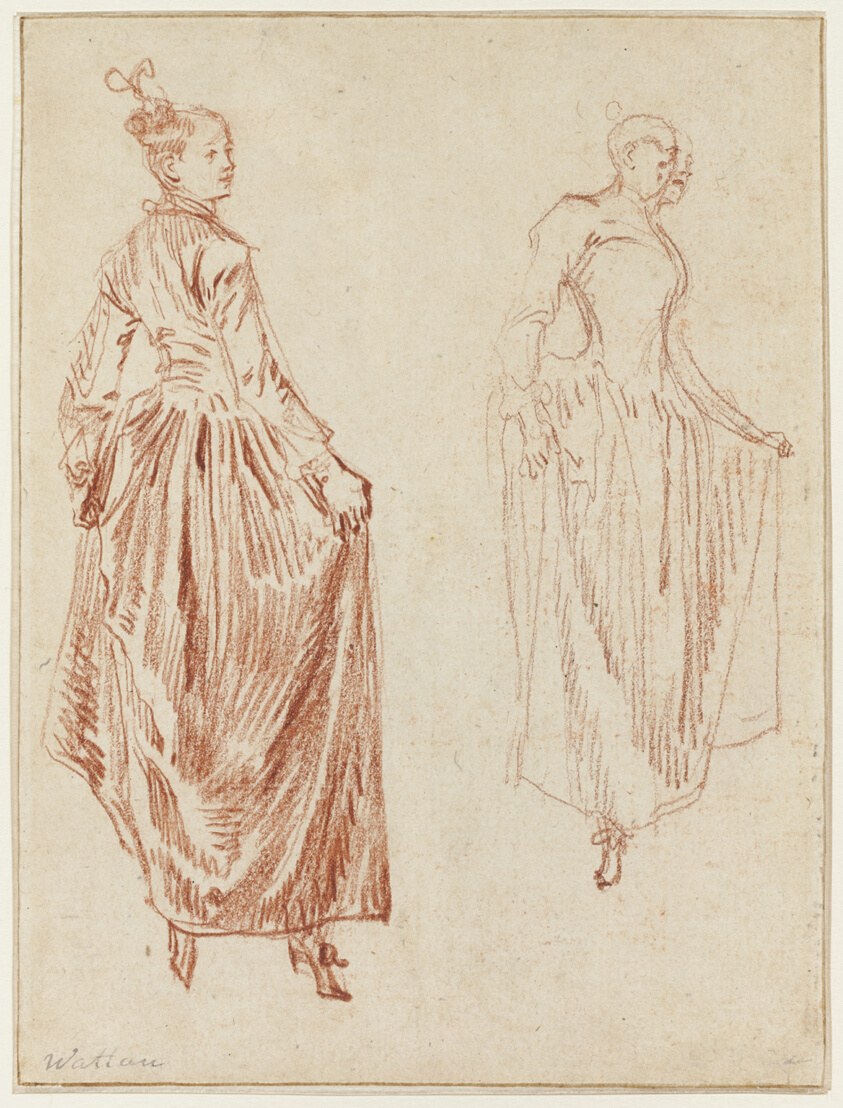
Two Studies of a Dancer Raising Her Skirt in Her Two Hands
Jean Antoine Watteau
- Source:
- Art Institute of Chicago
- Rights:
- Public domain — free to use, share and adapt.
- Recorded as:
- CC0 (Public Domain)
This sketch offers rare documentary evidence of how 18th-century dancers actually used their skirts in performance—not as passive ornament but as an active, hand-controlled element of the choreography. It shows us that the study of movement in this period included intense attention to costume and how bodies and garments worked together, a dimension often lost in later representations of historical dance.
What you are looking at
Two female figures dominate this ink sketch, drawn in red-brown chalk with fluid, confident lines. On the left, a woman in three-quarter view stands in profile turning slightly toward the viewer, her elaborate skirt gathered and lifted in both hands, revealing the volume and weight of the fabric. The skirt dominates the composition—it billows from her waist in deep vertical folds that the artist has emphasized with dense parallel hatching, creating a sculptural sense of mass and movement. Her upper body is corseted and fitted, with a high, elaborate coiffure topped by what appears to be a decorative plume or knot of fabric. The second figure, on the right, is rendered more lightly and sketchily, shown from behind with less detail; she too holds her skirt raised, though her pose is less defined. Both women wear the fashionable dress of the late 18th century—high waistlines, fitted bodies, and the characteristically large skirts of the period. The setting is minimal: a plain background with a simple border frame. The drawing's economy and the particular interest in the raised skirt gesture suggest this is a study of movement or costume rather than a narrative scene.
The dancing
Both figures stand upright with relatively formal posture, the leftmost dancer more fully articulated. The key gesture in both cases is identical: the skirt gathered and lifted in both hands, raised to approximately knee or mid-calf height. This is not a dynamic leap or turn but a deliberate, controlled presentation of the garment itself. The raised-skirt pose suggests a moment of display or a specific movement within a codified dance, where the costume is as much the subject as the body. The women's frames are slender and their weight appears centered; there is no suggestion of extreme extension or the dramatic port de bras of formal ballet, but rather a restrained, courtly bearing.
The dance depicted
The raised-skirt gesture is characteristic of 18th-century social and theatrical dance, particularly the minuet and other court dances where women's skirts were part of the visual vocabulary of movement. The pose may depict the moment in a minuet when a woman gracefully lifts her skirt—a gesture that demonstrated both the beauty of the fabric and the dancer's control and elegance. Alternatively, this could be a study for a theatrical or commedia dell'arte figure, where such costume display was part of performance language. The sketch's deliberate focus on two variations of the same pose suggests the artist was investigating how the skirt moved and how it could be posed for maximum visual effect, rather than capturing a moment in a larger narrative dance.
How it was made
This is a chalk drawing on laid paper, executed in red-brown or sanguine chalk—a medium favored for life studies and costume sketches in the 18th century. The artist has used loose, economical line work for the figures' anatomy and features, reserving denser parallel hatching for the skirts, where the weight of fabric and the fall of folds become the primary interest. The technique allows for rapid notation and revision; the sketchiness of the right-hand figure suggests the artist was working from life or rapid observation, refining the pose as they drew. This is plainly a working study rather than a finished presentation—the kind of sketch that would have circulated among artists, dancers, or costume makers as a reference for how the garment should move and be posed.
About this work
This is an 18th-century sketch study of two dancers or figures wearing fashionable dress, focusing on the gesture of raising and displaying the skirt—a movement central to court and theatrical dance of the period. The work belongs in a dance collection because it documents both a specific movement vocabulary and the role of costume in that vocabulary: the skirt is not merely clothing but an active participant in the dance, shaped and presented by the dancer's hands. The sketch's matter-of-fact treatment and focus on costume variation suggest it was made for practical theatrical or choreographic purposes rather than as a finished artwork for exhibition.
How to look at it
Look first at the artist's choice to repeat the same pose twice, with different degrees of finish. The left figure is complete and controlled; the right is lighter and more suggestive. This tells you the artist was interested in exploring variations—how the skirt could be held, at what angle, with what effect. Notice the density of the hatching on the skirts: the artist used line to show weight, volume, and the direction the fabric falls. The raised-skirt pose is not naturalistic movement but a moment of deliberate display, a freeze-frame of a courtly gesture. The minimal setting—just the plain paper and simple border—emphasizes that this is a study of the figure and costume, not a scene.
The artist
The artist is not recorded, but the signature visible at lower left reads 'Wilkan' or similar—not a name that appears in standard references for 18th-century dance artists or costume designers. The sketch may be by a theatrical costume maker, a choreographer, or an artist attached to a court or opera house, working in a tradition of rapid notation studies that were valued as working documents rather than signed artworks.
The period
This drawing dates to the late 18th century, when the minuet and other court dances were still the foundation of ballroom practice, though the waltz and newer social forms were beginning to emerge. The exaggerated, sculptural quality of the skirts depicted here belongs to the 1770s–1790s, when women's skirts were at their most elaborate—gathered at the back in deep swags and often supported by panniers or other structures that made them an architectural feature of the body. Theatrical dance and social dance were closely connected; the same movements and costumes appeared in both contexts. This was also the period when dance notation and the documentation of movement through drawing became increasingly important, as choreographers and costume makers sought to standardize and share their work.
Where it lives
The work is held in the Art Institute of Chicago. It is catalogued as coming from a source marked 'aic' but with minimal additional metadata. The sketch's character as a working study suggests it may have entered a collection later, valued more as a historical document of costume and movement than as a signed artwork of known provenance.
Dance in this work
Questions about this work
What dance is this?
The sketch does not depict a complete dance but rather a study of a single gesture or pose within 18th-century court or theatrical dance—most likely the minuet or a related court form. The raised-skirt movement shown here was a standard element of women's movement in these dances, used to display both the costume and the dancer's grace and control.
Why are there two figures?
The artist appears to be exploring variations of the same pose: how the skirt looks when raised to different heights, or how the pose reads from different viewpoints. This is typical of costume and movement studies, where an artist works out the possibilities of a gesture through repeated sketching.
Who was the artist?
The artist is not identified in the catalogue record, though a signature is visible on the drawing. The style and subject suggest a working artist in theater, costume design, or choreography in the late 18th century, producing studies for practical theatrical use rather than artworks for sale or exhibition.
Is this an actual dance or a posed study?
It is both. The raised-skirt gesture was a real, codified movement within 18th-century court dance, particularly the minuet. But this sketch is not capturing a moment from a performance; it is a studio study of how that movement and costume could be presented, likely made to explore options for choreography, costume design, or instruction.
More dance artwork