49 works in this view — arrow keys or swipe to move between them.
Dance in Art
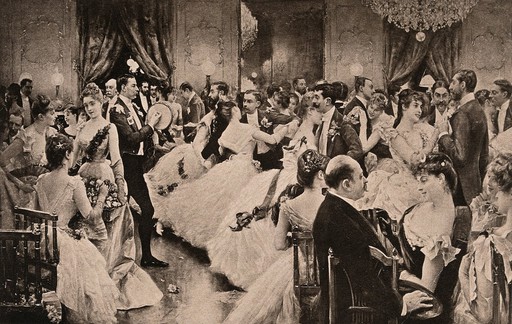
A man is playing a tambourine as couples are dancing in a ba
Unknown artist
- Rights:
- Not recorded. Do not assume this image is free to reuse — check the source record.
This photograph preserves the actual appearance and spatial organization of a ballroom waltz in motion, showing how couples moved relative to one another and to the room—information rarely captured in the still-life formality of posed dance photographs. For historians and dancers, it documents the social context in which Viennese waltz was performed and the visual conventions of ballroom dancing before standardized competitive forms emerged. It also shows the tambourine as a live dance-music instrument in a high-society context, a detail that complicates our understanding of late 19th-century orchestration for social dance.
What you are looking at
A formal ball or dance in a grand interior, likely from the late 19th or early 20th century. The scene is crowded with couples and groups in evening dress—men in dark tailcoats, women in light-colored gowns with long skirts—arranged across a spacious, ornately decorated room. In the foreground, a musician plays a large tambourine, his instrument raised prominently. Multiple couples are dancing in pairs throughout the composition, while others stand in conversation or observe. The room has high ceilings suggested by draped curtains and what may be a chandelier, establishing an atmosphere of wealth and formality. The sepia or monochrome tone and slight graininess indicate this is either a photograph or a photomechanical reproduction of one.
The dancing
The dancers are shown in closed ballroom holds: men facing their partners with upright posture, women in light gowns with skirts in motion suggesting rotation or forward movement. Several couples occupy the middle ground in different positions of the waltz frame—some progressing across the floor, others captured mid-turn. The tambourine player stands with his weight balanced, the large frame instrument held at chest height. A few figures at the margins appear to be walking or standing at rest, the depth of field suggesting layers of activity receding into the ballroom.
The dance depicted
This is a ballroom waltz or similar couple-dance of the late 19th-century European high-society tradition. The formal dress, the closed-position couples, the upright carriage, and the orchestra musician (likely part of an ensemble not all visible) all point to a social ballroom dance of the Viennese waltz era. The tambourine would be unusual in a strict ballroom context and may indicate either a specialty musician adding color to the evening, or—less likely—suggest a slightly earlier 19th-century context where such percussion was more common in dance music. The scale of the gathering and the formality of dress indicate this is the world of the social elites, not vernacular dance.
How it was made
This appears to be a photograph or photogravure—a mechanical photomechanical print that allowed photographs to be widely reproduced. The tonal range, the slight graininess, and the sepia coloration are consistent with late 19th or early 20th-century photographic practice. The composition's depth of field and the natural positioning of figures suggest candid or near-candid photography rather than posed portraiture. The medium's capacity to capture motion and crowded scenes made it ideal for documenting social events of the period, reaching audiences through reproduction in newspapers, magazines, or illustrated books.
About this work
This is a photograph or photomechanical reproduction documenting a formal ballroom waltz during Europe's Gilded Age. The work captures the aesthetic and social ritual of upper-class social dancing in the late 19th or early 20th century—the couple-dances, the formal dress, the orchestra musicians, and the segregation of dancers from observers. It belongs in a dance gallery as evidence of how waltz and ballroom dance functioned as both artistic performance and social practice in elite European society. The image shows dance not as spectacle staged for viewing, but as the ordinary activity of its own culture, which makes it historically rich.
How to look at it
Attend to the repeated closed-position couple-frames at different depths in the room, which show how the waltz structured social space. Note the musician's prominence—early photography often recorded orchestras and their role in enabling dance. Observe the women's skirts and the angles of their bodies as they turn, which give evidence of the rotational character of the waltz. Notice also the figures at rest and in conversation: the photograph captures the waltz not as continuous motion but as an event with rhythm and pauses, where couples dance in succession rather than all at once.
The period
The Viennese waltz was at the height of its social prestige in the 1880s–1910s, having conquered European high society over the preceding century. Photography was becoming the dominant mode of documenting social life and public events during this period, and photomechanical reproduction allowed such images to circulate widely in periodicals. The formality of dress and the grandeur of the ballroom reflected the confidence and visual spectacle of the Gilded Age in Europe. By this time, the waltz was so established that it required no explanation or justification; images like this one documented it as normal social practice.
Where it lives
The work is held in Europeana, a digital collection aggregating cultural heritage from European institutions. It appears as a single photomechanical object, catalogued with minimal information; the source institution is not specified in the available record. Works of this kind were typically published as prints in illustrated periodicals or collected into albums documenting social events.
Dance in this work
Questions about this work
Is this a painting or a photograph?
This is almost certainly a photograph, likely reproduced as a photogravure or similar photomechanical print for wider circulation. The naturalistic depth of field, the incidental positioning of figures, and the tonal qualities all point to photography rather than painting or drawing. The artist (photographer) is not recorded.
What is the date and location?
The catalogue record does not specify either. The style of dress, the formality of the setting, and the photographic technique are consistent with the 1880s–1910s period, and the context (formal European ballroom) suggests a major city like Vienna, Paris, Berlin, or London, but this cannot be confirmed from the image alone.
Why is there a tambourine player in a ballroom?
The tambourine was used in late 19th-century dance orchestras, particularly for adding rhythmic color and percussion to the ensemble. While it is less common in formal Viennese waltz orchestras, it may have been part of a larger ensemble, or the photograph may document a special event where unusual instrumentation was used. Without more context, the instrument's presence is intriguing but cannot be fully explained.
More dance artwork