49 works in this view — arrow keys or swipe to move between them.
Dance in Art
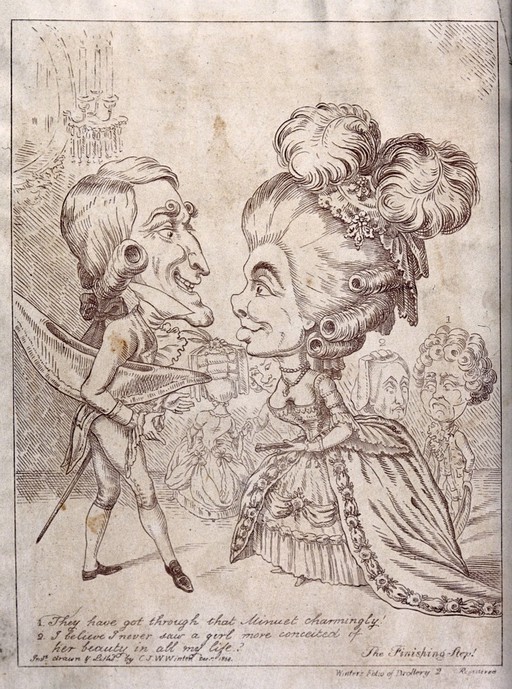
A young couple face one another on the dance floor as people
Unknown artist
- Rights:
- Not recorded. Do not assume this image is free to reuse — check the source record.
This print documents not just a dance but the social meanings attached to it—courtship, status, and the affectations of fashionable life—at a moment when dance was a primary arena for social interaction among the elite. For historians of social dance, it provides evidence of how these intimate dances were perceived and satirized by their contemporaries, revealing anxieties about sexuality, fashion excess, and social performance embedded in the dance itself.
What you are looking at
Two exaggerated caricatured figures face each other in an intimate dance pose, their grotesquely elongated profiles nearly touching. The man on the left, depicted with an absurdly pointed nose and thin face, wears formal dress with a decorative coat and breeches; the woman on the right has an impossibly high-piled coiffure adorned with ribbons and flowers, and wears an elaborate gown with panniers and a decorative bodice. They are shown mid-movement in what appears to be a close social dance, with their bodies angled toward each other. Behind them, smaller figures in similar fashionable dress can be seen, suggesting a ballroom or assembly room setting. The drawing style is satirical and exaggerated throughout, typical of 18th-century caricature prints mocking fashionable society and courtship rituals. The print includes handwritten text at the bottom, partially legible, which appears to comment on or mock the scene.
The dancing
The two central figures are depicted in a face-to-face closed position characteristic of courtship dances, with torsos tilted forward and heads nearly meeting. Their posture is intimate and flirtatious rather than formally structured. The artist has exaggerated the physical proportions—elongated limbs, impossibly small waists (especially hers, corseted to extremes), and caricatured facial features—to comic effect. The supporting figures in the background maintain similar poses, suggesting a synchronized social dance rather than choreographed ballet, though their smaller scale makes precise positioning difficult to assess.
The dance depicted
This depicts a fashionable social dance of the mid-to-late 18th century, most likely a minuet or country dance, dances central to courtship in polite society. The close face-to-face position and the setting of a ballroom with multiple couples suggests a social context rather than theatrical performance. The caricaturist has seized on the intimacy and affectation of these dances as subjects for satire—the exaggerated closeness and the ridiculous fashion extremes (the woman's towering coiffure, the man's pinched features) mock both the dancers and the courtship rituals they enact. The handwritten commentary below likely reinforces this satirical intent, though the text is not entirely legible in this reproduction.
How it was made
This is a satirical engraving or etching, executed in the fine linear style typical of 18th-century printmaking. The technique allows for sharp detail in the costume embellishments and the psychological intensity of the caricature, while the parallel hatching creates tone and volume. The presence of handwritten text on the plate suggests this is a published print, likely issued as a single sheet for sale or distribution among people who could afford such social commentary. The medium—reproducible, portable, and relatively affordable compared to painted works—made such satirical prints an effective vehicle for mocking fashion and manners in fashionable circles.
About this work
This is a mid-to-late 18th-century satirical engraving depicting two fashionably dressed figures engaged in a social courtship dance, rendered in exaggerated caricature. The work ridicules both the dance itself and the extreme fashions of the period through grotesque distortion of the human form. It is a product of the flourishing tradition of printed social satire that used dance, dress, and courtship as windows into the follies and pretensions of polite society. The print's survival in European digital collections (Europeana) reflects its status as a widely circulated commentary on contemporary mores.
How to look at it
Attend to the way the artist has used the intimacy of the dance position—the faces nearly touching, the bodies angled toward each other—as the vehicle for satire. The exaggeration is not uniform: the dance frame itself is recognizable, which is what makes the mockery effective. Notice how the supporting couples in the background, though smaller and less detailed, maintain the same pose, emphasizing that this is a widespread social ritual, not an individual eccentricity. The handwritten text at the bottom, though difficult to read, signals this as a published print with a specific message about the folly being depicted.
The period
The minuet and country dances depicted here were the dominant social dances of the 18th century European ballroom, central to courtship and the display of gentility. This period saw an explosion of printed satirical imagery mocking fashion and manners—caricature as a distinct printmaking genre emerged and flourished in Britain and Europe from the mid-18th century onward. Artists like Hogarth had established the use of exaggeration and social commentary through visual distortion; this print is part of that broader tradition. The extreme fashion elements—the woman's panniers and towering coiffure, the man's tight breeches and affected posture—reflect the silhouettes of roughly the 1770s–1790s, the height of rococo excess.
Where it lives
The work is held in Europeana, the European digital library and aggregator of cultural heritage collections. It is catalogued with minimal metadata, suggesting it may be held in a European print room or library collection whose records have not been fully digitized or described.
Dance in this work
Questions about this work
What dance are these figures doing?
Most likely a minuet or country dance, the two dominant social dances of polite 18th-century society. The face-to-face intimate position and the ballroom setting are consistent with minuets and courtship dances of this period. The caricaturist chose this moment because the closeness and affectation of the dance made it a perfect target for satire about courtship rituals and fashion excess.
Why are the figures drawn so grotesquely?
This is satirical caricature, a genre devoted to mocking the pretensions of fashionable society. The exaggerated features and impossible proportions—the woman's tiny waist and towering hair, the man's pinched nose and spindly legs—ridicule both the extreme fashions of the period and the vanity of those who wore them. The satire works precisely because the dance itself is recognizable beneath the distortion.
What does the handwritten text say?
The text is partially legible in this reproduction and appears to be a satirical caption or commentary on the scene, typical of 18th-century printed satirical images. Such captions usually reinforced the mockery by adding witty or cutting remarks about the dancers' behavior or the follies being depicted. A high-resolution image or original impression would be needed for a complete transcription.
More dance artwork