29 works in this view — arrow keys or swipe to move between them.
Dance in Art · 1900
Wehman Bros.' book on the way to dance : a book which teaches the art of dancing without a master
Unknown artist
- Era:
- 1900-1920 (Ragtime/Early Jazz)
- Source:
- Library of Congress
- Rights:
- Public domain — free to use, share and adapt.
- Recorded as:
- public_domain
This cover documents a pivotal moment in American dance history: the transition from elite, master-taught ballroom practice to mass-produced, self-taught instruction. The book's very premise—that one could learn to dance "without a master"—reflects the rise of the middle class and the commercialization of genteel culture. It is also a window into what ballroom technique looked like at the turn of the 20th century, before the innovations of Vernon and Irene Castle and the infiltration of jazz rhythms transformed American social dance.
What you are looking at
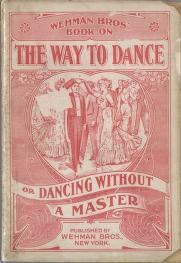
This is the cover of an instructional dance manual, printed in shades of pink and cream on paper stock. The composition is symmetrical and formal, with a decorative border framing the entire page. At the top, in ornate serif lettering, the publisher's imprint reads "WEHMAN BROS." Below this, a central oval medallion contains two figures in late-Victorian dress: a man in a dark suit and a woman in a full-skirted gown with puffed sleeves, positioned as if mid-dance. The woman's skirt extends in a graceful arc, suggesting motion. To either side of this central couple stand additional figures—a woman on the left and a man on the right—both in period dress, watching or attending the dancers. The title appears in large capital letters beneath the oval: "THE WAY TO DANCE" with a subtitle below: "A BOOK WHICH TEACHES THE ART OF DANCING WITHOUT A MASTER." Decorative flourishes and geometric patterns fill the margins. The overall design reflects late-19th-century print aesthetics, with an emphasis on Victorian gentility and the democratization of dance instruction.
The dancing
The central couple occupies a closed ballroom position: the man stands upright in formal attire with his arm raised to guide his partner, while the woman leans back slightly, her body extended in a graceful arc. Her arm rests on his shoulder, and her full skirt billows outward, creating the visual impression of a turn or waltz movement. The woman's posture is characteristic of the period—corseted, upright, with an elegant S-curve silhouette—while the man maintains the formal, upright frame expected of a gentleman dancer. The peripheral figures suggest spectators or additional dance partners awaiting their turn, reinforcing the social nature of ballroom dance.
The dance depicted
The image depicts a scene from the world of Victorian-era ballroom dance, most likely a waltz or similar closed-position partner dance that dominated late-19th-century social dancing. The cover is a teaching manual, and the frozen moment shows what we might call the 'ideal' ballroom couple—properly dressed, correctly positioned, and executing a graceful turn. This reflects the standardization of ballroom technique that accelerated in the 1890s, when dance instruction moved from the aristocratic drawing room to the middle-class market. The subtitle's promise of teaching "without a master" suggests the target audience was dancers of modest means seeking to acquire genteel accomplishment without hiring a professional instructor.
How it was made
This is a printed book cover, executed as a chromolithograph or multicolor lithograph—a technique that allows for several colors to be printed in succession, visible here in the registration of pink, cream, and black inks. Lithography was the dominant commercial color printing technology of the 1890s–1900s, and its use here indicates this was a mass-produced, affordable manual intended for widespread circulation among middle-class households. The ornamental borders and balanced composition are typical of book cover design of the Gilded Age, reflecting aesthetic principles of symmetry and decorative excess that characterized the period's commercial printing.
About this work
This is the cover of *The Way to Dance*, an instructional manual published by Wehman Bros. (a New York printing and publishing house active in the late 19th and early 20th centuries). The work represents the explosion of democratized dance instruction in the Gilded Age, when printed manuals made ballroom technique available to the rising middle class. The image itself—a frozen moment of a man and woman in a closed waltz position—encodes the ideals of Victorian gentility: grace, propriety, physical refinement, and the social legitimacy that ballroom dancing conferred on its practitioners. For historians of dance, this is crucial evidence of how dance knowledge was commodified and circulated in the early ragtime era, even as African-American vernacular and jazz influences were beginning to reshape American popular dance.
How to look at it
Attend first to the hold: the man's raised arm, the woman's inclined body, the connection of hands and shoulders. This is the closed position that defines European ballroom dance, and it is rendered with formal precision. Notice the woman's skirt—its arc and volume suggest a turn, and her backward lean indicates the characteristic sway and extension of the waltz. The peripheral figures on the cover reinforce the social context of ballroom dancing; this is not solitary practice but a social ritual performed for and alongside others. The ornamental frame and typography emphasize propriety and respectability, transforming a moment of physical intimacy into a display of social legitimacy.
The artist
Wehman Bros. was a publishing and printing house based in New York, active primarily in the late 19th and early 20th centuries. They specialized in affordable, mass-market instructional and entertainment publications, including dance manuals, magic trick guides, and novelty books. The firm was part of a broader ecosystem of commercial publishers who democratized knowledge—from etiquette to dance technique—during the Gilded Age.
The period
In 1900, ballroom dance in America was undergoing rapid transformation. The waltz, cotillion, and other Victorian-era partner dances still dominated formal balls and upper-class society, but the rise of ragtime music and jazz was beginning to disrupt these traditions. Meanwhile, the professionalization of dance instruction and the publication of instructional manuals reflected a broader late-Victorian project of codifying and standardizing genteel behavior for an aspirant middle class. Dance teachers and publishers raced to offer instruction—through books, diagrams, and photographs—to the thousands of Americans seeking to acquire the social polish and refinement that ballroom dancing promised. This manual sits at the intersection of these trends: it celebrates traditional ballroom form while capitalizing on the appetite for affordable, accessible instruction.
Where it lives
This work is held by the Library of Congress and is catalogued as a work from the 1900–1920 period. It is classified as a book cover or cover illustration, part of the broader holdings of popular American printed materials from the turn of the 20th century.
Dance in this work
Questions about this work
What dance is being shown on this cover?
The couple appears to be dancing a waltz or a similar closed-position ballroom dance. The man's raised arm, the woman's backward lean and extended skirt, and their formal attire are all consistent with Victorian-era waltz technique. The exact dance step cannot be determined from a single frozen moment, but the overall frame and posture are quintessentially ballroom.
Who would have bought this book in 1900?
Middle-class Americans—mostly women and young people—seeking to acquire ballroom dancing skills without the expense of hiring a private dance master. Dance was a marker of genteel status, and printed manuals made this accomplishment accessible to the rising middle class, particularly in urban areas.
How did people learn to dance before mass-printed instruction?
Before the proliferation of manuals and instructional books, dance was taught through live apprenticeship with professional masters or through observation and imitation at social gatherings. Printed manuals democratized this knowledge, allowing people to learn from diagrams, written descriptions, and images without access to expensive private instruction.
What does "without a master" mean?
It means the book promised to teach dance technique through printed instruction alone, without the expense or inconvenience of hiring a dance master. This was a bold marketing claim in 1900, suggesting that sufficiently clear diagrams and descriptions could substitute for live instruction—a claim that appealed to middle-class families with limited budgets.
More dance artwork