49 works in this view — arrow keys or swipe to move between them.
Dance in Art
Dancer
Unknown artist
- Rights:
- Not recorded. Do not assume this image is free to reuse — check the source record.
This is a primary record of how theatrical dance was presented and promoted in the early twentieth century, preserving both the movement vocabulary and the costume aesthetics of its moment. For dancers and historians, it documents the visual language of theatrical ballet as it existed beyond the stage—in the promotional imagination of impresarios and audiences. The identification of the performer (if accurate) anchors the image to a specific artist and potentially to specific productions.
What you are looking at
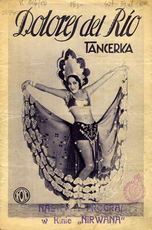
A woman in theatrical costume stands alone against a plain background, her body captured in a balletic pose. She wears a short, ruffled skirt gathered at the hips, constructed from layered white or pale fabric that extends to mid-thigh, paired with what appears to be a fitted bodice. Her arms are raised in a classical ballet frame, with one slightly higher than the other in a graceful, open position. Her posture is upright and elongated, weight seemingly balanced on one leg with the other extended or lifted. The figure is rendered in a style characteristic of early twentieth-century theatrical promotion—a hand-drawn or lithographic illustration with fine linework defining the costume's pleats and ruffles. At the top of the image, text reads "Dolores del Rio" and "Tandekka" (or similar), identifying this as a promotional portrait. The overall composition and styling suggest this is a studio study or costume plate rather than a moment captured in live performance.
The dancing
The single dancer presents a classical ballet position—the torso is held erect and squared to the viewer, the head tilted slightly, the gaze directed forward with theatrical presence. Both arms are raised to approximately shoulder height or slightly above, with soft, extended lines from shoulder through fingertip, avoiding sharp angles. The legs are not fully visible in their lower portions, but the stance suggests weight on a supporting leg with possible extension or turnout characteristic of ballet training. The overall frame is open and frontal, emphasizing presentation to an audience rather than narrative interaction with another dancer.
The dance depicted
This is almost certainly a portrait of a performer in early twentieth-century theatrical ballet or related staged dance—possibly a scene from a theatrical production, revue, or touring show. The costume, pose, and presentation format align with Romantic or Classical ballet aesthetics rather than contemporary dance of the 1920s-30s. The identification with "Dolores del Rio" (a major Mexican-American film and stage actress of the silent and early sound era) suggests this may document a specific theatrical role or studio portrait taken for promotional purposes rather than candid performance documentation. Without further context, the specific dance vocabulary and production cannot be confirmed.
How it was made
This is a lithographic print or hand-drawn illustration, likely a promotional portrait distributed as a poster or theatrical program insert. The technique employs fine linear definition to render costume detail—the pleats, ruffles, and fabric folds of the skirt are suggested through parallel lines and hatching rather than solid color. The simplicity of background and the focus on silhouette and costume suggest this was designed for legibility at a distance and for reproduction, making it an artifact of theatrical marketing rather than fine art. The style and printing method are consistent with European theatrical promotion of the 1910s-1930s.
About this work
This is a promotional portrait of a performer in early twentieth-century theatrical dance, likely created to advertise a specific production or to celebrate a performer's costume and role. The image documents a moment of balletic presentation—an upright, frontal pose designed to display both the dancer's training and the costume's construction. It belongs in a dance history collection as evidence of how staged dance and theatrical costume were marketed and remembered in the early twentieth century, when photography and lithography made such images widely circulated. The work sits at the intersection of dance, theater, fashion, and popular entertainment.
How to look at it
The artist has frozen a pose of presentation rather than a moment of active movement—the dancer is shown as if acknowledging an audience, not mid-step or mid-gesture. Notice the symmetry of the pose and the emphasis on upright carriage: this is how ballet training of the period defined a dancer's authority and elegance. The costume detail—the construction of the skirt, the precise line of the arms—was as important as the body itself; the lithographic technique allowed the artist to render fabric and form with fine parallel lines, a way of drawing that emphasizes pattern and silhouette over anatomy.
The artist
The artist is unknown. The work is attributed only to Europeana, a digital archive that aggregates artworks from European cultural institutions. The printing and promotional style suggest it was created by a theatrical printing house or design studio in Europe during the early twentieth century, as part of standard theatrical promotion.
The period
In the 1910s-1920s, theatrical dance and film were converging. Dancers from stage companies were increasingly crossing into cinema; Dolores del Rio, a major film star of the 1920s and 1930s, had a career that spanned both media. Promotional lithography was a standard tool for advertising theatrical productions, and such portraits were collected, traded, and displayed as souvenirs. Balletic costume and training remained prestigious markers of theatrical legitimacy even as new forms of entertainment (film, revue, jazz dance) were transforming popular dance culture.
Where it lives
This image comes from Europeana, a digital aggregation platform that harvests artworks and metadata from European museums, archives, and cultural institutions. The original holding institution is not named in the available record. The object is a promotional print or poster, part of the material culture of theatrical marketing.
Dance in this work
Questions about this work
Who was Dolores del Rio?
Dolores del Rio (1904–1983) was a major Mexican-American actress and dancer who achieved stardom in silent film (1920s) and continued her career into sound film and theater. She appeared in both Hollywood productions and Mexican cinema, and was known for her beauty, elegance, and dancing ability. She worked across multiple media—film, theater, and stage revue—making her a key figure in early twentieth-century entertainment.
What dance style is this?
The pose and costume suggest Romantic or Classical ballet from European theatrical tradition, though the exact production is not documented. The theatrical context and the date range suggest this may be from a theatrical revue, a period film, or a stage production mixing ballet with entertainment rather than pure classical ballet. Without a production title or date, the specific dance vocabulary cannot be confirmed.
Is this from a film or from live theater?
The format and style suggest this is a promotional portrait rather than a film still or a live performance photograph. It was likely created for distribution as a poster or program insert to advertise a theatrical production or to capitalize on a performer's fame. The lithographic technique and composition are consistent with early twentieth-century theatrical promotion.
Why are there so few details in the background?
This compositional choice—a single figure against a plain ground—was standard in theatrical promotion. It allowed the costume and pose to be the focus and ensured the image would be legible at a distance when printed as a poster. Simplicity also made the image easier and cheaper to print and reproduce.
More dance artwork