49 works in this view — arrow keys or swipe to move between them.
Dance in Art
Dancer
Unknown artist
- Rights:
- Not recorded. Do not assume this image is free to reuse — check the source record.
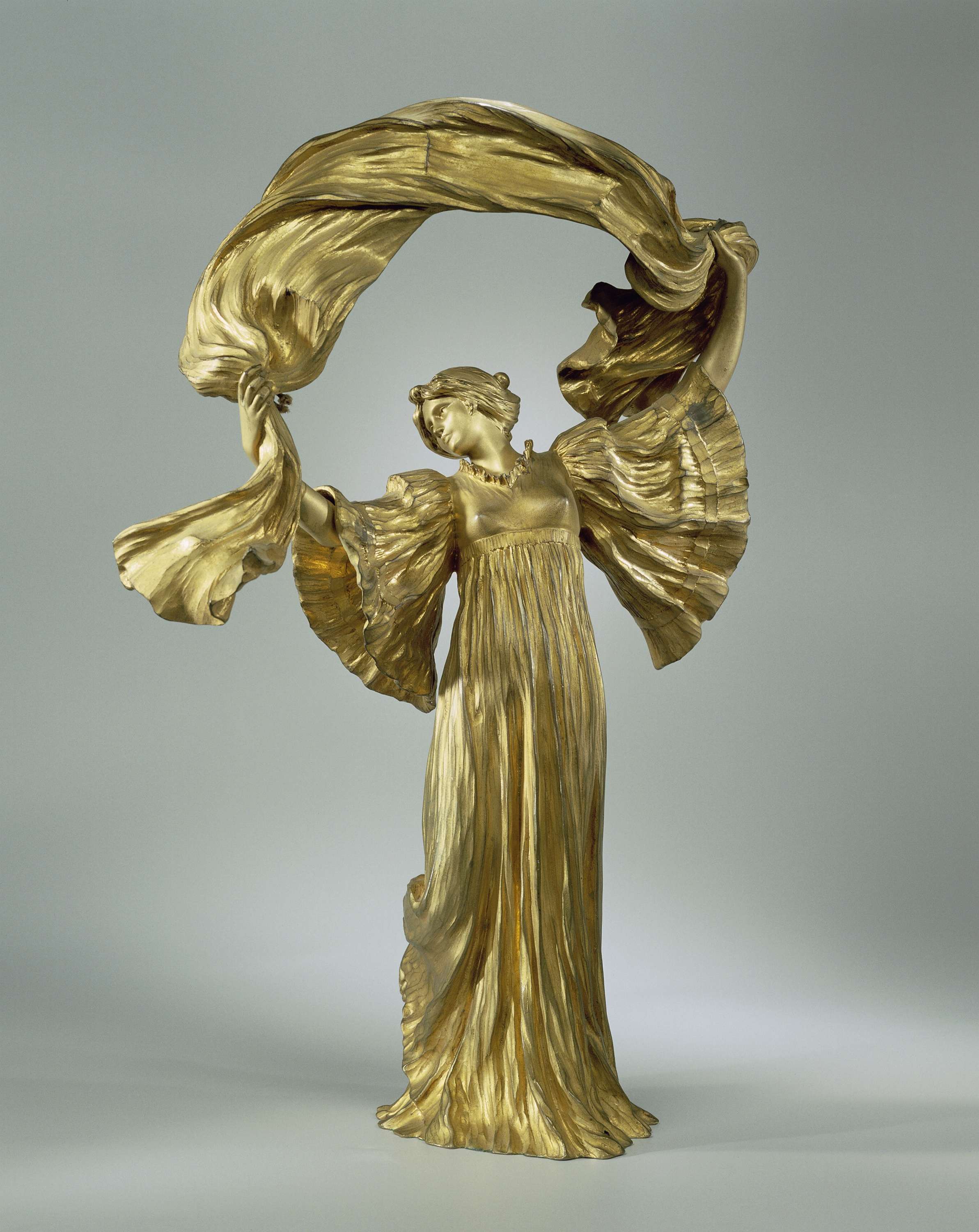
This sculpture documents an important but now-underexamined moment in dance history: the turn-of-the-century fashion for ancient Greek-inspired theatrical movement, which shaped early modern dance and influenced artists across Europe. The work shows that late 19th-century sculpture valued the dancer's body and the expressive potential of fabric as serious artistic subjects worthy of refined execution in precious materials.
What you are looking at
A gilt bronze or gilded metal sculpture presents a standing female figure in classical drapery, her body twisted in a graceful contrapposto pose. She wears a long pleated chiton or Greco-Roman gown that falls to her ankles, gathered at the waist with a simple belt. Her hair is styled in the classical fashion, and she wears a pearl or beaded necklace. The figure's arms are raised and extended outward, holding aloft billowing lengths of fabric—a scarf or veil—that swirl dramatically around her head and shoulders in a continuous arc above her. The fabric appears to float in arrested motion, its folds and pleats rendered with meticulous detail to suggest movement and lightness. The sculpture is freestanding and intended for viewing from multiple angles; the figure stands on an invisible base, her weight distributed as though caught mid-turn. The polished golden surface catches light across the drapery and the fabric she manipulates, emphasizing the delicate modeling of each fold.
The dancing
The single figure demonstrates refined classical contrapposto: her weight shifts onto one leg while the other remains relaxed, creating a gentle S-curve through the torso. Her arms frame the composition symmetrically, lifted to shoulder height and extended, holding the fabric taut above her. Her gaze is directed downward in a pose of serene absorption. The raised arms and held fabric suggest sustained extension rather than dynamic jumping or turning, and the stability of her stance indicates this is a moment of poise rather than traveling movement.
The dance depicted
This sculpture likely depicts theatrical or aesthetic movement rather than a specific named dance tradition. The pose and handling of the fabric suggest the classical or interpretive 'danza' traditions that emerged in the late 19th and early 20th centuries, particularly those influenced by Hellenism and art history. The figure recalls the draped female forms of ancient Greek art, and the deliberate holding and display of fabric is characteristic of aesthetic or expressive movement forms that were popular in European theatrical culture from the 1890s onward. The sculpture captures a moment of controlled stillness rather than kinetic dance, emphasizing the beauty of line, drapery, and classical proportion.
How it was made
This is a gilt bronze or gilded cast metal sculpture, almost certainly cast using the lost-wax (cire perdue) process—a technique that allowed for fine detail and flowing forms to be reproduced precisely. The gilding has been applied over the bronze, giving it the warm, luminous surface visible in the photograph. The casting technique made it possible to capture the delicate pleating of both the dress and the floating fabric with high fidelity. Such works were typically produced in multiple editions and intended for collectors and galleries rather than public monuments, suggesting a wealthy, educated market for small-scale art objects.
About this work
This is a small gilt bronze sculpture of a classical female figure engaged in aesthetic movement with draped fabric. The work distills early 20th-century reverence for ancient Greece and romantic ideas about expressive bodily movement into a single refined object. The sculpture represents the intersection of art history, theatrical costume, and the body—an era when dancers and artists drew inspiration from Hellenic imagery and when the manipulation of drapery became central to new forms of theatrical expression. The figure's calm, elongated pose and careful handling of fabric mark this as a high-art object intended for contemplation rather than a record of actual stage movement.
How to look at it
Observe the precise moment the sculptor chose to freeze: the figure is not in motion but in a moment of poise, holding the fabric aloft in a sustained gesture. Notice how the pleats of her gown fall vertically, anchoring the composition, while the fabric she holds curves upward and outward, creating a halo of movement around her stillness. The contrast between the orderly drapery of her dress and the billowing freedom of the floating scarf is where the sculpture's meaning lies—it captures the aesthetic ideal of expressing emotion and beauty through the controlled manipulation of cloth. The downward gaze and serene expression suggest an inward focus rather than a moment of spectacle.
The period
The late 19th and early 20th centuries saw a profound revival of classical Greek aesthetics across the arts. Dancers and choreographers—notably including Isadora Duncan—drew inspiration from ancient Greek vase painting and sculpture, seeking what they believed to be a more 'natural' or authentic movement vocabulary. Simultaneously, the art market produced a wealth of small decorative bronzes depicting idealized female figures; sculpture and dance overlapped as both explored the beauty of the classical body and the expressive potential of draped fabric. This sculpture sits within the broader Orientalist and Hellenophile taste of the Gilded Age and Belle Époque periods.
Where it lives
The work is documented in the Europeana digital collection, a pan-European aggregated resource. The catalogue record from Europeana is minimal and does not record the artist, date, medium, or current holding institution, suggesting this entry may be a recent accession to a European museum or collection whose metadata has not yet been fully enriched.
Dance in this work
Questions about this work
Is this based on ancient Greek dance?
The sculpture draws its aesthetic from ancient Greek art and the classical reverence for the Hellenic body. However, it more likely depicts a late 19th or early 20th-century theatrical style inspired by Greek sources—such as the aesthetic movement or early modern dance—rather than an actual recreation of ancient dance. The refined, museum-quality execution and materials suggest it is a work of high art commentary on classical beauty, not documentation of historical practice.
Who danced like this?
This pose and the handling of fabric are characteristic of aesthetic movement and early modern dance traditions from the 1890s-1920s, particularly those influenced by Hellenism. Isadora Duncan and her contemporaries and imitators performed similar draped, flowing movements. The sculpture captures the ideal of that movement culture rather than depicting a specific dancer or performance.
Why is she holding that fabric?
The scarf or veil is essential to this style of movement. Dancers of the period used drapery as an extension of the body to create flowing lines, to add visual interest and elegance, and to suggest emotional and spiritual states. The handling of fabric became a central technique in aesthetic and modern dance, and sculptors and painters frequently depicted this as a marker of artistic sophistication and refined taste.
More dance artwork