35 works in this view — arrow keys or swipe to move between them.
Dance in Art
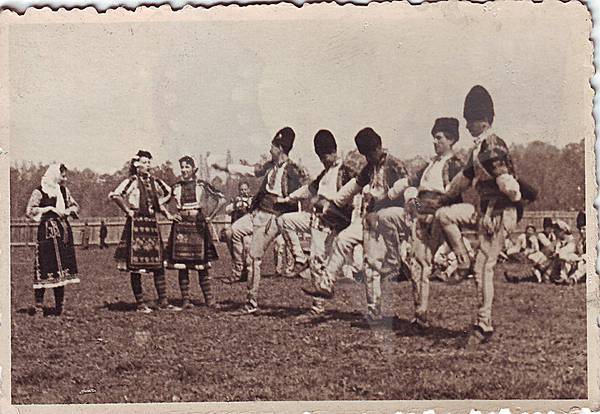
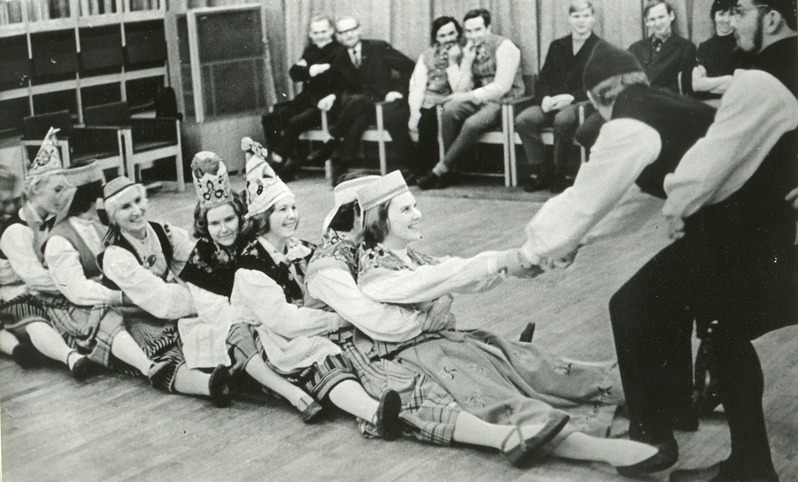
Folk dance ensemble Leigars 401 item 7PPZ4
Unknown artist
- Dance:
- Folk/Country
- Rights:
- Not recorded. Do not assume this image is free to reuse — check the source record.
This photograph documents the Soviet folk dance ensemble tradition, a significant but often overlooked moment in 20th-century dance history when state-sponsored groups standardized and theatricalized regional folk traditions. The image reveals how traditional costumes, headdresses, and body positions were adapted for concert stages and institutional audiences, reflecting both cultural preservation and ideological choreography. For historians of dance and costume, it provides concrete evidence of performance practice, ensemble formation, and the narrative or dramatic moments chosen for folk dance adaptation.
What you are looking at
A black-and-white photograph captures a folk dance ensemble mid-performance, likely from the mid-20th century. Five women wearing elaborate traditional costumes sit or kneel on a wooden floor in a loose diagonal line, their bodies angled toward the right. Each wears a richly decorated kokoshnik (tall embroidered headdress) and a patterned sarafan (traditional sleeveless dress) over a long-sleeved white blouse. The women's arms are extended in a coordinated gesture—reaching or pulling toward the right side of the frame where a figure in dark clothing (partially visible) appears to be engaging with them. The setting is institutional: wood-paneled walls and a radiator are visible behind them, and seated spectators in dark suits and dresses occupy chairs in the background, watching intently. The photograph is shot from a low angle that emphasizes the dancers' upper bodies and headpieces against the plain background.
The dancing
The five dancers are arranged in a kneeling or seated position rather than standing upright, which is uncommon for traditional Russian or Eastern European folk dance performance. Their arms are extended and unified in what appears to be a pulling or reaching gesture, creating a strong diagonal line across the frame. The posture and arm work suggest either a moment of dramatic narrative (such as a tug-of-war or courtship ritual) or a stylized theatrical interpretation of traditional movement. The ensemble moves as a coordinated unit, indicating trained group choreography rather than free social dancing.
The dance depicted
This is almost certainly a Russian or Soviet folk dance ensemble performance. The kokoshnik headdresses, sarafan dresses, and embroidered patterns are consistent with Russian folk costume traditions. The name 'Leigars' (possibly 'Laigars' or a Latvian variant) suggests either a Baltic or Eastern European ensemble. The kneeling position and dramatic arm gestures indicate a choreographed theatrical folk dance rather than social or ritual dance—a style that became standard in Soviet-era folk dance troupes, which often adapted traditional movements for stage performance and spectacle. The presence of an audience suggests a formal concert or cultural event.
How it was made
This is a black-and-white photograph, likely professional documentation of a live performance or rehearsal. The image quality, lighting, and composition suggest it was taken by a professional or institutional photographer, possibly as archival record. The low camera angle and tight framing are deliberate choices that emphasize the dancers' costumes and gestures. The photograph's crisp focus and exposure indicate mid-20th-century photographic practice, consistent with Eastern European documentary or arts photography of the 1950s–1970s.
About this work
This photograph documents a performance by a folk dance ensemble, most likely Soviet-era, wearing traditional Eastern European costumes and executing a choreographed theatrical interpretation of folk material. The image preserves a moment of coordinated group gesture—five dancers in elaborate kokoshnik headdresses and embroidered sarafans reaching or pulling in unison while kneeling on a wooden stage. The work belongs in a gallery of dance imagery because it captures both the formal aesthetics of mid-20th-century folk dance performance and the specific approach Soviet ensembles took to staging traditional material for modern audiences: adapting historical or rural movement vocabularies into disciplined, visually unified theatrical presentation.
How to look at it
Attend to the unified arm gesture and the kneeling position: neither is a typical posture for traditional folk dancing, suggesting this is a moment of choreographed drama staged for visual effect. Notice how the costumes—particularly the tall, ornate headdresses—are framed and lit to create strong visual geometry on stage. The camera angle from below emphasizes the dancers' upper bodies and gives the ensemble an imposing, dignified presence. The spectators in the background are watching intently, suggesting this is a significant or emotionally charged moment in the performance—perhaps a courtship scene, a plea, or a moment of collective action.
The period
This photograph dates to an era when Soviet and Eastern European folk dance ensembles were actively promoted as instruments of cultural and political representation. From the 1930s onward, state-sponsored ensembles like the Osipenko Ukrainian Dance Ensemble and various regional Russian and Baltic groups developed a distinctive style: using authentic traditional costumes and regional movement vocabularies but arranging them into precise, synchronized ensembles for concert performance. This represented a shift from participatory folk dance toward spectacle and artistry. The photograph's institutional setting and formal documentation reflect the cultural importance these ensembles held in Soviet cultural life.
Where it lives
The photograph comes from Europeana, a European digital library of cultural heritage, with the catalog title 'Folk dance ensemble Leigars 401 item 7PPZ4'. No information on the original holding institution, collection, photographer, date, or place of performance is recorded in the catalogue.
Dance in this work
Questions about this work
What are the women wearing on their heads?
Those are kokoshniki (singular: kokoshnik), tall embroidered headdresses traditional to Russian and some other Slavic folk costumes. They are often made with a wooden or decorated frame and adorned with embroidery, lace, and beads. In this photograph, they are clearly a formal, elaborate version—appropriate for a staged performance by a professional ensemble.
Why are they kneeling rather than standing?
The kneeling position is likely part of a choreographed scene or movement sequence created for theatrical effect. It is not typical of traditional Russian folk dancing, which usually involves standing and traveling steps. This suggests the ensemble adapted folk material for dramatic storytelling on stage.
Is this Soviet-era dance?
Almost certainly. The costume style, ensemble formation, institutional setting, and formal documentation are all consistent with Soviet folk dance troupes of the 1950s–1970s. Such ensembles were central to Soviet cultural policy and performed for both domestic and international audiences.
What does the name 'Leigars' tell us?
The name is unclear from the catalogue record, but it may be Latvian or refer to a specific regional ensemble. Without additional documentation, its exact origin and significance cannot be determined from the photograph alone.
More Folk/Country artwork