34 works in this view — arrow keys or swipe to move between them.
Dance in Art
Folk Dance GG Екслибрис
Unknown artist
- Dance:
- Folk/Country
- Rights:
- Not recorded. Do not assume this image is free to reuse — check the source record.
This image records a specific moment of folk celebration in motion and captures the early twentieth-century impulse to document regional dance traditions before industrialization and urbanization changed cultural practices forever. For dancers and historians, it provides evidence of how folk performances were actually organized and executed, not as staged spectacles but as informal community gatherings in open air.
What you are looking at
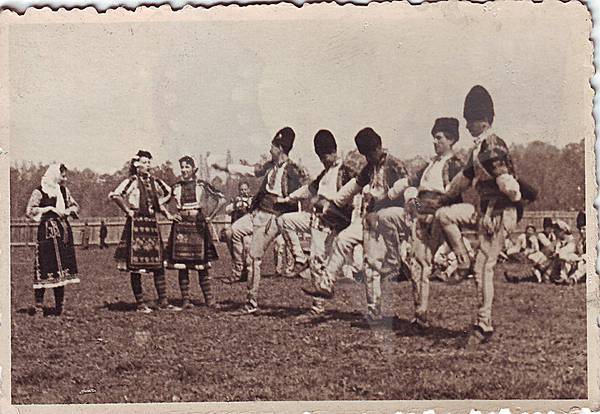
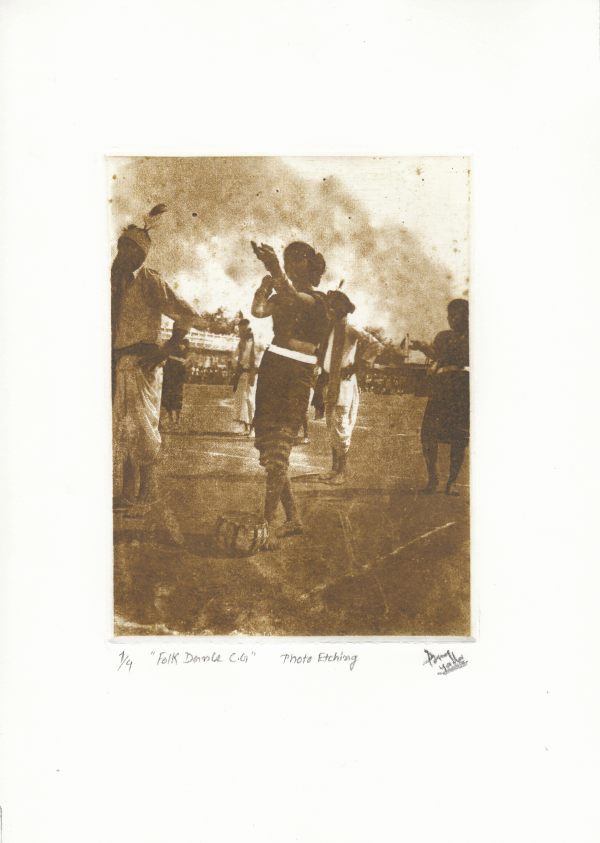
A sepia-toned photograph of an outdoor folk dance performance, showing at least five figures arranged across a dusty ground. The central figure, a woman in a dark dress with a white horizontal stripe or belt at the waist, stands with arms raised in an expressive gesture. To her left stands a man in light-colored clothing (possibly traditional folk dress), also with raised arms. Other figures are visible at the edges of the frame—a child on the far right, and additional adults partially visible on the left. The background is hazy and atmospheric, suggesting bright sun and dust kicked up during the performance. The photograph has the characteristic fading and spotting of early twentieth-century printing, with visible damage and age marks.
The dancing
The central woman drives the composition with her arms raised in an open, celebratory pose—shoulders back, elbows bent at roughly 90 degrees. Her male partner mirrors this gesture at lower intensity. The stance suggests a moment of joy or abandon rather than technical precision. The child on the right appears to be watching or participating at ground level. The bodies are not in a closed ballroom hold but rather in the open, individual-yet-synchronized style typical of folk dancing.
The dance depicted
This appears to be a regional folk or country dance, most likely from Central or Eastern Europe, shot during an outdoor performance or celebration. The raised-arm, open-formation style is consistent with Slavic or Balkan folk traditions. The dust-filled outdoor setting and informal grouping suggest a village gathering or festival rather than a staged theatrical performance. The woman's raised arms and the man's responsive gesture indicate call-and-response or mirroring patterns common in traditional circle or line dances. Without more specific costume or setting details, the exact regional tradition cannot be determined with certainty.
How it was made
This is a photogravure or photomechanical print, printed on paper in sepia tone. The technique allowed photographic images to be reproduced in relatively large editions, making documentary photographs of folk practices accessible beyond single negatives. The softness of the tones and the visible grain are characteristic of early twentieth-century photomechanical reproduction. The notation "Photogravure" visible in the lower margin confirms the printing method. This suggests the image was produced for publication or collection circulation, not as a unique photograph.
About this work
This is an early twentieth-century photogravure documenting a folk dance performance, likely from Central or Eastern Europe. The image captures an outdoor moment of celebration with raised-arm gestures and an open formation characteristic of regional folk traditions. The printing technique and apparent publication context suggest this was part of a documentary or artistic project to record disappearing folk practices, a significant concern in early modernist European culture. The work belongs in a gallery of dance imagery because it represents both the movement itself and the historical moment of its documentation—a time when folk traditions were being preserved through photography as industrial society threatened to erase them.
How to look at it
Notice the woman's face and the angle of her head as much as her raised arms—her expression and bearing convey the emotional tone of the moment. The photographer has caught not the peak of a synchronized movement but the middle of a gesture, suggesting spontaneity rather than rehearsal. The haze of dust and bright light create a sense of heat and effort, grounding the dance in physical reality rather than theatrical fantasy. The presence of the child and the informal grouping show that this is participatory community dance, not performance for an external audience.
The artist
The artist is not recorded. The work is identified only as a photogravure from the Europeana digital collection, suggesting it may be a museum or archive acquisition of unknown provenance. The inscription "Folk Dance GG" hints at a cataloguing system but does not identify the photographer or documenter.
The period
This photograph dates to the era of ethnographic documentation and folk revival, roughly 1900–1930, when European artists and intellectuals were increasingly interested in recording regional traditions as cultural nationalism grew and as modernism sought authenticity in folk forms. Photography was the primary tool for this work. Simultaneously, theatrical ballet and concert dance were moving toward abstraction and formalism, making photographs of actual folk practice particularly valuable as documents of 'living' tradition.
Where it lives
The work is held in the Europeana digital collection, which aggregates digitized cultural objects from European museums and archives. No specific holding institution, accession number, or acquisition history is recorded. The notation on the print suggests it was part of a catalogued series or project, but that context is lost.
Dance in this work
Questions about this work
Where and when was this photograph taken?
The record provides no date or location. The sepia tone, printing technique, and folk costume suggest early twentieth-century Central or Eastern Europe, but this cannot be confirmed from the image alone. The 'GG' notation may be a cataloguing code that could identify the source, but it is not explained in the available record.
What dance is being performed?
The raised-arm gesture and open formation are consistent with Slavic, Balkan, or Central European folk traditions, but the specific regional dance cannot be identified without more context. The outdoor setting and informal grouping rule out theatrical ballet or ballroom dance.
Is this a professional performance or a community celebration?
This appears to be an informal community gathering, not a staged theatrical event. The presence of a child, the dusty outdoor ground, and the unlined arrangement of dancers all suggest a village or festival celebration rather than a concert performance.
Why is the photograph in sepia tone?
This is not the original photograph but a printed reproduction—a photogravure. Sepia tone was standard for photomechanical prints of this era and was chosen both for technical reasons (it reproduced well) and aesthetic ones (it conveyed age and authenticity to period viewers).
More Folk/Country artwork